


The Upper Danube. Part 13
Description
This section is from the book "The Upper Danube - John L. Stoddard's Lectures", by John L. Stoddard. Also available from Amazon: John L. Stoddard's Lectures 13 Volume Set.
The Upper Danube. Part 13

Smiling Plains And Wooded Hills.

Engelhartzell, The First Town In Austria.

Where Gunpowder Was Used.
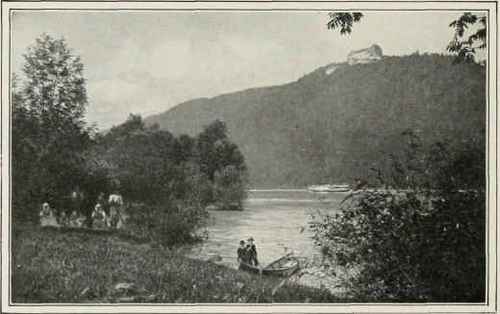
Castle Of Ranariedl.
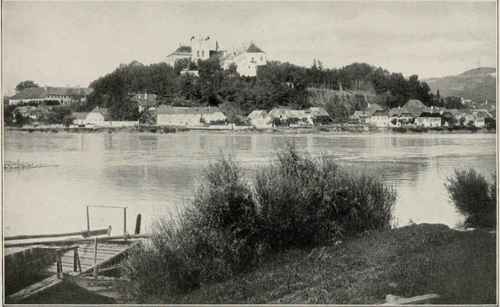
The Castle Of Ottenheim.
Almost as fabulous as this old superstition, seems at first a statement of geologists in reference to this locality. So numerous in this portion of the Danube are the fragments of its ancient cliffs, that they can hardly have been scattered here by earthquake shocks, or by the denudation caused by heat and cold, but are more probably the effect of powerful erosion. It is, indeed, believed that once between these forest-covered bluffs there fell a mighty cataract. This, like Niagara, century after century, crept slowly backward through the granite mass, till finally the last remaining barrier of an upland lake was gnawed away, and in a fearful flood the pent-up water found its present channel to the sea.

Castle Of Neuhaus.
One of the largest strongholds in this region bears the name of Neuhaus, and lifts its monster shoulders from a mass of pines hundreds of feet above the stream. Its history gives the traveler a startling realization of the former close relations of this portion of the Danube with the Orient. During the desperate conflict with the Turks, in 1683, when the redoubtable Moslems actually threatened Vienna, and thrilled all Europe with alarm, this structure was selected as a place of refuge for a multitude of Austrian women and children, who were for months provided here with food and shelter, and guarded by a suitable garrison. Some miles below this relic of those days of fear, a sudden lowering of the cliffs and broadening of the tide reveal the town of Aschach, - a pretty, sheltered nook of sunshine, famed for warmth and wine. The neighboring region for some distance has been rendered world-renowned through its connection with the national epic of the Germans, the Nibelungenlied. This is the Danube's song of chivalry. One half of that imperishable poem, it is true, has close associations with the Rhine, but the remaining half is no less intimately bound up with the Danube. The two great rivers of the German world have practically thus an equal representation in that work. Its ring unites them in a perfect and unbroken circle. As Wagner, in his musical portrayal of the Nibelungenlied, followed the Scandinavian, rather than the German legend, it may not be amiss, while traveling down the stream which forms the background for so much of that dramatic myth, to call to mind the outline of its plot. The heroine, Krimhilde, at the outset, lives at the court of her brother, Gunther, king of the Burgundians. His capital is Worms upon the Rhine. Thither comes Siegfried, famed already for his conquest of the Nibelungs - a race of northern dwarfs - and for his slaying of a fearful dragon. The former of these feats has made him the possessor of a fabulous amount of gold. The second exploit - through the application to his body of the dragon's blood - has rendered him almost invulnerable. One spot alone exposes him to death, if wounded there. It is a place between his shoulders, touched by a falling leaf before the monster's blood was dry. The hero asks King Gunther for Krimhilde's hand, promising in return to win for him, as bride, the powerful queen of Iceland, the renowned Brunhilde. This is, however, a difficult undertaking, for she has vowed to accept no man as husband who cannot vanquish her in three athletic contests. Siegfried accompanies the king to Iceland, and there by means of a magic cloak, which temporarily invests the wearer with Herculean strength, enables Gun-ther to subdue the queen. Brunhilde yielding, as she thinks, to Gunther's actual prowess, marries him. A deadly quarrel presently ensues between the women. Krimhilde taunts her sister-in-law with the humiliating fact that Gunther had deceived her through the aid of Siegfried. Enraged at this discovery, Brunhilde orders Hagan, one of Gunther's vassals, to murder Siegfried. The crime is consummated by stabbing the hero in the vulnerable spot. Gunther himself is present at the murder, and abets it, lured to the deed by lust for Siegfried's treasure, which is thenceforth sunk, for safety, in the Rhine. After the murder of her husband, Krimhilde's one desire is to avenge him. She hears his voice continually urging her to punish his assassins. To gain sufficient power to do this, she consents to marry Attila, king of the Huns in Hungary. Thither she goes, escorted by the gallant Rudiger from Pochlarn, one of the noblest figures in the Nibelungen Song, who had been sent by Attila to Worms to plead his suit. Pochlarn is mentioned in the poem as the residence of this hero, and there took place the great reception of the coming bride.
Continue to:


My Books

