


The Upper Danube. Part 8
Description
This section is from the book "The Upper Danube - John L. Stoddard's Lectures", by John L. Stoddard. Also available from Amazon: John L. Stoddard's Lectures 13 Volume Set.
The Upper Danube. Part 8
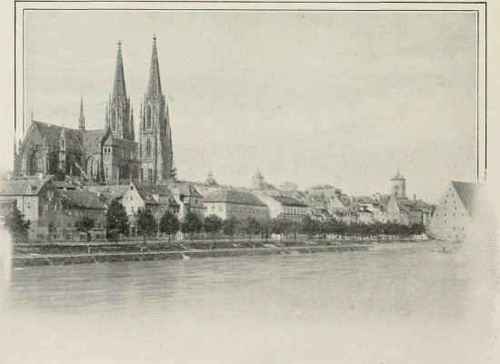
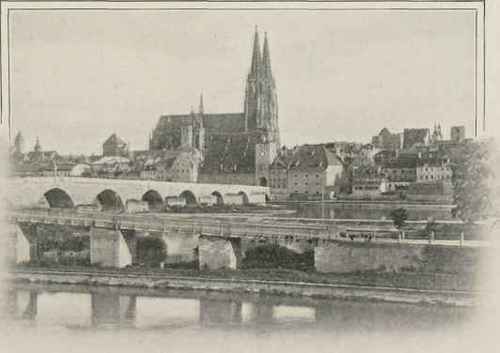
The Bridge.
It is not, therefore, strange that Regensburg became a most important feature of the "Holy Roman Empire" of Germany, and that from 1663 to 1806 all the great federative parliaments of that empire, known as Diets, were held within its massive Council Hall, still standing there to-day. Such legislative meetings were regarded then with a solemnity befitting their prodigious power. Before the eyes of all participants in them was displayed this warning : "Whoever thou art, who enterest this court as Senator to sit in judgment, lay aside in presence of thine office every private motive, -- anger, violence, hatred, friendship, and flattery, - and give thy whole attention to the public good. For, as thou shalt here be just or unjust in thy judgment of others, so must thou, too, expect to endure the judgment of God".

Roman Tower, Regensburg.
This Council Hall is not the only relic of the brilliant age of Regensburg. In one of its old thoroughfares, still called the Street of the Ambassadors, are several buildings which, though gloomy and neglected, retain suggestions of the days when members of the Imperial Diet lodged within their stately rooms: foremost of all, the seven Grand Electors, whose privilege it was to choose the emperor; then all the representative princes, temporal and spiritual, of the realm; and finally the delegates from Germany's "Free Imperial Cities," of which Regensburg was one. Here, too, Napoleon's sword, in carving out new boundaries for European kingdoms, made several deep incisions. Thus it was here, in 1806, that having incorporated under his protectorate all that remained of Germany outside the limits of a much-diminished Austria and Prussia, Napoleon compelled the emperor Francis to renounce his sovereignty of the Holy Roman Empire, and to assume the title only of Emperor of Austria. Hence, it was in the Council Hall of Regensburg that the great German Empire, which had existed since the time of Charlemagne, and boasted therefore of a full millennium of history, in gloriously ended; to be revived, however, under a new form sixty-five years later through the energy and genius of Bismarck and Von Moltke. Then the astonished world beheld, under the leadership of Prussia, in the brilliant palace of Versailles, the proclamation of the present empire of Germany, made possible only through the federative union of all German principalities and kingdoms, Austria excepted. Another incident of Bonaparte in this connection is worthy of remembrance here; for of his victory at Regensburg, in 1809, he ever after bore a disagreeable souvenir in the scar left by an Austrian bullet on his foot. What a charmed life that extraordinary man possessed! For, though repeatedly exposed to all the accidents of war from the beginning to the end of his career, this soldier, who had commanded in eighty-five pitched battles and six hundred skirmishes, was never seriously injured, the unimportant wound at Regensburg being one of the most severe!

The Council Hall.
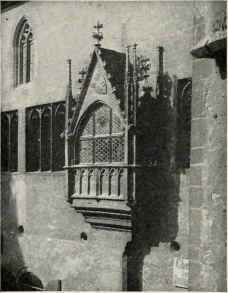
A Window In The Council Hall.
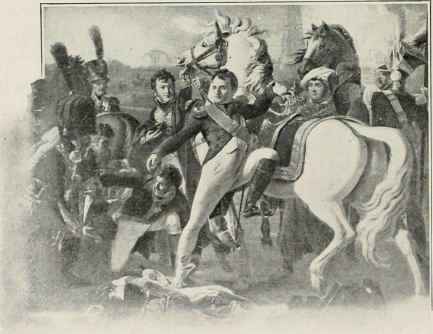
Napoleon Wounded At Regensburg.
Of course there is a noble mediaeval cathedral here, for this old city was the principal point from which Christianity spread out over southern Germany, and from its portals thousands of Crusaders started for the Holy Land. This fact is still commemorated by an old-time ballad, whose opening lines relate :
"There came a bold Crusader With fifty harnessed men. And he embarked at Ratisbon To fight the Saracen".

Proclamation Of The Modern German Empire At Versailles, 1871.
If there were not so many cathedrals in the Old World, the traveler would be more impressed by them. Like many famous paintings in a single gallery, they suffer from the fact that those who come to them are often wearied by a previous contemplation of their rivals. The writer will not, therefore, here describe the numerous points of beauty in this edifice, since it has fallen to his lot to write of many similar architectural triumphs of the Age of Faith. Yet his deliberate reticence in this respect is not due to his failure either to appreciate the rich, elaborate carvings in its soft gray stone, or to experience, in gazing upward at its lofty roof and glorious stained windows, a sense of satisfaction and repose which lingers like a benediction in his memory. Suffice it here to say that, quite apart from architectural and religious reasons, I do not know a better place for serious meditation on the history of any mediaeval city of renown than its cathedral - the sanctuary of its holiest aspirations for so many centuries. To leave the noisy streets for its cool, hushed interior, and there to sit in silence, reading and musing on the lives and deeds which made that city famous, is one of the most valuable means of mental growth and spiritual culture. Yet how few give themselves the privilege of such retirement and contemplation! And of the few who fain would do so, how many are hampered by a "party," some of whose members are as restless as they are irreverent, and have no more conception of the blessedness of thought in such a sculptured solitude than of the customs on the planet Mars!
Continue to:


My Books

