


Holland. Part 6
Description
This section is from the book "Holland - John L. Stoddard's Lectures", by John L. Stoddard. Also available from Amazon: John L. Stoddard's Lectures 13 Volume Set.
Holland. Part 6

A Liquid Avenue.
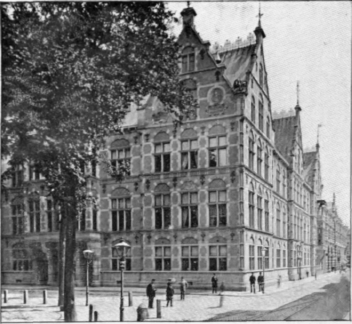
The Palace Of Justice, The Hague.
As a rule, the architecture of the Hague is not only solid and substantial, but handsome; not with the showy finery of Paris or Vienna, but rather like a dress, whose tasteful colors and perfect adaptation to the form lead one to thoroughly admire it, without at first being able to explain its charm. An air of elegance and leisure pervades its streets. We feel that here is the repose of wealth served by attentive tradesmen. At Rotterdam, they say, one makes his fortune; at Amsterdam he increases it; but at the Hague he spends it.
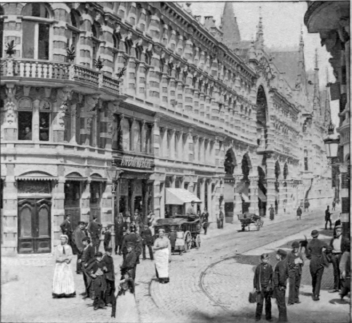
A Street In The Hague.
One of the most impressive features of the Dutch capital is the National Monument, the sight of which recalls the founder of the nation's independence, - William, the Silent. This hero is as highly revered in Holland as Washington is in the United States. As the principal opponent of Philip II. in the Netherlands, he was the incarnation of the national spirit in the noblest epoch of Dutch history, and dared to stand forth as the fearless leader of a persecuted people, in opposition to the mightiest monarch then on earth, whose kingdom included Spain, Belgium, Holland, a part of Italy, and a portion of North Africa, and threw its baneful shadow over the West Indies, Mexico, and Peru. Yet Philip II. with all these resources could not crush him; and finally, in 1580, was base enough to offer a reward of twenty-five thousand crowns and a title of nobility to any one who would assassinate him. Responsive to this shameful bribe, a score of dastardly assassins watched for a chance to strike the fatal blow. Eight desperate attempts were made before the one that finally succeeded. On Sunday, the 10th of July, 1584, the Prince, in company with some friends, was going down the stairway of his house to dinner. Leaning upon his arm was his beautiful young wife, who had already, several years before, witnessed in Paris the murder of her father in the massacre of St. Bartholomew. Suddenly a man stepped from a corner of the corridor and extended a petition.
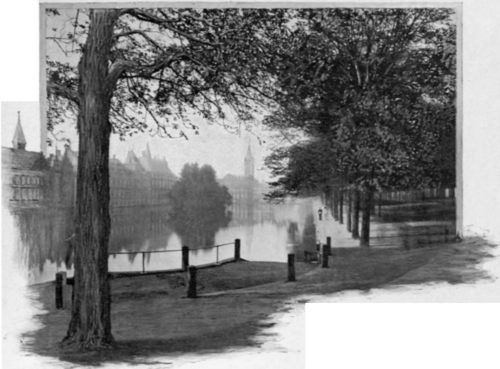
The Promenade.
The Prince requested him to come again when he was not engaged, and passed on to the dininghall. The stranger walked away without a word. During the repast, William was as usual gay and cheerful; for his surname, "the Silent," does not imply that he was taciturn or gloomy, but merely that he could, and did, conceal his plans with marvelous dexterity. His wife, however, appeared troubled, and spoke to him several times of the strange man whom they had just met in the hall, saying that he had certainly the most villainous face that she had ever seen. William laughed lightly at her fears and reassured her; then, at the close of the repast, he led his wife and friends once more along the corridor. As he approached the staircase, the assassin, who was waiting, sprang forth and shot him in the breast. The Prince reeled backward a few steps, and fell into the arms of his young wife. Five minutes later, one of the noblest of human hearts had ceased to beat.
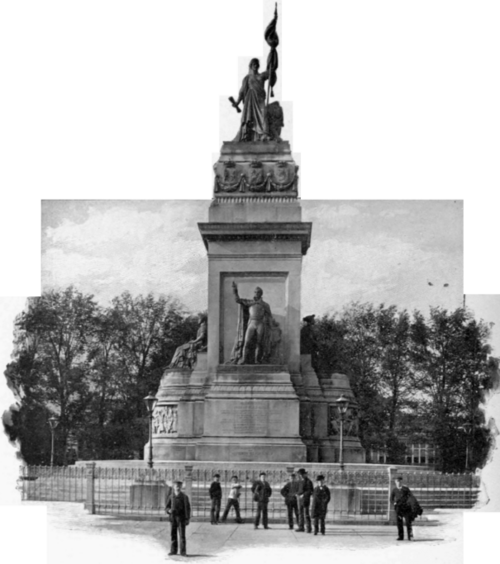
The National Monument, The Hague.
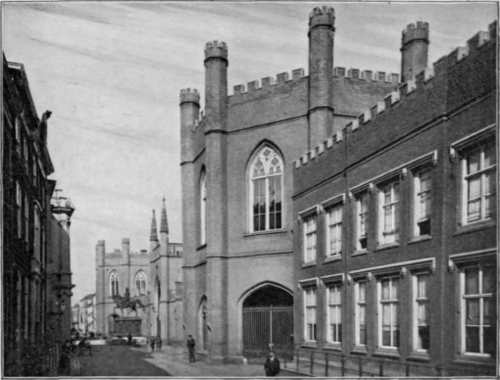
The Palace And Statue Of William.
Some of my pleasantest memories of the Hague are connected with the spacious park that lies between that city and the sea. Whoever is fond of level walks and drives, beneath magnificent oaks and elms, will find this park enchanting.
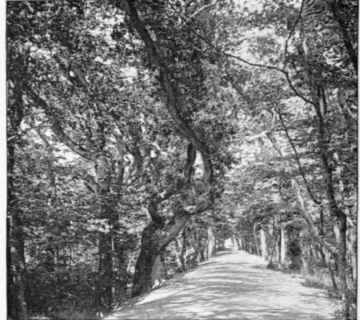
The Park.
Moreover, as it is three miles long, it is never overcrowded, and so luxuriant is its vegetation that I believe the statement made by a Dutch writer, that in the Hague and its vicinity there can be found a tree, a flower, and a bird for each of its inhabitants.
Here and there, within its cool enclosure, are villas of great beauty, in one of which the Queen resides in summer; yet there is no unusual seclusion in this abode of royalty. Strangers may wander freely through the grounds, and even enter the villa at certain hours of the day, for the park is looked upon as national property and is accessible to all. It is the remnant of an enormous forest, which formerly covered the entire territory of the Netherlands, and enabled its primitive inhabitants to resist for so long a time the legions of imperial Rome. On many of the historic elms and beeches in this forest the names of famous individuals have been bestowed. Hence they are dear to every Hollander. More than once, in their heroic struggle for independence, the Dutch were tempted to dispose of these trees for money, which was so essential; but when it came to the decisive act, the citizens always saved them by a voluntary contribution.
Continue to:


My Books

