


Holland. Part 7
Description
This section is from the book "Holland - John L. Stoddard's Lectures", by John L. Stoddard. Also available from Amazon: John L. Stoddard's Lectures 13 Volume Set.
Holland. Part 7

The Royal Villa.
The history of Holland is a record of the unexpected. One would suppose that this flat country - formed principally of the mud deposited by the Rhine, the Meuse, and the Schelde - would be the last part of the world to be the scene of bloody wars and fiendish cruelties; yet on this marshy soil, threaded by sluggish streams and brooded over by the exhalations of a threatening sea, bloodshed and torture cast their baneful shadows for a hundred years. Here, in the sixteenth and seventeenth centuries, were enacted some of the most important deeds in the world's history; and on a land, whose very existence is a perpetual conflict between life and death, occurred a struggle for religious and political freedom, unsurpassed in suffering and heroism. The Dutch are sometimes ridiculed as being stupid. It is a: serious mistake. Although they live of necessity a great part of the time in cloudland, they are the most practical people on the face of the earth. Slow they undoubtedly are; but they exemplify the fable of the tortoise and the hare, and retain abundant proofs of their career of conquest and commercial enterprise when they were rivals of Great Britain, and wrested from the Portuguese the sovereignty of the eastern seas. Small as their mother country is. the Dutch possess, to-day. in the Indian Ocean a splendid archipelago, which a Holland writer has compared to a girdle of emeralds strung along the equator; and in Java. Sumatra. Borneo. New Guinea, and other islands they have a colonial empire that covers an area of eight hundred thousand square miles, and includes a population of thirty-three million souls.

The Tower Of Mont Al1ban.
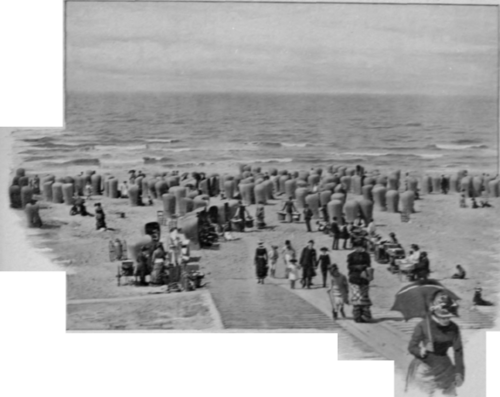
After driving for two miles through the charming forest near the Hague, we reached the little town of Scheveningen. His-toricallv, this is interesting as the port from which Charles II. sailed for England when he was recalled from exile after the death of Cromwell; but it is chiefly famous now as the fashionable watering-place of the Hague. Between the capital and this resort horse-cars and cabs are always rolling back and forth; and on bright summer days the entire population of the Hague appears to have assembled on the ocean sands. The fashionable life of Scheveningen is similar to that of every Continental bathing-place. There are, of course, the grand hotels, the crowds upon the beach, the bathing-carts, the wicker chairs for invalids, the music, dancing, and flirtation that characterize Brighton, Margate, Biarritz, and Ostend; but there is also quite another life at Scheveningen, peculiar to the country, and indicated most appropriately by the curious figures which now and then stand forth in striking contrast to the ephemeral gaiety on the shore. The pleasure seekers lead a butterfly existence here for two or three months, and then depart; but the old fishermen remain permanent features of the landscape. I found the natives of the Holland coast interesting objects of study. Living within two miles of the capital, and every summer visited by the crowds of fashion, they nevertheless preserve unchanged the primitive habits of their forefathers. Such as they were three centuries ago they are to-day. The personal appearance of some of them is extraordinary. Their skin resembles the exterior of a smoke-cured ham, and is as thickly seamed with wrinkles as Holland is with canals. I fancied that the rain must run in regular channels down their cheeks. Their mouths are usually large, and, when no teeth are visible, as is not infrequently the case, they open like old-fashioned carpetbags. I recollect that one of these "toilers of the sea" had legs, the curving lines of which I never saw surpassed, save in a wishbone or a lobster's claws; and I could never understand what must have happened to him in infancy to give his limbs a shape that would have made his fortune in a dime museum.
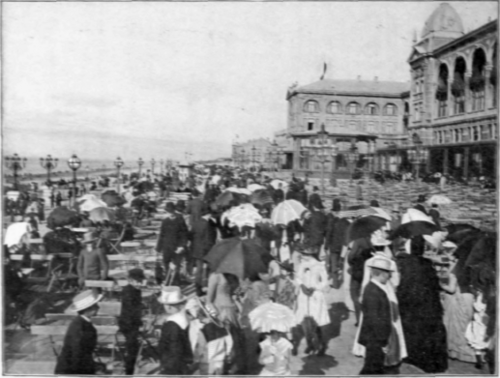
At Scheveningen.

Fishermen's Houses.

Interior Of A Dutch Cottage.
Continue to:


My Books

