


Genoa. Part 3
Description
This section is from the book "Genoa - John L. Stoddard's Lectures", by John L. Stoddard. Also available from Amazon: John L. Stoddard's Lectures 13 Volume Set.
Genoa. Part 3
One of the oldest and most interesting architectural souvenirs of ancient Genoa is the dark, square Tower of the Embriaci, which rises f rowningly above the mass of ordinary buildings that surround it, like an imprisoned giant, chained by lilliputians, or like a stern, old Puritan looking down disdainfully on a company of revelers in whose pleasures he can feel no interest. More than nine hundred years ago this formed the home of the Genoese captain, Embriaco, whose skill and valor did so much, in 1099, to achieve the conquest of Jerusalem. For, having burned his ships at Joppa to prevent their falling into the hands of the Saracens, this hero led his followers to the Holy City, to assist a siege which was beginning to appear to the Crusaders almost hopeless, on account of the height and thickness of the walls. But Embri-aco, with the ropes and timbers he had rescued from his ships, constructed there a movable scaffold of great height, which was eventually pushed up to the walls, so that the Christians, climbing to its summit, could leap on to the ramparts and grapple with their foes.
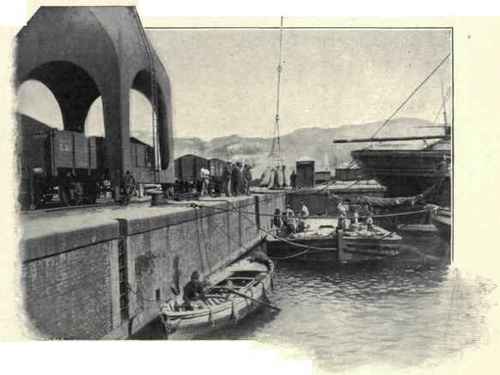
Loading Grain At Genoa.
Moreover, two years after this and, as the solitary instance of that style of architecture now in Genoa, remains a grand memorial of a mighty past.

The Tower Of The Embriaci.
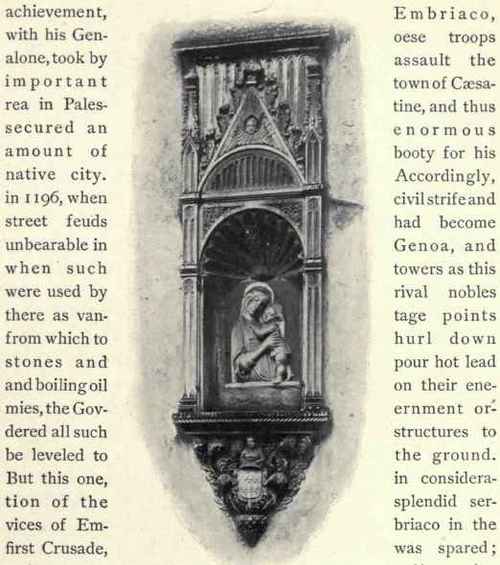
An Old Street Ornament, Genoa.
One sees still further proofs of Genoa's former glory in walking down the Via Balbi and the Via Garibaldi, on either side of which rise marble palaces which are unsurpassed even by those of Florence. The difficulty is to get a suitable perspective of their grand facades, so narrow are the thoroughfares on which they front. Unfortunately, too, the Via Balbi, where are the Palaces of the University and the Municipality, has been made positively dangerous for pedestrians by a double line of tramcars, the sides of which come perilously near the occupants of the restricted sidewalks. By standing on the opposite side of the street, however, in the shelter of a doorway, one gains some notion of the architecture of these palaces by leisurely observing their imposing entrances, their massive, decorated portals, grated windows, and thick marble walls. But even more impressive than their exteriors are their noble courtyards, which with their stately stairways, marble balustrades, and lofty, monolithic columns supporting two or more enormous galleries, seem worthy to be traversed only by the noblest of mankind. There is an air of amplitude and splendor in these spacious sunlit courts, surrounded by gigantic arches, that lifts one's thoughts above the pettiness and sordidness of common life. It should be quite impossible, for example, in such an edifice as the Municipal Palace to stoop to acts of baseness or corruption. Behind a number of these structures, also, are retired gardens, where in the midst of orange-trees and flowers the roar of city traffic dies away to a soft murmur, almost silenced by a sweet-voiced fountain, and one looks out above the masts and funnels of the harbor to the glistening sea. The beauty of these structures formerly appealed to civic, as well as to individual, pride; and in consideration of the exceptional beauty of one of them its owners were declared exempt from all taxation evermore. Where could we find to-day Municipal Councils with so high an appreciation of aesthetics? In these magnificent mediaeval dwellings, as in the old châteaux of France, one sees a grandeur and simplicity of form and an artistic sense of decoration, completely wanting in palatial houses of the present time, however lavishly adorned. The modern millionaire cannot conceive apparently of grand, harmonious proportions. Nor does his architect suggest them. In modern residential styles the marble lion has been largely superseded by the golden calf. One of these Genoese palaces, called from the color of its walls the Palazzo Rosso, contains the most extensive picture gallery in the city, including many masterpieces of Vandyke and Rubens, both of whom once resided here. Not only is this fine collection opened gratis to all visitors daily, but the entire palace with its art treasures was, in 1874, presented to the municipality by its former owner, the Duchess of Gal-liera, together with a revenue sufficient to maintain it. This is, however, only one of many benefactions of this lady and her husband. Thus, but a few months after making this disposition of her splendid palace, the Duchess founded an asylum for the poor with an endowment of four hundred thousand dollars; and, a year later, gave two million dollars for the creation of three hospitals, - one for adults, another for children, and a third for convalescents. These have at present an endowment of more than five million dollars, and with their wonderful hydraulic and electrical conveniences rank among the finest of such institutions in the world. One of them, designed by the Duchess herself, is round in form, and has in the centre a circular apartment, well lighted and ventilated, which serves as a general sitting room for doctors, sisters, chaplains, and attendants, who at a glance command the entire length of all the wards which radiate from it like the spokes of a wheel. The slightest noise in them is heard, and the required aid can be immediately given.
Continue to:


My Books

