


Lake Como. Part 3
Description
This section is from the book "Lake Como - John L. Stoddard's Lectures", by John L. Stoddard. Also available from Amazon: John L. Stoddard's Lectures 13 Volume Set.
Lake Como. Part 3

Como.

Old Twelfth Century Gate.
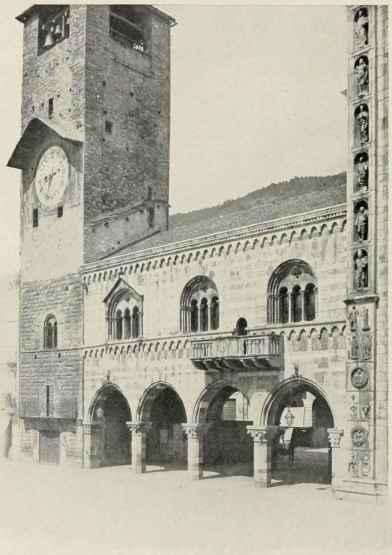
The Old City Hall Of Como.

A North-Italian Of The Cinque Cento.

Tomb Of a Bishop Of Como.

A Ghibelline Tower.
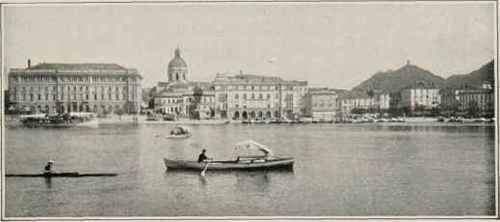
Como And Monte Baradello.

Castle Of Baradello.
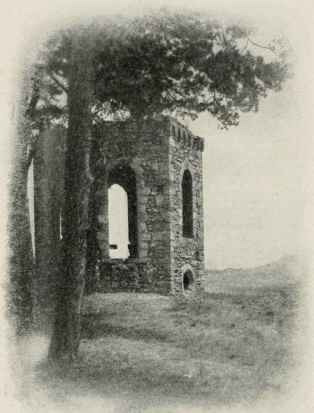
Fragment Of Castle Baradello.
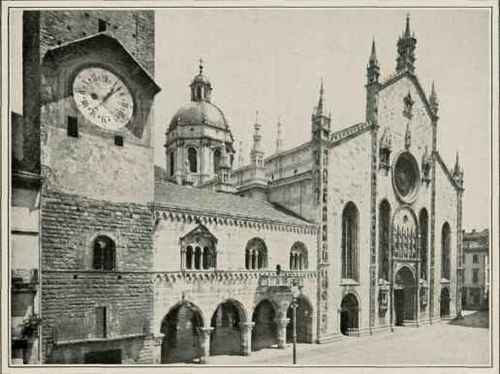
The Cathedral Of Como.
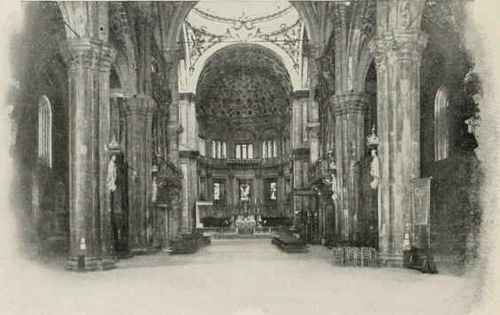
Interior Of The Cathedral.
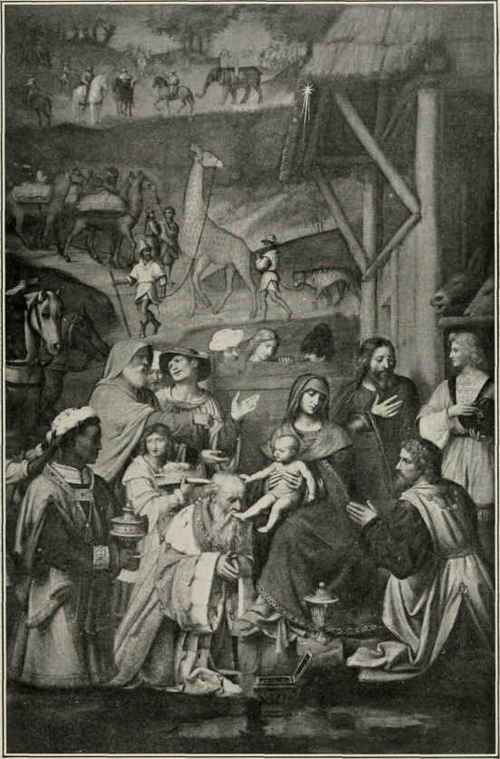
The Adoration Of The Wise Men, By Luini.
It was, of course, an incongruity to flank the portal of this Christian temple with the statues of the two most famous pagan residents of Como - the elder and the younger Pliny; especially as they are not clad in Roman togas, but in the costume of the fifteenth century ! No doubt, however, those who put them there reflected that such estimable Romans would have been good Christians, had they been born a little later. At all events, it is noticeable that their figures were not placed within the sacred edifice, but merely on the outside, near the door ! Of these illustrious Plinys still more interesting souvenirs will present themselves at other points upon the lake; but here at least one owes a passing tribute to another native of Como, - the distinguished electrician, Volta. The monument to his memory, which graces the Piazza named for him, is scarcely noticed by the average tourist, so swiftly does the electric tramcar -toward the possibility of which Volta himself contributed - convey him past it from the railway station to the steamer. If seen, it usually excites surprise; for we are all so prone to associate famous men and women merely with great cities, that we forget that geniuses are sometimes born in insignificant towns or humble hamlets. Como cannot be classed in either of these categories, yet many a traveler is astonished to discover that it was the birthplace and for many years the home of one whose name has been immortalized in the nomenclature of electricity. For various modifications of such terms as volts, voltaic batteries, and the voltaic pile, now form a part of every civilized language of the world, and are perpetual reminders of the scientist of Como. The knowledge which he gained in this mysterious field of research more than a century ago still holds an honored place; and not w ith -standing the immense advance which has been made in the study of electricity within recent years, there is said to be little in Volta's writings which even now could be called erroneous. Born here in 1745, he became at the age of twenty-nine professor of physics in his native city, and subsequently was appointed to a similar position in the university of Pavia, where he taught and studied thirty years. His talents, happily, met with recognition both in his own and foreign lands. Thus, he received, in 1791, the Copley medal of the Royal Society of London, and ten years later was invited to Paris by Napoleon, who honored him with the title of count and a senatorship in the kingdom of Lombardy, besides conferring on him the gold medal of the Institute. Further distinction awaited him in 1815, when the Austrian emperor appointed him to the directorship of the philosophical faculty in Padua. Finally, however, in 1819, withdrawing from all active pursuits, he chose for his retirement his beloved Como; and there his life was peacefully concluded at the age of eighty-two. The fame of such a man is naturally precious to his fellow-citizens; and hence, among the many interesting collections in Como's Civic Museum, an entire room is devoted to memorials of Volta, such as his first electrical instruments, his simple desk and chair, numerous letters and portraits of the electrician, and many of the decorations given him in recognition of his genius. One of the first impressions made upon the traveler, as his steamer slips away from Como, with its prow turned toward the Alps, is the resemblance of this sheet of water to a river. Each of its three long arms is narrow, - never exceeding two miles and a half in breadth, and averaging half that distance. The buildings, therefore, on one shore are always plainly visible on the other, and the white silhouettes of steamboats are distinctly seen, as they arrive at, or depart from, opposite landing-piers. Accordingly, Lake Como is more home-like than the broader lakes of Garda and Maggiore, and probably on that account has always been a favorite place of residence not only for Italians in their villegiatura, but also for the representatives of many lands, who have retired here to rest, - often to work, in undisturbed tranquillity amid divinely beautiful surroundings. Near Como, for example, on the eastern bank, near Torno, is the Villa Ferranti, where Pasta, the great singer for whose voice Bellini wrote his operas "La Sonnambula" and "Norma," lived in seclusion from 1840 till her death in 1865. Like Volta, she had been born in Como. Like Volta, she returned to its fair environs to die. Not far from the former home of Pasta stands the Villa Taglioni, once the residence of the "ideal" dancer of that name, whom Thackeray and Balzac mention in their novels as phenomenal Moreover, farther up the lake, at Cadenabbia, are villas which have formed the temporary abodes of Verdi and of Rubinstein, and in which some of their finest works have been composed. Where shores are crowded thus with interesting objects, it is of course impossible to form an adequate conception of a lake by merely gliding swiftly over its surface. True, like a weaver's shuttle, the little steamer traverses repeatedly the blue expanse, touching now here, now there, on either bank. But such a voyage is necessarily superficial, and leaves upon the mind only a pleasantly confused impression of handsome villas, lovely gardens, picturesque towers, countless churches, and old, white-walled convents, set in huge frames of olive-groves and cypresses, -the whole relieved against a background of imposing mountains, always beautiful in form, and often glittering with snow.
Continue to:


My Books

