


Around Lake Garda. Part 10
Description
This section is from the book "Lake Garda - John L. Stoddard's Lectures", by John L. Stoddard. Also available from Amazon: John L. Stoddard's Lectures 13 Volume Set.
Around Lake Garda. Part 10
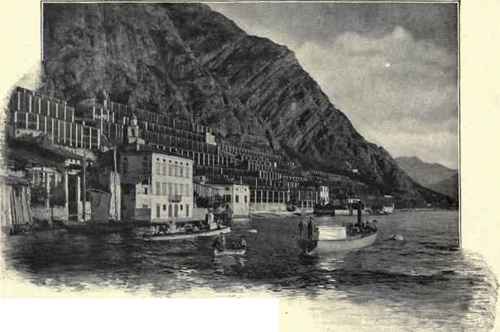
Custom House Boats At Limone.
Here, therefore, on a southward voyage, one makes his first acquaintance with the singular galleries, built solely to protect that fruit, and rarely visible elsewhere than on the western border of Lake Garda. Viewed from a distance, they looked to me like miles of skeleton cages ranged in terraces along the shore; and even when we drew still nearer, their lines of cream-white columns suggested rows of gun-barrels in an arsenal. They are in reality arcades, made out of pillars of cemented bricks, each column being twenty feet in height and eight feet distant from its neighbor. They are connected by iron rails, upon which planks are laid in winter as a roof, while windows are inserted in the vertical spaces.
Hence, in cold weather they become conservatories, receiving solar light and heat through their glass screens in front, but walled up at both ends, and sheltered overhead by temporary coverings of boards. Seen close at hand, the golden fruit, hanging in clusters in this series of contiguous compartments, reminded me of ornaments displayed in the windows of successive jewelry shops. The export of lemons has been for centuries a profitable business for the people of this region; but it is now precarious, partly because of cheaper means of transportation of the fruit from Sicily, and partly owing to the malady which recently attacked the trees.
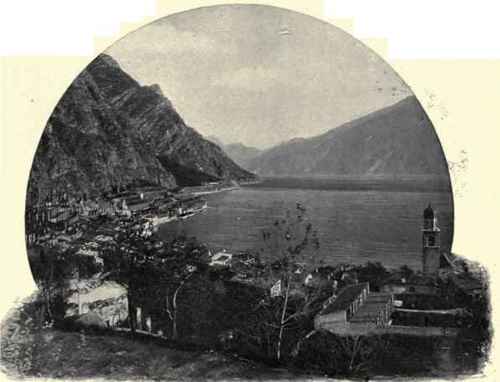
Lemon Galleries At L1mone.
Poor Italy! It seems to have had really more than its share of agricultural and political misfortunes.
For in addition to the heavy taxes levied for the army, navy, and colonial schemes, which have been grinding down the income of the peasantry for years, a series of calamities, such as the illness of the silkworm, the blight of the vines, the injury to the mulberry trees, and the disease of the lemons, have caused so much distress that hundreds of formerly prosperous families in this vicinity have been reduced to poverty, and forced to sell their farms for merely nominal prices. It is little wonder, therefore, that thousands of the still more wretched peasants have been compelled to leave the country to avoid starvation, and that the largest number of immigrants to the United States is at present furnished by Italy.1 It is a significant fact that in parts of Italy there are now no singing birds, the lovely landscapes being strangely silent. There is in this respect a painful contrast between Tyrol and Italy; for while the common people of the former country treat birds with the utmost kindness and feed them in the streets, the poor Italians catch as many as possible to sell, or kill them outright for the little food which they can furnish.
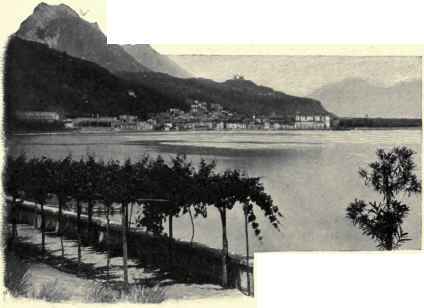
Lemon Terraces At Maderno.
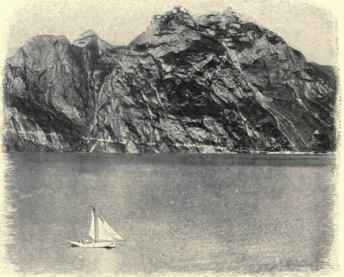
Coming Up With The "Ora".
Meanwhile, our steamer has been speeding to the opposite shore, to touch at the picturesque village of Malcesine, once rendered formidable through its stately castle, built by Charlemagne. This stands upon a narrow promontory, which cleaves the water like the prow of a warship; and it is not surprising that the nobly situated fortress so appealed to Goethe that he at once proceeded to make a sketch of it, forgetting that the act might look suspicious to the less aesthetic officials of the Venetian government. In fact, he had hardly finished a rough, preliminary draft of the building when a crowd began to assemble, whose leader asked him what he was about. Gœthe replied politely that he was merely sketching the ruined tower; but his interrogator rudely snatched away the paper, tore it up, and sent for the police. Absurd as the situation now appears, it was for a time a serious one for the author of "Faust"; for the authorities of the place declared their belief that he was an Austrian spy, who had come hither to construct a map of the frontier of the Venetian Republic to be used later by the Austrian emperor in some nefarious project of aggression. Goethe protested that he was a citizen of Frankfurt, had absolutely nothing to do with the Austrian government, was on his way to Italy to study art, and could not possibly have supposed that such a ruin as this ancient castle would be considered a fortress, a plan of which would be of service to an enemy. To this, however, the Podesta of Malcesine replied by asking scornfully what there could be in that old building worthy of a sketch ! It must have been a scene worth traveling many miles to witness, when Goethe tried to explain to him, and incidentally to the assembled populace, the unappreciated beauties of this massive stronghold, which had survived the tempests of a thousand years. Whether it was the poet's eloquence or the corroboration of his statements by an Italian who was present that induced the judge to alter his opinion, is uncertain; but there can be no doubt that the great German narrowly escaped arrest, and probably a most unpleasant temporary imprisonment at Verona.
Continue to:


My Books

