


Around Lake Garda. Part 9
Description
This section is from the book "Lake Garda - John L. Stoddard's Lectures", by John L. Stoddard. Also available from Amazon: John L. Stoddard's Lectures 13 Volume Set.
Around Lake Garda. Part 9
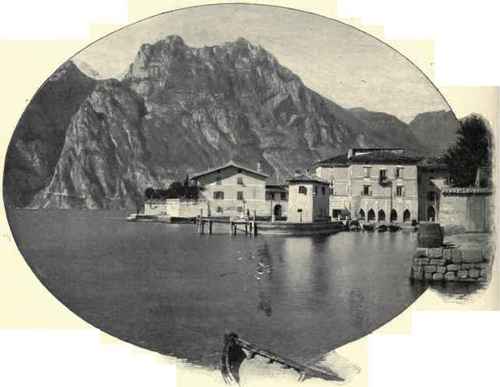
The Hotel Terrace At Torbole.
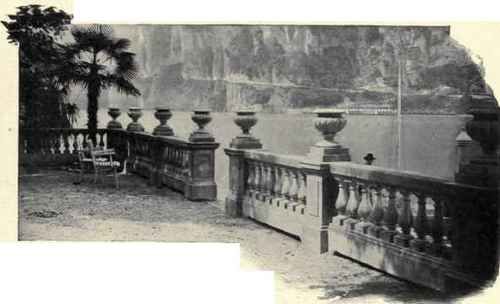
My Boat By The Garden Wall, And The Via Ponale.
Moreover, through these tinted areas narrow paths of lapislazuli and silver meandered here and there capriciously, as if the lake were a mosaic map, whose colored sections were marked off by lines of precious stones. In presence of so sumptuous a pageant I should have found it natural to meet enthusiastic painters here at every turn, profiting by a thousand subjects for pastels and aquarelles; but during the entire drive we saw not even an amateur. Yet Venice presents nothing finer or more tempting to an artist's brush than this resplendent Garda-see, especially when the adjoining mountains wear their crowns of snow, beneath which miles of perpendicular cliffs are purple to the water's edge. An added charm is given to the scene, when one or two fishing boats appear, gliding mysteriously round a distant headland, and looking with their red, blue, brown, or orange sails, like monster butterflies, skimming with gorgeous wings the mirror of the lake.
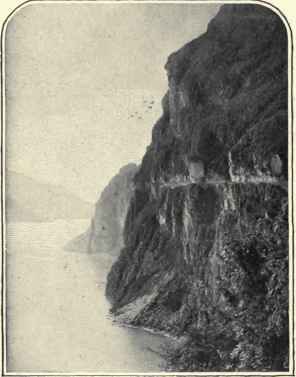
The Via Ponale, Looking Down The Lake.
All these impressions are intensified when we explore Lake Garda in one of the graceful steamers whose keels cut, diamondlike, their furrows in the glassy flood; now curving eastward to some village nestling in a tiny bay, now darting thence diago-nally to the western shore. Seen from a mountain summit, these boats resemble swallows in their zigzag flight.
Surpassing by a third the area of Lake Maggiore, the Gar-dasee is much the largest of the lakes of northern Italy, and in the inexhaustible variety of its brilliant colors is also the most beautiful. Its upper end is still Tyrolean, not alone politically, but in appearance. Near Riva it is purely a mountain lake, shut in by cliffs which give it quite the look of a Norwegian fjord. But in the south it broadens into a miniature, sunlit sea, whose shores recede and almost lose themselves in silvery haze. I might compare Lake Garda to a human face, marked by a lofty forehead, piercing eyes, and stern expression, yet tempered by a tender mouth, possessing a bewitching smile. This difference shows itself not only in the physical conformation of the country, but in the vegetation of its banks, which gradually changes as we sail from the bare mountains around Riva to luxuriant gardens, where oranges and lemons flourish in profusion, and roses bloom throughout the year, in that delightful region of fertility which Shelley calls "The waveless plain of Lombardy".
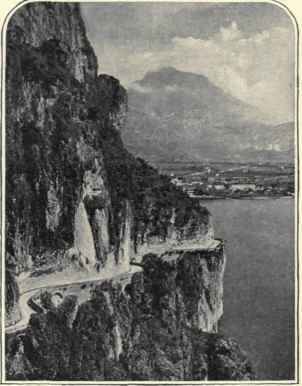
The Via Ponale, Looking Toward Riva.
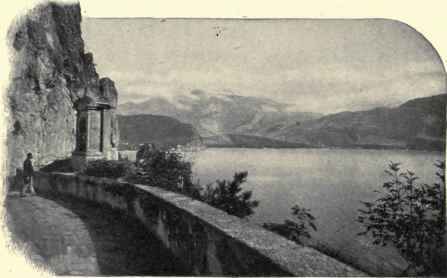
A Shrine On The Via Ponale.
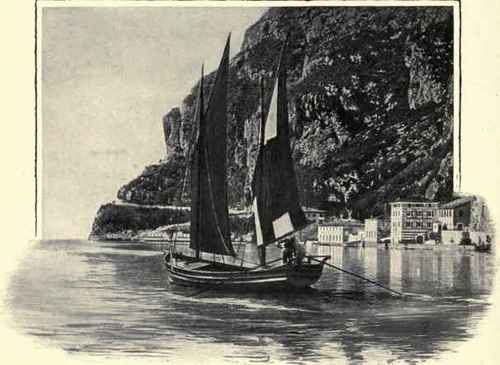
A Sailboat On The Gardasee.
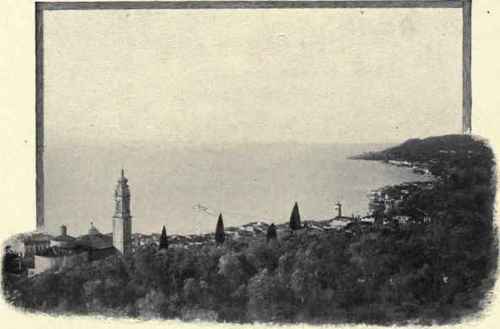
Cutting Their Furrows In The Glassy Flood.
About an hour after leaving Riva we glide across an invisible line of demarcation, and are informed that we have left the empire of Franz Joseph, and are now in Italy. Nothing suggests the change, however, except the appearance of two rakish-looking craft, resembling torpedo boats, which every night cruise back and forth along the liquid frontier, directing search lights to the right and left, in order to detect and thwart any attempts at smuggling. For contraband traffic is encouraged here by heavy customs duties, and in the days before the advent of these watchdogs of the lake, evaders of the law found this an admirable field for operations. With a swift boat, adventurous fishermen or sailors would sometimes gain thus, on a single dark or stormy night, more than they could have earned legitimately in a month. But with these fiercely brilliant eyes of science peering pitilessly into every cove and cranny of the cliffs, and lighting up the lake for miles, he would indeed be reckless who should try to smuggle now. The usual place of anchorage for these police boats is, naturally, the first Italian town to greet us after entering Victor Emmanuel's dominions, which is appropriately named Limone, from being the most northern point upon the lake where lemons are extensively cultivated.
Continue to:


My Books

