


Around Lake Garda. Part 14
Description
This section is from the book "Lake Garda - John L. Stoddard's Lectures", by John L. Stoddard. Also available from Amazon: John L. Stoddard's Lectures 13 Volume Set.
Around Lake Garda. Part 14
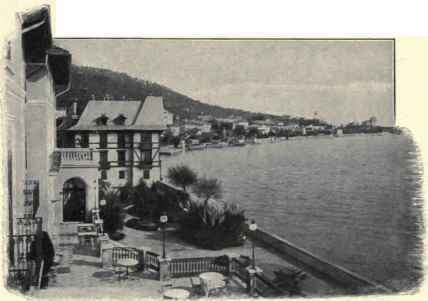
Fasano, On Lake Garda.
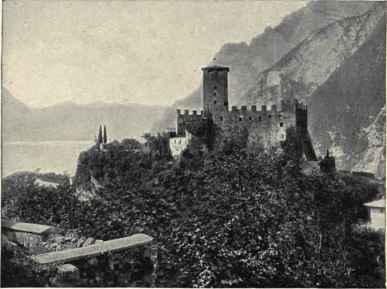
Castle Tenno, A MediÆVal Stronghold On Lake Garda.
To reach this scene of conflict from Lake Garda is an easy and agreeable undertaking, since one can drive there in an hour from Desenzano, and the excursion in a carriage through the fruitful Lombard country is one that leaves behind it charming recollections. Both of the towers reared upon this sanguinary field are interesting and impressive; but that of San Martino filled me with especial reverence and admiration. The fighting of the French was dictated by the policy of Napoleon, which can be hardly called entirely disinterested when one considers the consequent addition to France of the provinces of Nice and Savoy. It was by his command, rather than by their personal inclination, therefore, that his soldiers fought so bravely here; for otherwise they would have followed peacefully their usual occupations in "La Belle France," and would not have exposed themselves to all this agony and carnage for a cause of which they knew but little, and cared less. But with the Italians it was different; and SanMar-tino's stately shaft commemorates the noblest task that any people can assume - the struggle of an entire nation to achieve its independence. How ardently the fires of patriotism glowed in the Italian breasts is shown by an authentic incident recorded of a young Venetian, fatally wounded in this battle. The lad was found among the fallen Austrians, and was at first supposed to be a soldier of Franz Joseph. So, technically, he had been; but he was able to explain to the Italians that his musket never had been loaded, and while his young life ebbed away, the poor boy whispered to the soldier who had shot him that he had been compelled by the Austrian government at Venice to join the kaiser's army, but that he had never fired on his countrymen, preferring to be killed by them. The little hero died an hour later, clasping the hand of one of Garibaldi's men; and on the following day his brothers in the struggle for Italian liberty removed his Austrian uniform, and buried him among the Italian dead. Lovers of Elizabeth Barrett Browning's verse will recollect that she has consecrated to this touching story one of her sweetest poems, entitled "A Forced Recruit at Solferino".
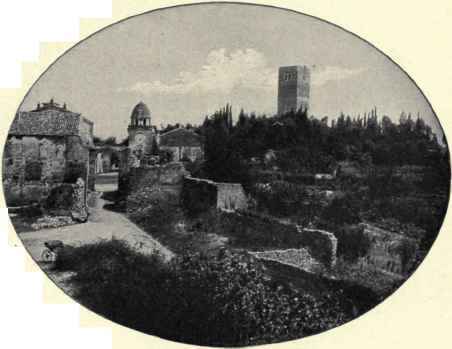
The Tower Of Solferino.
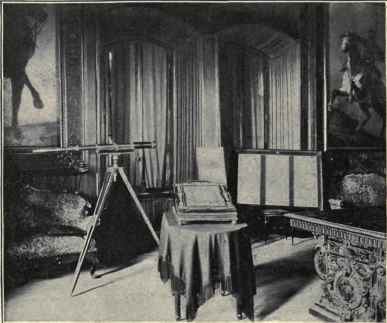
" Hall Of The Sovereigns," In The Tower Of Solferino.
The country which these towers overlook is a well-cultivated plain, resembling a boundless garden, dotted with vineyards, orchards, churches, villages, and villas, which stretch away to the horizon; either toward turreted Verona, whose imposing battlements present so fine a picture of the feudal past; or down the Mincio, toward Mantua, where Virgil lived, and Giulio Romano painted and designed; or northward, toward the glorious Garda-see, whose blue expanse melts gradually into the violet outlines of the Tyrolese Alps.
Alas! that such a marvelous illustration of prolific nature should have been crimsoned, deeply and repeatedly, with human blood. Yet almost in the shadow of these towers stand melancholy proofs of man's mortality. Each of the shafts adjoins an edifice which serves as church and ossuary for the men who here gave up their lives for Italy's redemption. In each case avenues of solemn cypress trees, like battle flags which have been tightly furled, lead up to these memorial chapels, within whose chancel the walls are lined with cases containing rows of skulls, ranged carefully behind glass doors. With questionable taste the chapel at Solferino is rendered specially grewsome by the presence of four skeletons standing, like ushers to a coming ceremony, on pedestals before the heavy curtains. Most of the skulls are nameless; but here and there I saw one bearing a label, in proof of its identification at the time of its discovery. But those whose skulls are thus presented here are but a fraction of the dead, whose bones are heaped up in the crypts of the two ossuaries. It made me sick at heart to look upon those ghastly relics of the brave young soldiers - the joy and pride of many loving hearts - who found upon these hills and the surrounding plain the death of heroes. The crypt of San Martino contains the bones of nearly three thousand of these sons of France and Italy; and that of Solferino seven thousand. Yet even this is but a meagre gleaning of the awful harvest reaped upon these fields by death! It was, indeed, a day of horrible carnage; and - if I may credit the statement made to me by an officer who participated in the conflict, and to whom subsequently was assigned the task of caring for the dead and the dying - this battle was followed by an amount of physical agony from wounds, thirst, heat, and a lack of suitable care unparalleled in recent times.
Continue to:


My Books

