


Around Lake Garda. Part 13
Description
This section is from the book "Lake Garda - John L. Stoddard's Lectures", by John L. Stoddard. Also available from Amazon: John L. Stoddard's Lectures 13 Volume Set.
Around Lake Garda. Part 13
If an admirer of Bocklin's famous picture, "The Island of Death," would see what possibly suggested it to the artist's fancy, let him behold by moonlight the castle-crowned and cypress-shaded promontory of Lake Garda, called the Point of San Vigilio. Even by day, however, this terminus of Monte Baldo, as it makes its final plunge into the lake, is an imposing feature of the eastern shore; and further interest is given to it by the fact that, more than a thousand years ago, its castle was bestowed by Charlemagne on the hermit St. Vigilio, in honor of whom the cape has ever since been called. Within the pretty bay, protected by this headland, lies Garda, an insignificant village now, but formerly of such importance that it has given to the lake its name. For Charlemagne established here a dukedom, to which for many years the entire region of the Gardasee belonged. But now, except for the imperishable beauty of its situation and the mildness of its winter climate, its glory has departed. Its fate, however, has been less tragic than that of the old city of Benacum, on the other bank, from which the lake's first Roman title was derived; for that was utterly destroyed, in the third century of the Christian era, by a landslip from the neighboring mountain.
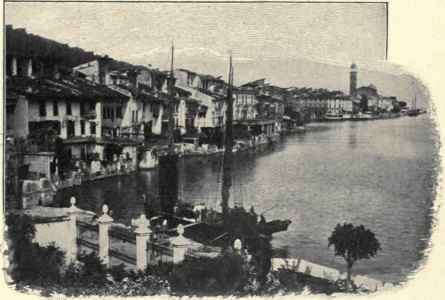
Salo, On Lake Garda.
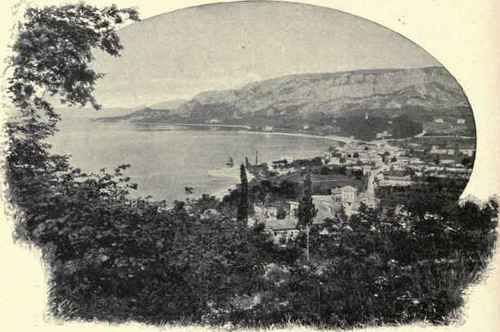
Garda, On The Gardasee.
But though ill-starred Benacum may have been the first, it certainly was not the only Roman town upon these shores. Scholars have long since ascertained that the whole circuit of the lake was thickly settled, and that in many instances the citizens of these riparian towns were notable for wealth and culture. Nor should it be forgotten that the commerce of Lake Garda was then far more extensive than it is to-day, since at that time it was connected with the ocean through the channels of the Mincio and Po, and fleets could pass between its waters and the Adriatic. We cannot wonder that for such a prize the conquerors of the world have fought repeatedly. Its history has, in fact, been stormier than its wildest waves.
Mankind seems always to have been attracted to it by its fruitfulness and beauty, for evidences of its primitive settlements go back to prehistoric times. Thus, near Peschi-era and Ma-derno, one may still see relics of the savage lake dwellers, who built far out into the water the rows of piles on which their houses were supported, in the same manner as did their Swiss contemporaries. Yet even these were probably not the earliest to roam along the borders of this lake. Since the first cave-man peered out through the parted forest leaves upon its sailless solitude, who knows how many races may have come and gone, leaving behind them no more traces of their presence here than do the boats that cut their momentary furrows in its waves, the birds that darken its bright surface in their rapid flight, or the fair colors fading from it with the setting sun! Later, the Cimbri, Rhetii, and other warlike tribes, repeatedly descended from the gloomy forests and inhospitable mountains of the north, and strove to get possession of this inland sea, which of itself could furnish them with sustenance, and which was rimmed with wealthy settlements. The Romans, therefore, were compelled to fight again and again for its retention; and near its southern bank, 268 a.d., the emperor Claudius is said to have defeated two hundred thousand savage warriors, who had swept thus far southward from Tyrol. During the Middle Ages, also, when separate cities, like Verona, Venice, and Milan, were fighting one another in their bitter rivalry, Lake Garda was the scene of many desperate battles, waged not alone upon its banks by armies, but on its waves by hostile fleets. Still later, in the wars with France, its towns were cruelly ravaged, and its waters stained with blood; while many of the victories of the first Napoleon, in the marvelous campaign of Italy, which marked the opening of his career, were won in its vicinity. But the most powerful, as well as the most recent, memories of war connected with the region of the Gardasee are vividly recalled to us by two great towers a few miles from the lake and from each other, and plainly visible to passengers on the steamer an hour or more before they reach the terminus of their southward voyage at Desenzano. They are two national monumerits, erected by the French at Solferino and by the Italians at San Martino, these being the respective points on the same battlefield where the united armies of Napoleon III. and Victor Emmanuel gained their crowning victory over Austria, on the 24th of June, 1859. It was a bloody struggle. Brave men on both sides fought with fury all day long beneath a burning sun, the allied forces numbering one hundred and fifty thousand men, the Austrians one hundred and seventy thousand, and when the longed-for darkness came, no less than thirty-seven thousand of these combatants lay stretched in death.
Continue to:


My Books

