


South Tyrol. Part 10
Description
This section is from the book "South Tyrol - John L. Stoddard's Lectures", by John L. Stoddard. Also available from Amazon: John L. Stoddard's Lectures 13 Volume Set.
South Tyrol. Part 10
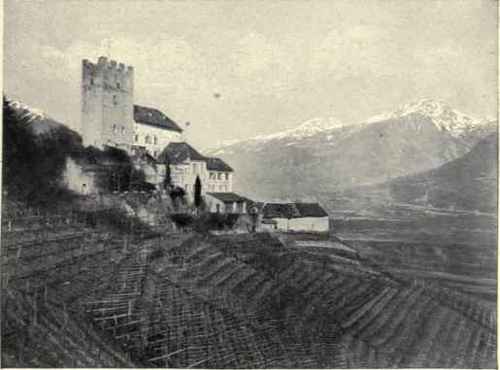
Schloss Lebenburg And Its Vineyards In Winter.
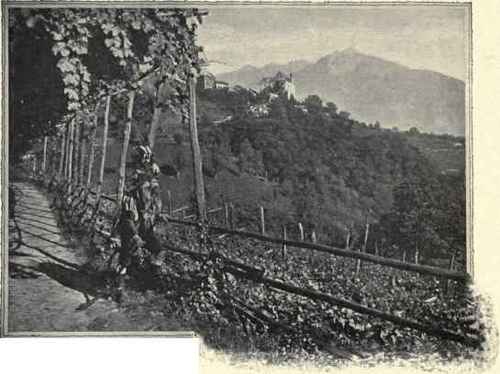
A Contemplative Saltner.
Since in the earliest paradise on record poor human nature found the plucking of forbidden fruit an irresistible temptation, it is not strange that in this paradise of the Tyrol the vineyards have to be protected by custodians. These watchmen, known as "Saltners," live for a month or more preceding vintage in cabins hidden away in shady corners of the long arcades. Their food is brought to them by the peasants, and they are supposed to roam about all night, to guard the ripening grapes; but even by day they always seem to be awake and active, eager to find an innocent tourist trespassing unawares on their domain. For then, in accordance with an unwritten law, they are entitled to exact a trifling fine from the intruder. Of course they do this usually under the pretext of soliciting tobacco; and churlish would the stranger be who, amid such surroundings, should refuse a few "tabac-kreutzers" to these poorly paid defenders of the fruit upon whose sale so much of the prosperity of South Tyrol depends. Nevertheless, the costume of the Saltner is startling enough to cause at first some apprehensions. He wears a fancifully decorated leathern jacket, and short knee breeches, between which and his low, white socks the legs are bare. Upon his chest hang rows of wild boar's teeth and claws, and not only does his embroidered belt contain a knife and pistol, but in his hand is usually held a formidable looking spear. The most marvelous part of the Saltner's wardrobe is, however, his hat, which certainly-must rank among the most extraordinary head gears of humanity. Its basis is a form resembling the characteristic three-cornered chapeau of Napoleon; but on this is built up a sort of grotesque mound, composed of multicolored plumes and feathers, interspersed with tufts of fur, while bushy foxtails hang down over either ear, like monster curls.

A Saltner.
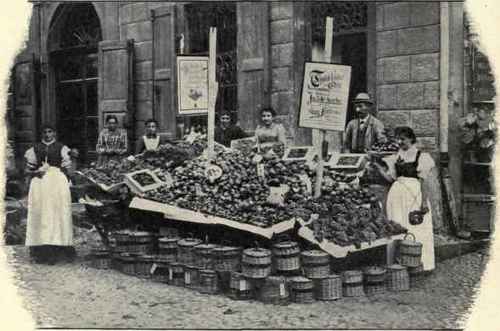
A Fruit Market In South Tyrol.
The Saltner's work ends, naturally, with the vintage. Then every hillside is alive with happy toilers. Scattered through miles of leafy labyrinths, a multitude of men, women, and children work from dawn to dusk, and often far into the night, when the land is white with the splendor of the moon. Through long arcades, whose roofs are green and gold, with purple pendants, sturdy young men and smiling maidens come and go, sometimes exchanging tender glances over the baskets held between them, heaped with the mounds of fragrant grapes, upon which rests a bloom as soft and beautiful as that which clothes the mountains with their amethystine veils. A thousand shapely arms are lifted toward the glowing clusters, which nimble fingers cut and deftly lay in trays held up by patient children, proud to contribute some assistance to the great harvest of their native hills. Meanwhile, the men are kneeling on the ground, engaged in packing some of the grapes for immediate exportation in wicker crates made specially for the purpose. Here and there also, in corners of the vineyards, are seated older women,weaving straw covers for these crates, and fastening them securely over the cool, moist fruit. How delicately they handle the sweet-scented bunches! How carefully they place them side by side, and pile them up, until they look like mounds of purple flowers! The grapes designed for wine-making, however, are dropped into enormous wicker cornucopias, which other laborers straightway buckle to their backs by means of shoulder straps, and carry off to vats, where the rich, juicy masses undergo the usual processes of crushing and fermentation.
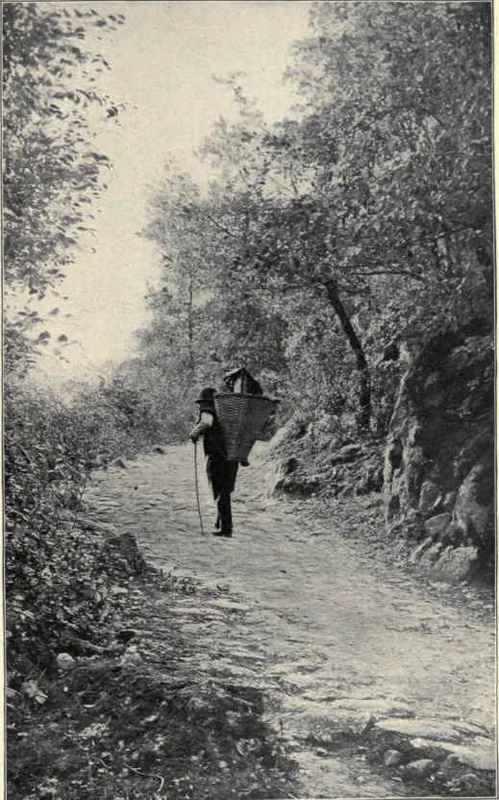
A Tyrolese Peasant With Shoulder Basket.
The quality of wine produced by these Tyrolean vineyards has been appreciated for two thousand years. The Romans paid great attention to the cultivation of the grape here; and the light, stealing through the glasses which contained the precious produce of these sun-steeped slopes, illumined frequently with ruby or with amber tints the napery of the imperial table on the Palatine. The Emperor Augustus is said to have preferred the wine of the Tyrōl to any other.
Continue to:


My Books

