


South Tyrol. Part 6
Description
This section is from the book "South Tyrol - John L. Stoddard's Lectures", by John L. Stoddard. Also available from Amazon: John L. Stoddard's Lectures 13 Volume Set.
South Tyrol. Part 6
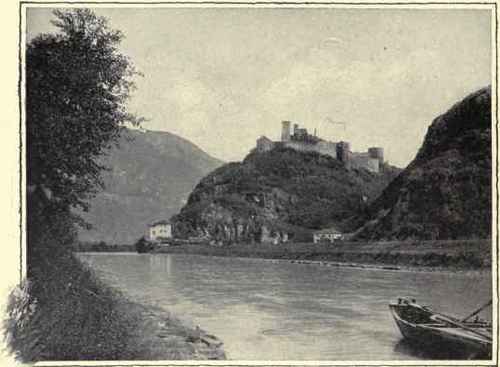
Sigmundskron Schloss, Near Botzen.
Standing upon the very brink of the precipitous hill that overlooks the town, the most conspicuous object in the immediate neighborhood of Meran is a square, crenellated tower, called the Pulverthurm. Its site commands a glorious view; and, as a gently graded path deprives the ascent to it of any difficulty, the spot is daily visited by scores of people. Although this was erected in the thirteenth century, the place had evidently been well fortified from earliest times; for the exterior of the structure is a stout, mediaeval shell, with walls five feet in thickness, enclosing a smaller watch tower, probably of Roman origin. Hence, as it stands to-day, the Pulverthurm may be regarded as a striking representative of Meran in the three principal periods of its development. The tower's ancient nucleus, or core, hidden from all save those who scientifically search for it, corresponds to the era of the Romans; its outer walls, so massive, yet unsuited to the present age, suggest the centuries of Castrum Majense; while the elaborately built and fashionable promenade which leads to and surrounds it, is typical of the modern epoch of Meran, when this gray tower looks down no longer upon Roman legionaries or mailèd knights of Christendom, but on a polyglot company of men and women, the great diversity of whose speech might now appropriately give to it the title of the Tower of Babel. At all events, whatever Meran may have been in St. Valentine's or Sigmund's time, the Pulverthurm has never seen it in so prosperous a condition as to-day.
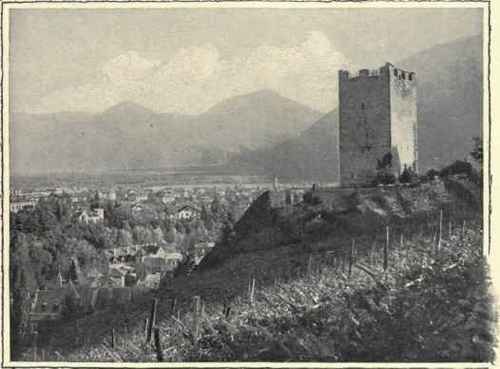
The Pulverthurm.
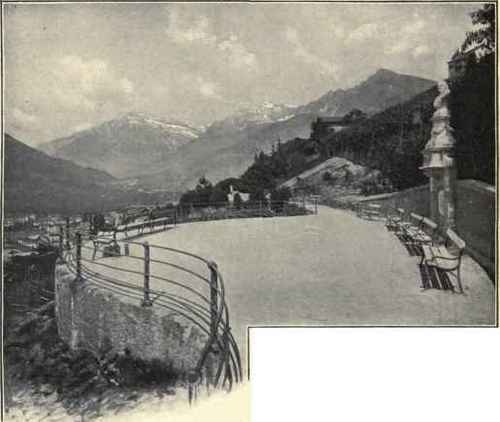
The Approach To The Pulverthurm.
"Hitch your wagon to a star," says Emerson; in other words, - Join forces with the powers of Nature, and let them draw you on to fortune. Meran has improved upon this precept by hitching its wagon to the sun. Apollo is its tutelary deity, with Bacchus as his coadjutor. About fifteen thousand strangers, - most of them fugitives from Boreas, - come here every year; some of them migrating to Meran at the approach of frost, as regularly as the storks to Egypt. Such is the cosmopolitan character of the place that one can hardly realize that it forms a part of any special nationality. Like Baden-Baden, Nice, and many other resorts, frequented by the entire world because of their romantic scenery or health-restoring springs, it seems the common property of humanity. Its inhabitants are international. Thus, at a single concert I have seen here Germans, Austrians, Hungarians, English, Americans, Finns, Italians, Russians, Turks, and even Japanese. Nor are these always birds of passage. Sometimes the birds build nests here; particularly on the sunny slopes of Obermais, where one finds little else to-day than acres upon acres of arcaded vineyards, among which rise a number of historic castles (suitably transformed to meet all modern requirements), and scores of pretty villas, each with its own garden, and usually built in such a way as to secure for all the "living rooms " and balconies the maximum of solar warmth.
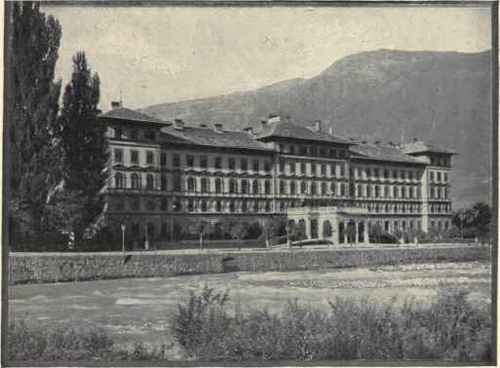
The Hotel Meranerhof, Meran.
The occupants of these chateaux and villas are representative of many lands. The author's home, for example, was built by a Russian, who called it the Villa Baltica; its second owner was a Brazilian, who named it after a town near Rio Janeiro; while over the garden of its third and latest possessor float the Stars and Stripes. One of his neighbors was for twenty years a tea merchant in Yokohama. Another is the former minister of Germany to Mexico. Not far away, in a delightful situation, stands the Villa Colorado, built and occupied by two American ladies from Denver; while in another charmingly retired home has lived for many years a lady born in Boston.
These residents are not invalids. Although in perfect health, they choose to live in this enchanting spot, chiefly because of its warm sun, magnificent scenery, and bracing air. Some have retired to this vine-girt valley because they have grown weary of the whirl and strife of the great, money-seeking world, and wish for quiet and repose; others, because they here enjoy a freedom from the bondage of "Society," whereas at home a round of social functions would inevitably fetter them with gilded chains; and others still there are, who crave an opportunity to live thus face to face with Nature in some of her most fascinating aspects, and amid such inspiring surroundings to stimulate their minds with what the wittiest and wisest of mankind have written, and in the laboratory of intellectual research slowly to distill the essence of their thought.
Continue to:


My Books

