


South Tyrol. Part 3
Description
This section is from the book "South Tyrol - John L. Stoddard's Lectures", by John L. Stoddard. Also available from Amazon: John L. Stoddard's Lectures 13 Volume Set.
South Tyrol. Part 3
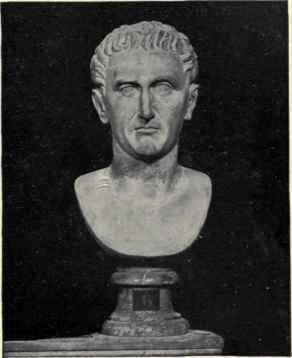
Drusus, The Conqueror Of The Tyrol.
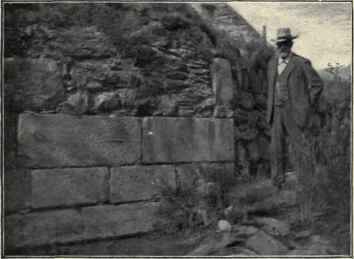
Foundation Of The Old Roman Bridge.
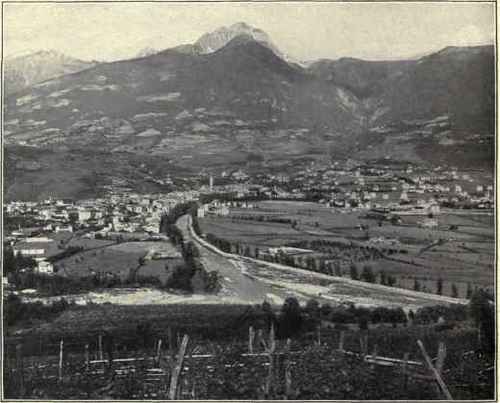
Meran, Obermais, And Mt. Ifinger.
In the days of the Caesars this settlement bore the musical name of Maia, which now unfortunately has assumed the less euphonious form of Mais, bestowed upon the suburbs Obermais and Unter-mais. Why the name Maia was originally given is not definitely known; but it may well have been connected with the Roman goddess, Maia, who was associated with the month of blossoms, and who might naturally be thought to have endowed this Alpine pocket of perennial sunshine with an exceptional wealth of floral beauty and fertility. In the great downfall of imperial Rome this military station and its settlement were drawn into that dreadful gulf of ruin and obscurity, as boats are sucked into the vortex of the sinking ship. Indeed, so utterly do they vanish for a time, that many have supposed them to have been destroyed by some tremendous overflow of the treacherous stream that issues from the ominous Mount Ifinger. But, although serious devastation has at times been caused thus, it is more probable that Maia was temporarily trampled out of sight by the wild hordes which, as the empire tottered to its fall, rushed through this valley from the north, to overrun the treasure-house of art and luxury embraced within the shores of Italy. Then followed a long interval of semi-barbarism, the history of which is lost in gloom, relieved occasionally by a lurid flash, caused by some sanguinary struggle or deed of individual daring. At last, however, the importance of this meeting-point of three great valleys, uniting Austria, Italy, and Switzerland, was again perceived, and the old Roman station, so long "Left by the stream whose waves are years," once more emerged from its obscurity under the warlike name of "Castrum Majense".
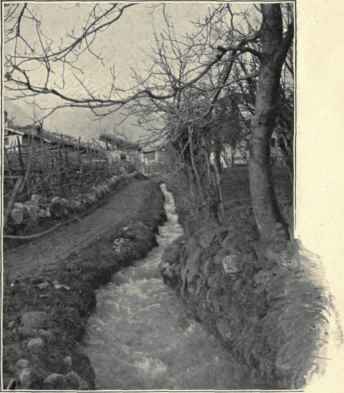
A Rivulet In Obermais.
It is a curious fact that we are indebted for the earliest documentary proofs and descriptions of this fortified, mediaeval town, not to a warrior, but a saint; and still more singularly, to one whose name is commonly associated merely with sentiments of love, - Saint Valentine. Little I thought when, as a child, I sent out and received on the fourteenth of February poetical effusions inscribed on cards adorned with two gilt hearts transfixed with Cupid's arrow, that I should ever live in a place historically connected with Saint Valentine. Perhaps I should, however, immediately distinguish which St. Valentine; for in the history of the Church two holy men have borne this name. The first was put to death at Rome about the year 270 a.d., while the second died here at Meran, two centuries later, almost contemporaneously with the downfall of the imperial city. It is the latter only who concerns us; since he it was, who, in the early part of the fifth century, came to the Tyrol and preached the gospel to its pagan population.
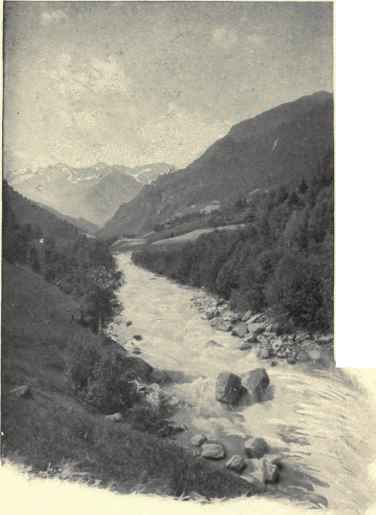
A Bit Of The Passeier Thal.

ST. valentine's church.
According to a mediaeval writer, this Christian apostle built, in his old age, at a little distance from Meran, and "far from the tumult of mankind," a chapel, where he passed his closing years, and finally died, bequeathing to posterity the benediction of his saintly life. This last abode and burial-place of the Tyrolese missionary has been from time immemorial identified with the little Church of St. Valentine, hidden away upon the southern slope of Obermais, in a romantic corner of the Meran valley. Hence it has been for fourteen hundred years a place of pilgrimage, and is believed by some authorities to be the oldest pilgrim-shrine in Germany. Though its exterior is plain, the modest sanctuary has, within, two paintings of exceptional beauty. Moreover, its situation is idyllic. Sheltered from winds and storms by the encircling hills, its venerable walls bask in the mellow sunshine as an old man warms his limbs before the fire; and in the spring, its time-worn spire seems rejuvenated, as it looks southward over miles of blossoming orchards and luxuriant vineyards toward the gate of Italy. About the middle of the eighth century this shrine lost much of its importance through the removal of St. Valentine's body to Passau on the Danube, where it now reposes; and there, in 1120, was found in his coffin a memorial tablet which had been placed there nearly seven hundred years before, at his first burial at Maia, and which contained clear references to his life and labor here. In fact, so prominent is the part played by this holy man in Meran's early history, that the existence of any other saint of the name of Valentine is practically unknown and almost resented in the Tyrol.
Continue to:


My Books

