


South Tyrol. Part 2
Description
This section is from the book "South Tyrol - John L. Stoddard's Lectures", by John L. Stoddard. Also available from Amazon: John L. Stoddard's Lectures 13 Volume Set.
South Tyrol. Part 2
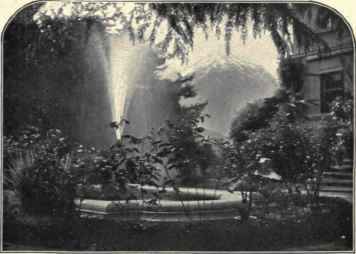
In The Author's Garden.
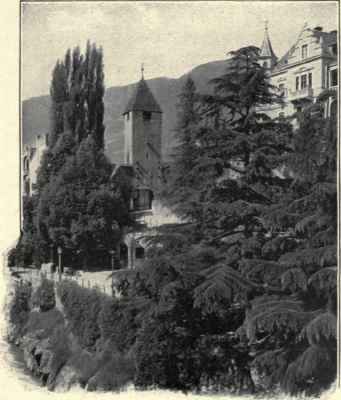
Sunshine And Shadow In Meran.
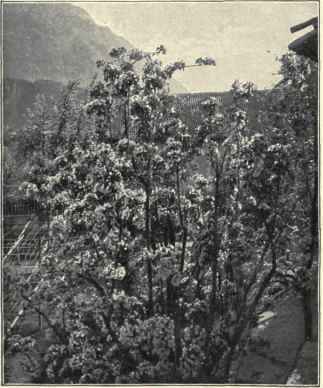
Blossom1ng Time.
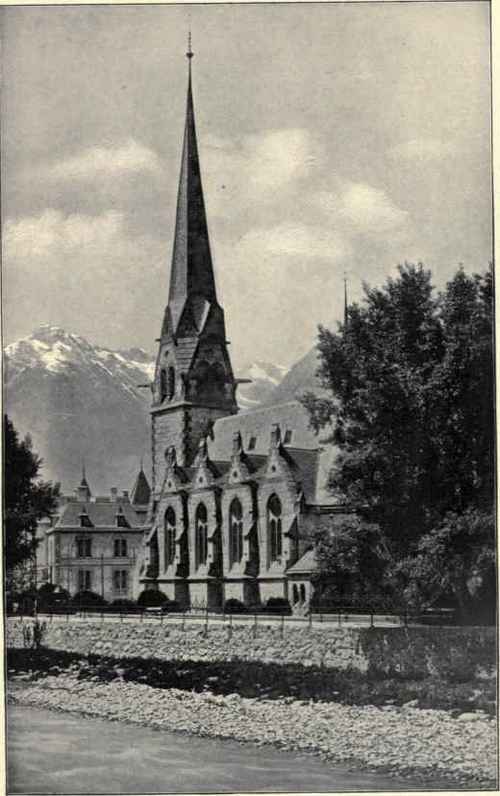
The German Protestant Church, Meran.
"Thou hast indeed a magic spell Alike for every season's span; The God of light hath dowered thee well, Tyrol's sweet paradise, Meran!"
Moreover, with its charms of scenery and sunshine, patent to all observers, there is blended, for the satisfaction of the student, the fascination of antiquity. At every step we tread upon historic ground. Thus, at the entrance to the Vintschgau valley, at a little distance from Meran, is a plateau, distinctly visible from Obermais, known as the Roman Terrace. There, in the second century after Christ, stood a temple to Diana, a fine memorial of which exists in the so-called "Ara Dianæ," discovered there in 1824, and now preserved in the Museum at Innsbruck. This "altar" was undoubtedly the pedestal for a statue of the goddess, as the niche upon its summit plainly indicates, and is especially interesting from the information furnished by its inscription. For on its front are sculptured words which the historian Mommsen thus translates:
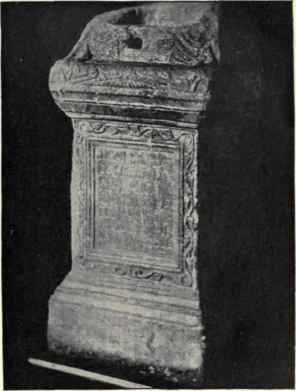
The "Ara DianÆ".
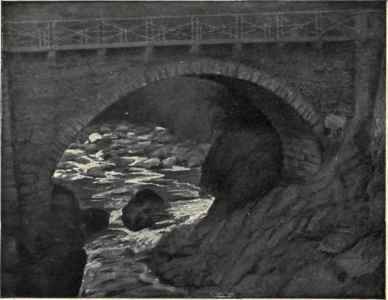
The "Toll" Bridge On The Roman Terrace.
"In honor of the temple of the most holy Aetetus, a freedman of the imperial household, and the revenue collector of the Mais Station, dedicated this altar and statue on the Diana, Ides of August, in the Consulship of Præsens".
This mention of a well-known consul gives indubitable proof that the shrine and statue were consecrated here on the thirteenth of August, 180 a.d. Moreover, the allusion to the revenue of the Mais Station confirms the belief, long held by scholars, that probably in Obermais itself, at least in its immediate vicinity, stood formerly the "Statio Majensis," - an imperial Customs Station at the Roman settlement called Maia. The collector's office was probably located, not in the settlement itself, but near the temple of Diana, on the Roman Terrace; for the entrance to the Vintschgau valley is still called the "Toll," - a name apparently derived from the Latin "Telonium," or "Custom House".
It was in the fifteenth year before the birth of Christ that Tiberius and Drusus, the step-sons of the Emperor Augustus, subdued the warlike tribes inhabiting the Tyrol, and brought their country under the dominion of the Caesars.
As soon as possible after this event a military road was made through the subjugated region, in conformity with Roman usage, in order to connect Rome's widely scattered legionary camps, and to establish an easy means of communication between the heart of the empire and the outlying provinces.
This road was the Via Claudia Augusta, which led directly northward from Verona, turned sharply to the left at Botzen, and thence passed through Meran and the Vintschgau valley on to Augsburg, and was the first great highway that united Italy and Germany.
Traces of this may even now be seen, within an hour's walk of Obermais, not only in some sections of the ancient pavement, but in the square-cut, massive blocks which once formed part of the old Roman bridge that spanned the river Etsch at a point somewhat lower than the present crossing. Along this famous thoroughfare, therefore, marched for at least four hundred years the legions of imperial Rome; and the well-situated, easily-defended spot, now designated by the general name of Meran, was for the passing troops a favorite halting-place. Here also were extensive storehouses for grain and war materials intended for the nourishment and equipment of the transport trains, which moved continually to and fro between the northern provinces and Rome. As time went on, and life and property in this region became more secure, these noble slopes of verdure and of snow attracted residents, until a considerable Roman town spread over the territory adjoining the Station, which seems to have had substantial fortifications and a permanent garrison. Proofs of this fact occasionally come to light, even at the present time, particularly in Obermais, where, at a depth of four or five feet, there have been unearthed many Roman coins, wine-jars, handmills, household implements, and personal decorations, as well as gravestones bearing in the Latin tongue pathetic farewells to the loved and lost. One cannot, therefore, doubt that many of the villas and châteaux which now adorn the slopes of Obermais stand upon sites once occupied by Roman residences.
Continue to:


My Books

