


South Tyrol. Part 5
Description
This section is from the book "South Tyrol - John L. Stoddard's Lectures", by John L. Stoddard. Also available from Amazon: John L. Stoddard's Lectures 13 Volume Set.
South Tyrol. Part 5
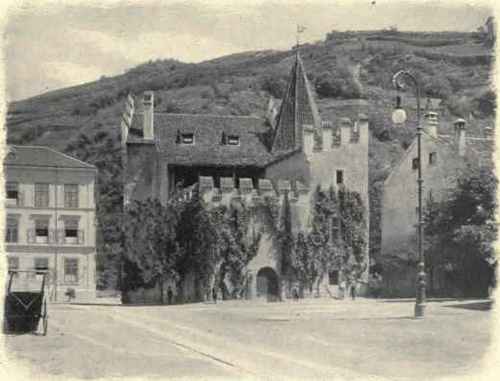
The Prince's Castle, Meran.

The Bedroom.
He knew both French and Latin, admired Chaucer and other early English bards, and had himself composed such excellent verses that he was called the "Poet King." At the age of thirty he married the beautiful Lady Jane Beaufort, whom in his love and admiration he called his "milk-white dove".
It was a daughter of this gifted king and lovely queen, - the princess Eleanor, - who in September, 1448, became betrothed to the Archduke Sigmund, lord of the Tyrōl; and early in the following year she came to live here as his bride. One naturally wonders how this marriage came about between a princess of a tiny, turbulent kingdom of the distant north, and the ruler of this principality on the edge of Italy. It is, however, easily explained. Margaret, the eldest daughter of James I., had married, in 1435, the Dauphin of France, afterward Louis XI. Accordingly, after the murder of her father and the death of her mother, Eleanor was naturally sent for protection to her sister at the French Court. Misfortune seemed, however, to pursue her; for, on arriving in France, Eleanor found her sister dead. Nevertheless Charles VII. received her kindly, and wished at first that she should replace Margaret as the Dauphin's wife. But as it was impossible to obtain the Pope's consent to such a union, the king arranged the match between the princess and the Archduke S i g-mund;and an extant letter from James II. of Scotland thanks Charles VII. for his outlay connected with this matrimonial alliance, to which, as Eleanor's brother, he gives his hearty consent. Although she had come so near being Queen of France, Eleanor seems to have been contented with her humbler lot, and the young couple were happy and well mated. The bride inherited her father's taste for literature, and was herself a clever writer, translating into German from the French a novel, which she dedicated to her husband. The archduke, too, possessed remarkable artistic tastes, and personally was a handsome man, with so much strength and agility that he could vanquish in the sport of wrestling the most athletic men of the Tyrol. After his marriage he began at once the building of this little castle, which we may therefore look upon as a wedding present to his bride.

In The Audience Room Of The Castle.
We can imagine with what pride and pleasure the newly married pair watched the construction of their nest. No doubt the woman's taste was exercised in much of its design and decoration; and possibly she may have suggested the conical red tower which, set so jauntily on one side of the tiled roof, relieves the heaviness of the sombre walls. Within are several old-time portraits and armorial bearings, among which are conspicuous the royal arms of Scotland. Quaint tables, wardrobes, chests, and chairs, and in particular a Gothic bedstead, quite elaborately carved, recall to us the life of those old times. Especially conspicuous is a porcelain stove of green tiles, said to have been made for Sigmund as a work of art then rarely seen. In fact, under the patronage of this ruler, art reached its highest point in the Tyrol. Some of the noblest Gothic churches in the land were built or finished by his order, and many castles and other prominent structures, such as "Sigmundskron," near Botzen, still perpetuate his name.
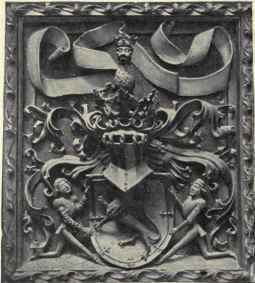
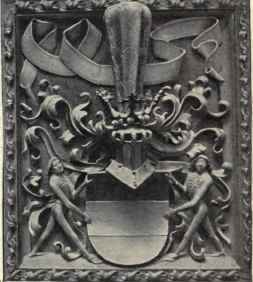
The Arms Of Scotland And Hapsburg In The Castle.

King Arthur Of England, One Of The Statues Surrounding Maximilian's Tomb.
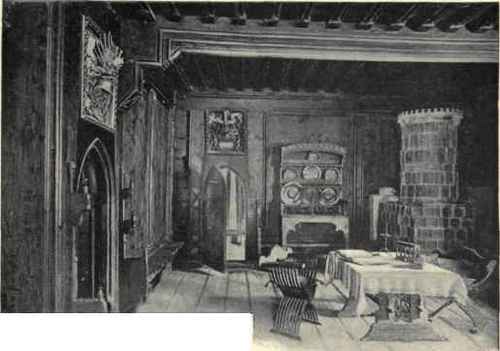
A Corner Of The Castle.
Subsequent to the reign of Sigmund and Eleanor there came at intervals other royal personages to this tiny burg, the most illustrious of whom was the Emperor Maximilian I., whose tomb in Innsbruck - a masterpiece in bronze, surrounded by magnificent statues of the same material - is one of the most remarkable sights in Austria. But after the removal of the capital from Meran to Innsbruck, this castle became more and more neglected, until it narrowly escaped destruction, in 1876, when its site was coveted for the erection of a schoolhouse. Through the exertions of some lovers of antiquity, this danger was averted; and, thanks to the generosity of hundreds of contributors, the princely residence has been restored to practically the same condition in which it stood at the time of its founder, four hundred and fifty years ago. However it may be with other visitors who stand among the vineyards of the Küchelberg, and look down on this small but proud memorial of former days, when I behold it, all other personalities connected with its history fade away, and I think only of the handsome Sigmund and his Scottish bride who, long before Columbus sailed for the New World, built here their home of youthful happiness and love. Nor can I doubt that from its oriel window they often watched the rays of the declining sun sparkle upon the snowcapped summits of these same unchanging mountains, which, as I write these words, I too behold still glittering in their immemorial splendor.
Continue to:


My Books

