


The Dolomites. Part 12
Description
This section is from the book "The Dolomites - John L. Stoddard's Lectures", by John L. Stoddard. Also available from Amazon: John L. Stoddard's Lectures 13 Volume Set.
The Dolomites. Part 12
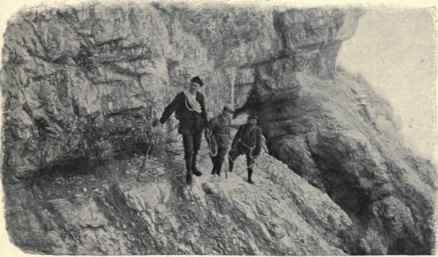
On Monte Cristallo.
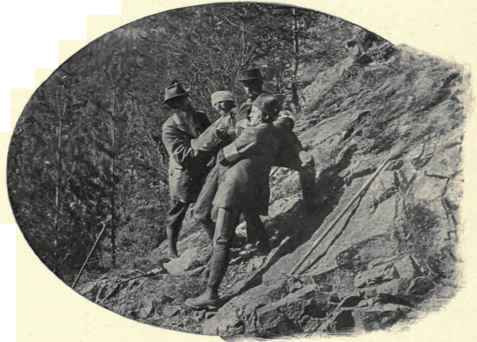
One More Unfortunate.
Thus, from the inn at Schluderbach the place was pointed out to me, on the side of Monte Cristallo, where, on the twentieth of August, 1888, the most renowned of all the Dolomite guides, Michael Innerkofler, lost his life. For seventeen years he had been traversing these peaks and ledges with the sure-footedness and courage of the chamois. His skill and strength, combined with an innate genius for surmounting obstacles, had made him easily the chief of cragsmen in this part of the Tyrol. Yet even he, in making the descent of Monte Cristallo - a mountain which, though ten thousand five hundred feet in height, is not considered specially hard or hazardous, - met with a fatal accident. He was accompanying two alpestrians over that portion of the mountain covered by a glacier, when an ice bridge suddenly gave way beneath the foremost of the party, who naturally fell directly into the crevasse, dragging his comrades after him, since all were bound together by a rope. The guide, who was the last of the trio, had barely time to brace himself for the tremendous strain, but even his herculean strength proved unavailing. The rope, drawn taut by the two falling men, cut through the flesh of Innerkofler's arm until it reached the bone, and finally pulled him also into the abyss. Another party, which had seen the accident from a distance, hurried to the rescue, and succeeded in bringing up the bodies from their icy sepulcher. The tourists, whose fall had been retarded by the efforts of the guide, were practically uninjured, save for a few severe contusions and a nervous shock; but Innerkofler, when at last wrenched downward from the spot which he had struggled desperately to retain, had struck his head with such tremendous violence against the chasm's icy wall as to be killed outright.

A Fearful Ascent.
Among the most extraordinary of the Dolomitic peaks, in form as well as color, is a remarkable triad known as the "Drei Zinnen," or " Three Pinnacles." Of these the smallest, which is practically perpendicular and more than nine thousand feet in height, is the most difficult and perilous mountain to ascend in the whole region of the Dolomites. Indeed, I have been assured by more than one expert that the formerly universally dreaded Matterhorn is far less formidable than this. Moreover, the ill-fated Innerkofier, who was one of the first to overeome the difficulties of its fearful cliffs, gave his opinion of it in the following words: "Schlechter als die kleinste Zinne kann ein Berg nimmer sein. Die ist ein Teufel." At certain points in climbing it one is obliged to "inch" across the perpendicular wall from one side to the other, and not infrequently even to lift one's self over a treacherous projection. Meantime, for any but the strongest heads, the view below is simply horrible, if one by chance gives even the briefest glance to the rough rocks piled up against the mountain's base, so far beneath him, yet so swiftly reached. On these an instantaneous death with mutilation would be the consequence of the least slip, unless, indeed, the guide had found a solid crag, around which he could wind the rope so stoutly that the man who fell would be at least suspended in mid-air until he could regain his clutch by finger tips or toes upon the smooth, sheer surface of the precipice.
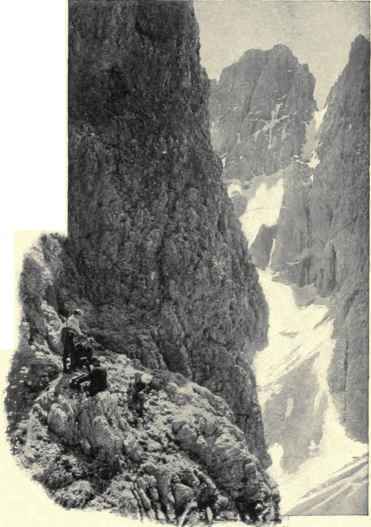
A Shelf On Which To Rest.
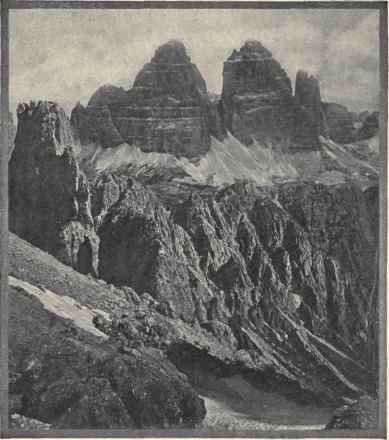
The "Drei Zinnen".
Incredible as it may seem, it is a fact that women now sometimes ascend the hardest and most perilous of these pinnacles. Dr. Marc-zell, for example, told me that he had recently scaled the famous "Kleinste Zinne" in the company of two English ladies and their guides. Needless to say, such women wear no skirts on these excursions. Attired in blouses, knickerbockers, and stout shoes, they have the necessary freedom of their limbs for making any effort that may be required, either in creeping up the "chimneys" of these crumbling towers, or crawling up a vertical cliff with but the tips of the toes inserted in a crevice and the bent fingers hooked upon a narrow wrinkle in the rock above. Photographs of such climbers, taken from a neighboring place of safety, alone enabled me to understand, or even to believe, that such blood-curdling ascents were possible.
Continue to:


My Books

