


The Dolomites. Part 14
Description
This section is from the book "The Dolomites - John L. Stoddard's Lectures", by John L. Stoddard. Also available from Amazon: John L. Stoddard's Lectures 13 Volume Set.
The Dolomites. Part 14
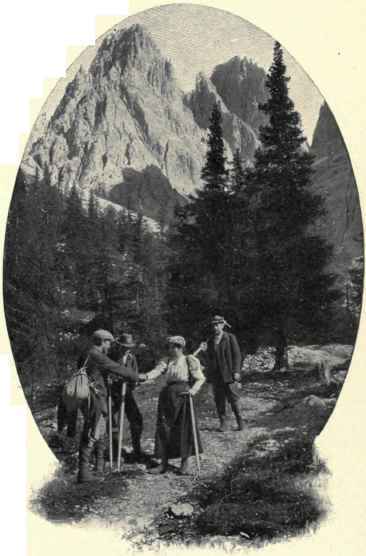
Welcome To GRÖDner Thal!.
The most extraordinary feature of this portion of the route is a stupendous field of boulders, extending from the left bank of the stream along the flank of an adjoining mountain. That these are part of a moraine heaped up here by an icy plowshare of the prehistoric past cannot be doubted, nor do I recollect, even in Norway, a more remarkable display of glacial debris. These boulders cover a larger area than those of the Stony Desert already mentioned, near Lake Garda, but are less grewsome, because the most of these archaic fragments have been softened by a mantle of gray lichens, or are shaded by enormous pines.
Soon after leaving this expanse of shredded crags, we welcomed with delight the first appearance of the noble mountain which crowns the head of the valley and is the undisputed monarch of the Grödner Thal - the Langkofel. So much attention has been given already in this volume to the formation and character of these limestone reefs that space is lacking for minute consideration of this viceroy of the western Dolomites. Suffice it, therefore, to remark here that it ranks as one of the most difficult and dangerous to ascend in the entire catalogue of Dolomitic peaks, and many of the illustrations given on the previous pages of the perils of such climbing represent the crags and precipices of the Langkofel. In fact, in such esteem do cragsmen hold Paul Grohman, who first scaled its cliffs and gained its summit, that they have erected to his memory a massive monument near St. Ulrich, and also named for him the most appalling of this monster's cruel teeth - the Grohman Spitze. For the huge body of the Langkofel has been cleft and furrowed by the elements into a series of sharp, jagged fangs of very nearly the same height - about ten thousand feet - the mastery of which can be achieved by experts only.
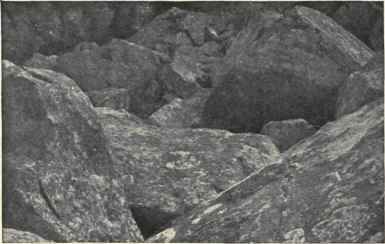
Glacial Boulders In The GRÖDner Thal.
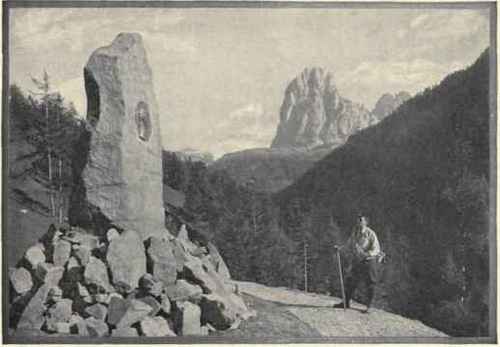
Monument To The Conqueror Of The Langkofel, Near St. Ulrich.
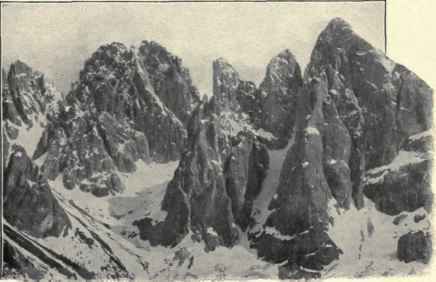
The Teeth Of The Langkofel.
But if in most respects this mountain bears a close resemblance to its fellows, the singular people living in its neighborhood merit special study. We made our first acquaintance with them when we reached the principal village of the Grödner Thal - St. Ulrich. I never shall forget the pleasure and surprise I experienced on arriving here. It had been hot and close at Waidbruck; but a three hours' drive had brought us to an elevation of four thousand feet, where the cool air was as delicious as the scenery was imposing. The town itself was also so attractive in appearance that I could hardly realize that it was a mountain settlement of thirteen hundred souls, who are for several months in winter practically isolated from the outer world. The valley, which broadens at this point into green, fertile meadows, presents a charming picture, its large stone houses being spacious and symmetrical, with an unusual number of windows, bright with flowers. Especially impressive is its parish church, whose reddish bulbous dome is visible for miles in the clear atmosphere. How is it possible, I asked myself, that such a small community, in a retired corner of the world, can have such handsome structures ? And if I asked this question at a distance, still more was I desirous of a solution of the mystery when I entered the church and saw its gorgeous decoration. For its elaborate frescos, paintings, and wood-carvings are such as any sanctuary might be proud to claim; and I have never seen a statue of the Mater Dolorosa that so moved me as one, in wood, which stands within this building, the work of the sculptor, Moroder, a resident of St. Ulrich. Indeed, the effigies of Christ, the Virgin, and the Saints, which one sees here, are so superior to the average of such figures that they reveal the secret of St. Ulrich's beauty and prosperity. It is a town of sculptors, and art is their chief occupation. In other words, the climate being severe, and agriculture at this height being insufficient to support the population, these villagers, like the citizens of Cortina, have succeeded in creating here an industry whose products have gone out to every portion of the civil ized world. Like many another great success, it had a small beginning. Exactly two hundred years ago, that is, in 1703, the pioneer in this art of wood-carving in St. Ulrich began to manufacture simple picture-frames. Others, who sought some lucrative occupation during the winter months, soon followed his example, and in the course of time the subjects chosen by them naturally multiplied. To picture-frames succeeded crucifixes; and these again were supplemented by Madonnas, Saints, all sorts of animals, and children's toys. Here the list practically ended, for the demand for these became so great that further invention has been needless. Thus is explained the large size of the houses; for they contain not only living rooms, but workshops, storage halls, and salesrooms. In making an examination of the ateliers, one passes from the sight of crude and tasteless objects to products of real merit in the realm of art; that is, from jointed dolls, rough toys, and "Noah's Ark" animals - made by hundreds daily, and actually sold by weight - to classic figures needing months of labor to create them. In the lower ranks each worker, as a rule, carves only one or two kinds of subjects. A maker of donkeys, for example, continues to carve donkeys all his life, with possibly an occasional détour into the sphere of cats; and such a man will teach his children to carve cats and donkeys until the family becomes noted for its excellence in portraying asinine or feline eccentricities. It seems incredible that such toys can be disposed of in enormous quantities; but in the spacious houses of St. Ulrich I saw piled up in various compartments, like heaps of peanuts or potatoes in a bin, hundreds of thousands of small soldiers, horses, sheep, elephants, donkeys, and even separate parts of dolls, all waiting to be painted before exportation. Some of the jointed figures are less than an inch in length, and are not only the tiniest dolls in the world, but are the specialty of one family. Whoever can remember the " Noah's Ark " of his childhood, should have a friendly feeling in his heart for fair St. Ulrich in the Grödner Thal, for here those interesting relics of the deluge had their origin. St. Ulrich is, thus, not alone the capital of wood-carving; it is the chief metropolis of toydom.
Continue to:


My Books

