


Sweden. Part 5
Description
This section is from the book "Sweden - John L. Stoddard's Lectures", by John L. Stoddard. Also available from Amazon: John L. Stoddard's Lectures 13 Volume Set.
Sweden. Part 5
The chapel where he lies is draped with faded battle-flags which he so often led to victory, together with a multitude of tattered trophies taken from the enemy. To right and left of the sarcophagus rise pyramids of drums and trumpets, which many a time have given the signal for a desperate charge, or sounded joyously to celebrate a victory. Their muffled tones were last heard when they heralded the hero to the grave. Now they are mute beside his tomb. The drum-heads, once so resonant, no longer vibrate to the rhythmic beat; the trumpets' throats are choked with dust. Some striking parallels between Gustavus II. and Charles XII. suggest themselves to one who stands by their adjacent graves. Both became sovereigns when in their teens. Both fought against Russians, Danes and Poles, and were victorious. Both compelled Poland to relinquish territory to Sweden. Both, also, lost their lives on foreign battle-fields (Gustavus Adolphus falling at Lutzen, in, as a leader of the Protestants in the Thirty Years' War), and both now lie beneath the same roof in the city where they reigned.
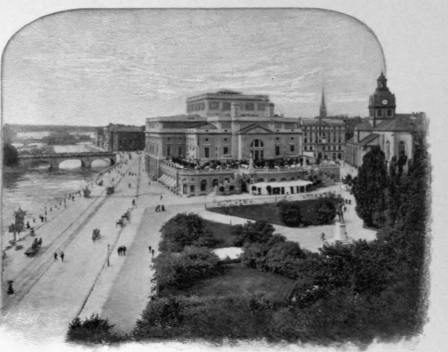
The Royal Opera House And Terrace.

Statue Of Charles XII.

BringlNg Home The Body Of Charles XII.
![The Riddarholm's Church And The Statue Of Gustavus]Vasa](images/The-Riddarholm-s-Church-And-The-Statue-Of-Gustavus-Vasa.png)
The Riddarholm's Church And The Statue Of Gustavus]Vasa.

The Riddarholm's Church From The Water.
There is something touching and inspiring in the fact that, go where we will, north, south, east, or west, mid Arctic pines or under tropic palms; beside the Jumna, at the grave of Akbar, or by the sacred Nile, at Thebes; among the cromlechs of the Celts, or under the huge cryptomerias of Shogun sepulchres, we find no land too poor to have its heroes, and none with skies so dark that they have totally eclipsed the memory of a brighter dawn. In many cases death has given to those demi-gods more glory than they knew in life. The softening veil that Time, with kind indulgence, draws between them and posterity conceals their human imperfections while magnifying their heroic qualities; and even Mediocrity, which while they lived would only envy and malign them, now renders homage to their memory, because there is no possibility of being overshadowed and belittled by too close a contrast. "Whom the gods love die young," the ancients said. Gustavus Adolphus died at thirty-eight, as Charles XII. and Lord Byron did at thirty-six, Raphael and Burns at thirty-seven, and Alexander the Great at thirty-three. Fortunate those who die at any age, while still secure of love and admiration ! For it is life, not death, that can estrange.

The Statue Of Bernadotte.
The most elaborate tomb in the Riddarholm's church is that of " Charles XIV.," which was the title assumed by Marshal Bernadotte, the founder of the present dynasty. In 1810, when Napoleon was at the height of his glory, his marshals were among the most conspicuous personages in Europe. Accordingly, in view of the fact that the King of Sweden was at that time a feeble, childless old man, it is not strange that the Swedish Parliament, in considering who should succeed him, decided to elect, as heir apparent to the throne, one of the Napoleonic heroes. The choice fell upon Berna-dotte, who was forthwith adopted by the aged monarch as Crown Prince, and in that capacity soon turned his arms against his former chief and sovereign, and his native land. For, in 1812, after Napoleon's retreat from Moscow, Bernadotte joined the Allies in the great coalition of nations which ultimately overthrew the Emperor, his military talents and intimate knowledge of Napoleon's methods contributing much to the result. Posterity holds divided views as to this conduct of a former marshal of France; but there can be no doubt that Bernadotte's descendants, as sovereigns of Sweden and Norway, have been universally respected and beloved.
The present highly accomplished king of the United Coun- tries, Oscar II., is the grandson of Bernadotte, his principal residence being the enormous edifice at Stockholm known as the Royal Palace. The exterior of this building has little to attract the tourist, save its commanding situation and immense proportions; but its interior well repays a visit. The state apartments are sumptuous in decoration and majestic in dimensions, the Banquet Hall especially being very imposing. This superb room, which must present a magnificent appearance when lighted for a festival, is, on account of its snow-white, glittering walls, entitled the "White Sea." I was, however, particularly interested in the private apartments of the King and Queen, as well as in those of the Crown Prince and Princess. These are usually open to visitors in the absence of the family, and are characterized by an attractive air of comfortable domesticity; their furnishings, though elegant and tasteful, being neither too rich nor formal to be freely used and thoroughly enjoyed. Thus, on the floor of the sitting-room of the Crown Princess I saw the playthings of her children; and there, as elsewhere in the palace, are proofs in clay and marble of that lady's talent as a sculptress. The study table of the Crown Prince, which he had left but a few hours before, bore many portraits of his family, and very pleasant were the stories which my attendant told me of the happy life, and cordial, unaffected intercourse of the members of the royal household. Beautiful paintings also decorate the walls of these immense but well-filled, hospitable-looking rooms, and countless seem the handsome ornaments which have from time to time been given to the king by royal relatives and friends.
Continue to:


My Books

