


Sweden. Part 6
Description
This section is from the book "Sweden - John L. Stoddard's Lectures", by John L. Stoddard. Also available from Amazon: John L. Stoddard's Lectures 13 Volume Set.
Sweden. Part 6

The Council Hall, Royal Palace.

The Queen's Drawing-Room.

The Sitting-Room Of The Crown Princess.
The Study Of The Crown Prince.
One portion of this edifice is devoted to an Armory and Museum of Costumes, and contains relics of exceptional interest. Thus, amid many panoplies of war for men and horses, surrounded by a multitude of guns, spears, swords and helmets, are several personal mementos of great Swedish warriors, such as the armor of Gustavus Vasa, worn in his conflicts with the Danes; the sword and pistols carried by Gustavus Adolphus in the battle where he lost his life; and even the blood-stained shirt which, in that hour of death and victory, covered as brave a heart as ever beat. Moreover, among the wooden figures, made to exhibit the styles of ancient equine decorations, we see (preserved by taxidermic skill) the very horse on which the hero rode at Liitzen. Here, also, are the coronation robes and gala dresses worn by the sovereigns and dignitaries of the Swedish Court on many of the notable occasions of the last three centuries. Linger before them, for a little, thoughtfully. They merit more than a mere hasty glance. Each of them once commanded admiration, if not envy; each was the cynosure of many eyes; and beneath each has throbbed a heart, it may be jubilant with joy, or, notwithstanding all this outward splendor, heavy with corroding care. This costume may have decked a breast whose thoughts and aspirations were as pure as Arctic snows; that may have hidden one in which were nurtured infamous desires and the basest crimes. Through one of them the shaft of Death has found its way. It is the suit of King Gustavus III., worn by him at the masked ball where he was assassinated.

Armory And Costume Hall.
Here is a watch without a name, or other indication of its history. To whom did it belong? Through what eventful Here also stands the cradle of Charles XII.; and there, but a few paces distant, lies his hat, pierced by the fatal bullet at the siege of Fredrikshald, - pathetic emblems of the opening and closing of his brief existence, - the alpha and omega of his brilliant life.
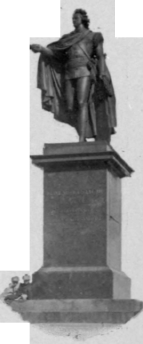
Statue Of Gustavus III.


New Residence Quarter, Stockholm.
Stockholm, in 1800, had but seventy-five thousand inhabitants. To-day its population numbers more than two hundred and fifty thousand. After an absence of only ten years, I found that great material improvements also had been made in the northern portion of the city, fine shops, elegant residences, and spacious boulevards having been added to its former attractions.
In walking through the Swedish capital, the traveler is at first surprised by the peculiarities of the language, as displayed on street signs or on passing vehicles. There is a similarity in many of the words to their English and German equivalents; but the way in which they are spelt suggests entirely different meanings. Thus, when I first read on an express wagon the sign, "Godsexpedition," I felt for a moment like the Italian priest who, on perceiving in a hat the name of its London maker, "Christie," protested to the shopkeeper against the seeming blasphemy. But as I reflected that "Gods" in this instance undoubtedly meant " goods," the misunderstanding became amusing. So also, when, a little later, I saw on a large building the word, " Godsmagazin," I knew the name did not refer to any divinely inspired publication, but merely indicated a storage warehouse. Over a door, in every Swedish railway station, is inscribed the somewhat ambiguous legend, "am Rum "; but even the most devoted member of the Women's Christian Temperance Union must pass beneath this if she would enter the " Ladies' Room "; and in a similar way when one is offered in a hotel " Bad Rum," or even " Dam Bad Rum," it must be understood that it is only a bath-room, or a ladies' bath-room, that is meant. "Buljong " looks startling on a bill of fare; but on remembering that "j " in Swedish is pronounced like " i," we recognize our old friend, " bouillon." No amount of reasoning, however, can prevent a man from experiencing a momentary shock of apprehension when he reads upon the window of a barbershop "Rak Salon "; nor is a lady less alarmed when she perceives above the door of a coiffeur's establishment the notice, "Dam Friseur."
Continue to:


My Books

