


Bees - How They Live and Work For You. Part 4
Description
This section is from the book "A Hobby That Pays - Bees - How They Live and Work For You", by G. B. Lewis. Also available from Amazon: A Hobby That Pays - Bees - How They Live and Work For You.
Bees - How They Live and Work For You. Part 4
You will see that a beginning in honey production is no strain on your time, even if you are a busy person. Many professional men and women, who are tied down in offices days without end, take up honey production. It gets them out of doors and nearly every one of us, without regard to education, delights in things which bring us closer to Nature, as bees do. The writer knows of no vocation one may take up which can, if you wish, take you profitably into so many avenues of study. However, the study may be inexpensive and not necessarily lead into the luxury type, but confined to profit making lines.
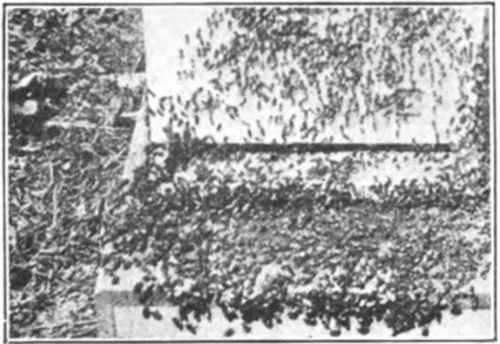
10. Bees Flying Actively
Will the bees sting you? So far as it is known there are no persons whom bees will not sting at times. There are folks who claim to be able to handle bees at any time and under all conditions without ever being stung. The writer has never found anyone able to demonstrate this. However, bees so seldom sting, if properly handled, that you wonder at the vast amount of handling they may be given without a sting, rather than the stings themselves.
Bees sting just as a cat scratches or a dog bites. It is their only means of protection to keep other animals from stealing their honey. However, man through his intelligence, has learned to handle bees as explained on page 8, so that in the end he is worried less by the few stings than other greater worries of life. Bees have been bred to gentleness, along with prolificness and industry. The Italian strain most generally used in this country, and offered in the Lewis catalog, is probably as gentle as any strain readily purchased in this country. By starting with gentle bees and by handling them gently, stinging becomes the least of worries.
There are very rare persons to whom the sting of almost any insect causes extreme swelling and pain. Such persons should never attempt to handle bees. Others to whom the sting may be a little painful or cause some discomfort at first, soon reach an immunity after which the sting of any insect becomes nothing to worry about. Your doctor will tell you this is true. Nothing is gained without some adversity.
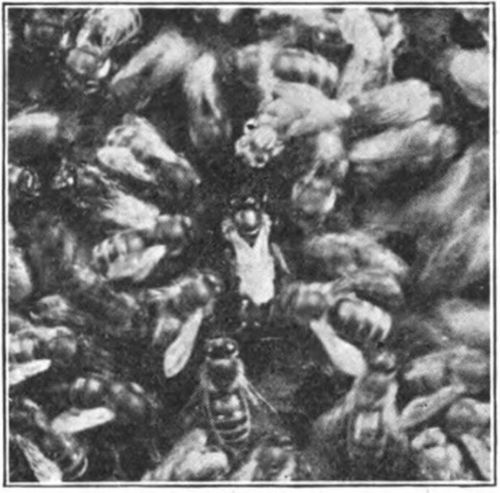
11. Bees about their Queen
The bee's sting is at the rear end of her body. (Drones or males have no sting). It is tiny and sharp enough to pass through the outer skin. It is almost too tiny to be painful in itself. The discomfort comes from the liquid poison which is said to be acid in nature. As quickly as possible after being stung push or scrape the sting out of the wound with the finger nail. A cold poultice may help reduce the swelling. The writer has dwelt on this at some length to explain it so those who have had no experience will understand. There is no use to dodge facts. We are just being truthful with you. After you have kept bees a while you will no doubt wonder why we gave it all this space. Naturally, however, when the novice thinks of bees, their ability to produce honey will become the first thought which enters the mind. All thoughts about bees become centered in the pleasure and profit they may bring one.
How much will they pay you? This question can only be answered when you decide in just what form you wish to be paid. If it is in honey only, as the practical person will ask, that is fairly answerable even in a booklet like this read in all parts of the country. However, there are many forms of pay from bees which should be included in your list of returns, such as outdoor activity, Nature study, the change of occupation from habitual pursuits and the genuine fun of it. Bees are fascinating-that's certain.
In a previous page it was stated that a return of 50 pounds of honey per colony per year, even the first year with right care, was a reasonable minimum to expect. This implies that you are keeping bees in any of the thousands of good localities in this country where honey plants abound and where the winters are not too cold and the summers too short. There are commercial producers, operating with help 500 colonies of bees, whose crop will exceed 100,-000 pounds of honey in good years. However, in this booklet we want to keep within the reasonable bounds which a beginner can expect. Nevertheless, we want to emphasize that your returns will be gauged as much by the correct application of good methods at the proper time as from any other one factor in honey production.
As to how long the bees will hold your interest, if one may judge by an acquaintance with hundreds of beekeepers, your interest will never end. It is not necessary to become a commercial producer to retain your interest in bees year after year. In fact some of the best students of bee culture, and by the way, the most successful producers, have been known to the writer as just owners of a few hives of bees. They did not have the time nor inclination to own many bees, although they had the means. However, the many avenues of fun and interesting learning that their contact with bees gave them were a never failing source of pleasure.
Not the least of the important considerations in beekeeping is that after you get the bees and initial equipment , there is scarcely any additional expense. Their continued success is largely a matter of your learning the simple rules of bee management. Thus you need have little or no additional expense from year to year, except as you choose to expand your operations or to replace equipment which in time may become somewhat obsolete or worn. The bees feed themselves.
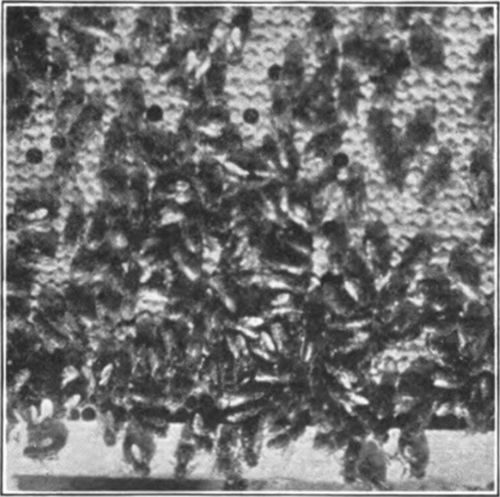
12. Bees on their Honey
How do bees use the hive? This is one of the most interesting features of beekeeping. Before man discovered a means of harnessing the bee activities for his own pleasure and profit, they were wild animals. They lived in hollow trees or in the clefts of rocks or even in the walls of buildings. Honey as a food, although valued from time immemorial, was then largely a matter of chance. If one found a bee tree and cut it down in winter, when the temperatures were so low the bees were inactive, honey was in the diet. However, this uncertainty taxed both man's impatience and ingenuity, so beehives were invented after centuries of secondhand acquaintance with bees and their product. With the invention of the movable comb hive, a half section of which is pictured below, man was not only enabled to study bees and use their energy more to his advantage, but to control their habits.
Continue to:


My Books

