


Bees - How They Live and Work For You. Part 3
Description
This section is from the book "A Hobby That Pays - Bees - How They Live and Work For You", by G. B. Lewis. Also available from Amazon: A Hobby That Pays - Bees - How They Live and Work For You.
Bees - How They Live and Work For You. Part 3
By following directions for their care they build up rapidly and go to work for you. It is advisable to have them reach you early in the season, preferably during fruit bloom or shortly thereafter. Only in localities where the season is long and honey plants are in bloom in quantity all summer, does it pay to buy packages for a start and have them arrive much later than June 1. It is most important to not only prepare the hive in advance of the arrival of the bees but to get your bee book in advance and learn their care from its pages.
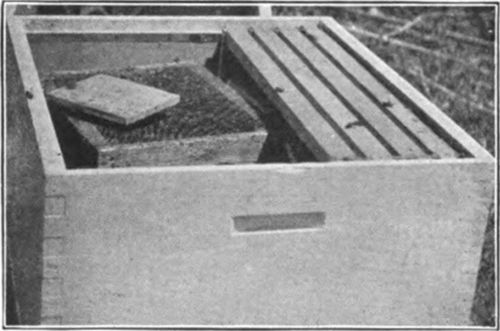
8. A Package of Bees
The cost of the bees cannot be given here as it varies from year to year. We do not recommend that you buy less than a 3-pound package and the usual price on them, F. O. B. shipping point, including queen, is around $3.50. By reading for a few minutes in your spare time you will learn how to handle them upon arrival, as this is simple. Good beekeepers are students. You will find that with your readiness to study and learn the whole field of honey production will become more interesting as you go along. You will get a thrill with the arrival of your first package of bees that comes only from delving into the mysteries of so interesting a subject as bees. Only study will enable you to get the most from them the first year.
How do you handle bees? Naturally this question is in your mind. However, bees are far easier to handle than the inexperienced believe. In your beginner's outfit is included a veil made of wire screen with ventilated cloth top and bottom. This is worn over the head and keeps the bees away from your face. Some prefer to wear special gloves with long sleeves attached, but these are usually discarded after the beginner handles bees a few times. Except for a smoker nothing else is required. Here are simple directions to follow which will be elaborated upon in your bee book.
In the picture below you see bees being handled. The combs are being examined to learn the progress the bees have made and to see how well they are storing honey. With each initial outfit include a bee smoker, which consists of a round metal barrel with a hinged top and closed bottom, with small bellows attached. In this smoker may be burned old pieces of cloth or almost anything that makes smoke. By working the bellows the smoke is directed through the nozzle so it may be sent into the hive entrance or over the top of the frames after the cover has been removed. It is seldom wise to attempt to handle bees at any time without smoke.
No one knows just why, but a few puffs of smoke in the entrance of the hive causes the bees to rush to their combs and gorge themselves with honey. Before removing the cover, blow a few puffs of smoke under the edge, after prying it up with the hive tool, as this quiets the bees. The cover may then be removed and with the aid of the hive tool, the frames are removed and can be examined. Handle the bees carefully just as you would any fragile object, as they are easily crushed. Mistreatment will cause them to sting, just as the use of too much smoke will do. That's all there is to it. You may be quite timid about handling them at first but will be surprised and delighted at how easy it is after a little experience. The hive should only be opened when the temperature is above 60° F., and preferably when the bees are flying freely. Frames on which the bees are clustered may be set down beside the hive until you are through, then set back.
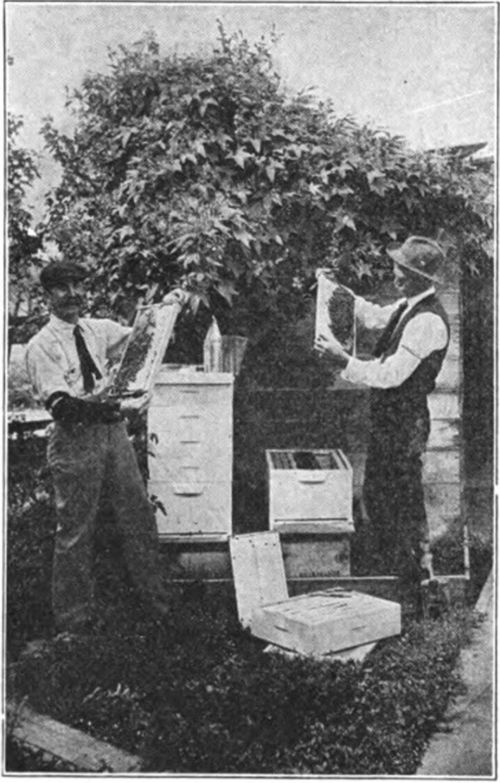
9. Making an Examination
How much training do you need? Beyond the knack of management, there is nothing more to learn than explained on page 7. By the knack of management, we mean learning what the progress of the colony is at different seasons of the year and the advantage the producer takes of this knowledge to get the most honey. In the early spring and summer all your effort is spent in assisting the bees to build up to the greatest strength to store the most honey. If you handle them so they do not swarm, you will get more honey. Increase should be made artificially instead of by natural swarms, as explained in "How To Make Increase." (See back inside cover). This fits the time to spend with the bees more largely when you have it to spare and prevents swarms issuing and escaping, which means the loss of the bees and a honey crop.
So far as necessary time is concerned, in starting with one hive of bees, you should not need to spend any more time with them than would amount to about two whole days in a year. You will no doubt spend more with them, because of the interest they will arouse. In most cases the novice does not let the bees alone enough, but disturbs them too often just to satisfy his own curiosity. After a season's experience with one or more hives as a start, you will get the "hang" of it, so you will probably spend little or no more time in handling ten hives than one.
You will see that if you become a beekeeper you also become a student of Nature. You learn some botany in studying your local flora. You learn some zoology in learning the life history of the bee and how you take advantage of this knowledge in your beekeeping operations. You take more interest in the effect of the weather on honey plants, their response to variations in temperatures and humidity, etc. In other words you may go just as deeply into this delightful hobby and its sidelines of study as you wish and have the time for. Usually the smattering of knowledge necessary to handle bees makes you a thorough student of Nature.
Continue to:


My Books

