


Bees - How They Live and Work For You. Part 2
Description
This section is from the book "A Hobby That Pays - Bees - How They Live and Work For You", by G. B. Lewis. Also available from Amazon: A Hobby That Pays - Bees - How They Live and Work For You.
Bees - How They Live and Work For You. Part 2
The writer has seen beehives ranged in rows on a sunny hillside in the desert and only investigation which showed fields of irrigated alfalfa within bee flight told the story of their successful existence. Perhaps the strangest place was on a boat tied up on a southern river, where the hives were closed up at night when the boat and the keeper's family wanted to move to a new location on the river the next day. It was never learned if this proved profitable. Thus it will be seen that the location of the apiary is largely up to the owner, with reasonable consideration to the rights of others. So far as the value of the locality for honey is concerned, that can readily be ascertained by questioning a few farmers or beekeepers, as to the honey plants available in your vicinity. You will find other honey producers interesting folk to talk with and that they are glad to tell you what they know.
How are bees kept? Their home should be a hive such as offered in the pages of the catalog sent you. While bees are at times kept in boxes, sections of tree trunks, etc., no one can expect the maximum return from their investment unless they are kept in modern equipment, accurately made up. This is because bees can only return maximum crops of honey when they are in equipment which permits their manipulation for the benefit of their owner and without harm to the bees. In modern hives there are removable frames in which the bees build their combs. These enable the beekeeper to examine the bees at will, in warm weather, and direct their work so it will profit him most. In most states the keeping of bees in other than movable frame hives is illegal. Modern honey production requires the control of swarming and this can only be accomplished in movable frame equipment. When bees swarm they divide their strength. Keeping this instinct dormant and the storing instinct dominant, is the first principle of successful beekeeping. Hence our recommendation is unbiased.
On this page is shown a diagram of the modern beehive. The bottom board is the floor and the cover the roof. The brood chamber is the living quarters in which the bees raise their young and in which they store honey to carry them through long cold winters. In the upper parts of the hive, called supers, the surplus honey is stored, which the owner can remove at will, as ready, during warm weather. Only in such types of equipment as Lewis Bee-ware, with the correct methods it allows, can the work of the bees be so directed as to store quantities of honey in the supers, beyond their own needs. Such equipment is usually purchased KD, in the flat. Complete and simple directions for setting up the equipment come with it. In this way you save setting up charges and learn the few parts of the hive and just what you are to work with to accomplish the best results.
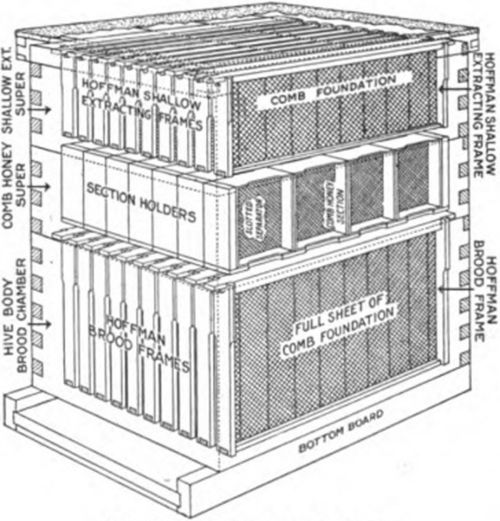
6. The Home of the Bees
As required later, additional supers may be secured so as to expand the storing space of the hive. All equipment if properly set up and cared for will last a lifetime, making a very low investment over a period of years. Additional hives may be secured as the producer wishes to expand his operations. After the initial purchase there is little to buy in the following years, except the little section honey boxes and bee comb foundation for them, to replace those you use in removing honey to use or sell.
What will it cost? This of course may vary from year to year due to changes in prices of equipment. However, the cost of the necessary equipment need not exceed around $10, including the bees, to make a start in a small way. In most localities in an average year 50 pounds of honey may be secured, which if sold at the extremely low price of 5c per pound, would yield a return on the investment of 25% the first year. It may appear to the novice that with such a return possible, he should by all means start with 25 or 50 hives of bees. This is not to be done as there are things you have to learn about handling a small number of hives successfully before you can safely undertake handling a larger number. It is just like any other work, you must learn to do it right first. Increase may be made later after you have mastered the easily learned rules of successful beekeeping explained in "How to Succeed With Bees," and other books listed in the Lewis Catalog.
Below on this page are listed the necessary items you need to make a beginning. They are named and will be easily found in the Lewis catalog by referring to the index. After looking over the catalog and descriptions of the various articles, others you may wish to have can, of course, also be purchased. An explanation of their use is given in the catalog and in all books on bees. Any Lewis dealer whose name is on your catalog will be glad to advise you or you may write us direct for further information.
BEGINNER'S LIST and COST
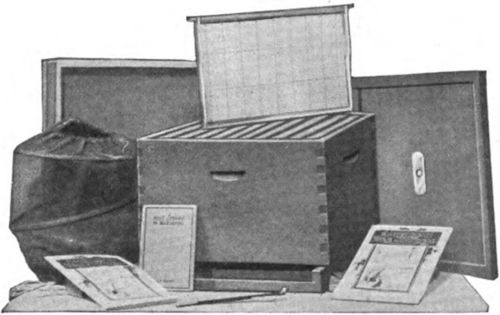
7. Some of the Equipment the Beginner Needs
1 Modified Dadant Hive, K. D.
1 3-lb. package of bees with queen
11 sheets of foundation, No. 351
1 Doctor Smoker
1 Excelsior Veil
1 10-in. Hive Tool
1 Book "First Lessons" and American Bee Journal
Where do you get the bees? These may be ordered from Lewis or Dadant direct and come by express from our breeders nearest you in the South. You pay the express charges upon arrival, which are small considering the distance they are shipped. A charge of about 75c for each three pound package would apply, for example, from Louisiana to Wisconsin. These bees are in a light wooden cage with wire screen sides, without combs, and the net weight of the bees is not less than three pounds or about 15,000 worker bees. A mated queen accompanies them and they are shipped to reach you on the date you specify as near as weather conditions and filling of orders in rotation permits. Feed accompanies the bees sufficient for the trip. When they are received they are released in the hive which you must have prepared for them in advance of their arrival according to instructions. Pictured below is shown a hive with cover removed and part of the frames out, allowing the cage to be set down into the hive and covered up for release. Be sure to order a copy of "How To Manage Package Bees" listed on the back cover of this booklet which tells just what to do.
Continue to:


My Books

