


Bees - How They Live and Work For You
Description
This section is from the book "A Hobby That Pays - Bees - How They Live and Work For You", by G. B. Lewis. Also available from Amazon: A Hobby That Pays - Bees - How They Live and Work For You.
Bees - How They Live and Work For You
THERE is romance, pleasure and profit in beekeeping. As you walk along the garden path and see a honeybee seeking diligently in your flowers, have you ever wondered just what it was all about? If you ever had a hankering to own a few hives of bees this little booklet will give you an idea of the pleasure and profit in beekeeping-a hobby that pays.
Bees are insects whose purpose in creation was evidently to fertilize or "set" the millions of nectar bearing flowers, assure their seeding and continuation. Bees are attracted to most flowers because the blossoms contain nectar or pollen or both. The nectar and pollen are both used as food for their babies and the nectar is in part modified into honey and stored in their combs. Thus man, whose intelligence enables him to profit from the activities of the honeybee, takes some of their honey for his own use.
Parts of the bee are covered with fine short hairs so when the bee visits flowers, some of the sticky pollen adheres to her body and she carries it back to her hive as food for baby bees. Incidentally, she carries this pollen from the '"male" to the "female" parts of the flower, or from one flower to another in her visits, and insures the fertility of the plant. Unquestionably she is of greater value to mankind through this agency than for honey production alone, but it is as honey producers that we are most concerned.
There are three kinds of bees that make up the life within the hive. They are illustrated on this page. The "queen" is the only perfect female, lays all the eggs, and, therefore, is the life staff or center around which the life of the hive revolves. Then there is the "worker," an imperfect female, to whose lot falls all the work of the hive. The "drone" is the male. The difference is easily noted by even the novice, due to difference in shape, length and size of the body and length of the wings in proportion to the body. Most of the bees in the hive are workers, whose life span is but some six weeks in summer when they are most active. In the inactive season they survive winters in sufficient quantity to continue the "colony" next season with the queen, perpetuating themselves.
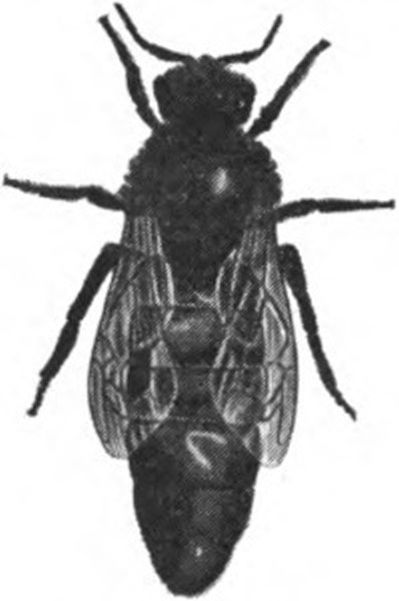
1. A Worker
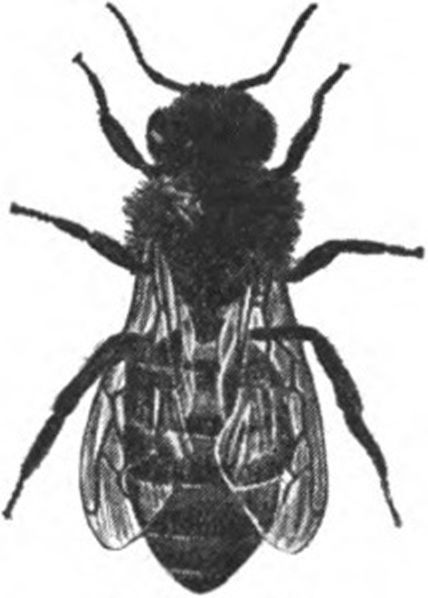
2. A Queen
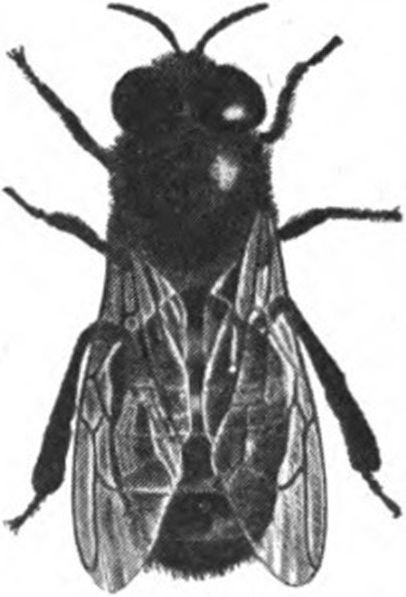
3. A Drone
Honey is of value to man as a food because in it are three valuable sugars and traces of minerals. The honeybee, in gathering the nectar of flowers from which to produce honey, gathers at the same time certain other properties of the blossom, which give honey, its wonderful flavors and "bouquets." Use of honey as a food reaches beyond the written history of mankind since its use was common to the ancients, as evidenced by its mention in the oldest writings and hieroglyphics. The flavors vary according to the honey plant of most value to the bee and blooming heaviest at any one time in any locality. Clovers, the widest spread honey plants in the U. S. A., give light colored honeys, mild in flavor. Blossoms of other plants contribute to the store of the bees, such as fruit, dandelions, locust, alfalfa, buckwheat, etc. Each varies in color, body or flavor and preference is usually accorded each according to the locality in which it is most common. No doubt but a few of us give any thought to the tremendous number of visits to flowers by thousands of honeybees, to produce the section of honey that goes so well with your hot biscuits or pan cakes. It is indeed a romantic food, well fit for the table of any king.
You, too, may share in this very interesting hobby and produce not only enough honey for your own table and that of your friends, but may profit by the sale of your crop in excess of your own needs. During 1933 many wrote us they received more for their honey, in proportion to their investment, than from any other farm crop. The amount of honey one may produce in any locality depends upon the honey plants in that locality. However, even in poor localities, with proper management, returns are often surprising but some states are naturally better honey producing areas than others. However, there are few localities in any state where honey may not be produced and in most of them profitably. In any event if you or your family like honey it is worth the inexpensive venture. There is perhaps no food so widely and favorably known because of its own virtues, than honey. This aids greatly in its sale and thereby a profit to you. Presentation of honey recipes to your customers and prospective customers will interest them in more ways to use honey. This will increase your market for honey and your profit. A little ingenuity may open up a large market for you.
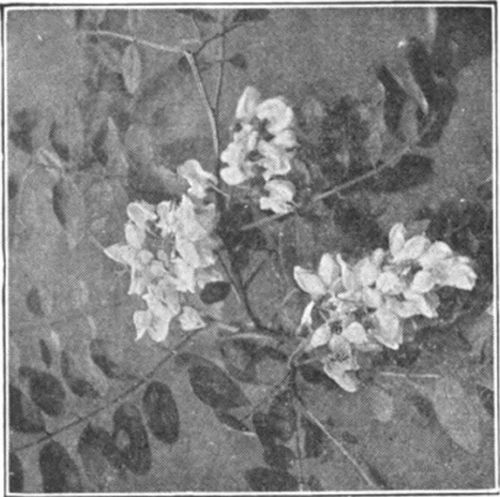
4. Honey Locust
Where can bees be kept? Naturally this is the question that first comes into your mind. Apiaries are kept in many strange places, on the roofs of buildings in cities, in the desert, in the back lotter's garden, in orchards or almost anywhere. Generally, they can be kept any place just so they do not bother others. It is always best if they can be kept in a protected place facing away from the prevailing winter winds, which usually come from the north or west. Bees like sunlight and shade is not necessary if they are where the air may circulate readily. They seldom interfere with humans or animals, unless improperly handled, or where such move past through their line of flight near the hive entrances. It is better to always keep them away from those who are timid.
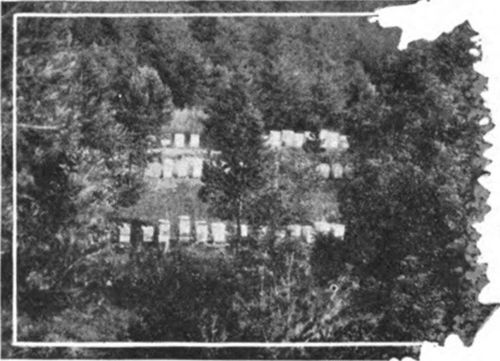
5. A Mountain Apiary
The picture on this page shows an apiary or bee yard perched among the trees on the steep side of a mountain. The hives in this yard face the sunrise, are set on blocks to keep the hives up off the damp ground, and the whole makes a beautiful and romantic setting. Those who have no suitable space on their own property may readily arrange with someone on the edge of town or in the country, for an apiary site. Often just the promise of a little honey in good crop years is sufficient pay for the small space used. It is well to choose a dry, well drained spot and easily accessible at all times. As a rule it pays to make a study of the nectar bearing plants in the locality and be sure the bees are within easy flying distance of them. Bees will readily fly from one to three miles for honey plants and do it successfully.
Continue to:


My Books

