


Bees - How They Live and Work For You. Part 6. How to Sell Honey
Description
This section is from the book "A Hobby That Pays - Bees - How They Live and Work For You", by G. B. Lewis. Also available from Amazon: A Hobby That Pays - Bees - How They Live and Work For You.
Bees - How They Live and Work For You. Part 6. How to Sell Honey
How do you sell honey? This is of more importance after you have reached the stage where your family cannot use all the honey you produce. Many who live on highways where travel is extensive have only found it necessary to set up an attractive sign such as the one shown on this page. Honey is always in demand and many folks buy honey from the producer in preference to a store, under the impression that the honey is better. In many homes the writer has known of an income from honey that exceeded that from any other crop, investment considered. In others, children have become interested and enabled to sell enough honey to pay their way through school, when their operations became extensive enough and they have become adept at beekeeping.
Others trade honey at their grocery for food or develop regular customers to whom they deliver honey at regular intervals, just as they may eggs, dressed poultry, etc. Of course, when a sufficient crop is raised to exhaust the avenues of sales mentioned above, the honey is then packed in standard containers and sold to honey dealers. We are interested in making a start just now.
Children earn spending money selling the honey to friends or neighbors when the bees are kept as a hobby and the income from them may be used as a means of teaching little folks the value of money and how to sell. While a great deal of honey is sold through the regular wholesale and retail channels of trade, roadside stands have become so popular the last decade that many tons of honey have been sold in this way. The writer knows of very extensive producers, whose crops each year are many tons of honey, whose entire output or the greater share of it, is now sold over roadside stands. In this way the producer sells at "retail" prices and gets more profit. The quantity of honey that has been disposed of at roadside stands in the last few years would total a great many carloads. It pays to keep the same sort of selling place that you would buy at yourself.

17. A Roadside Sign
Now that you have read this brief story about bees and honey, no doubt you will want to make a start with these interesting money makers. It may occur to you to question the statements we have made and to ask upon whose authority they are made. All this information is accurate and in it all we have been conservative about the returns to you, a difficult matter while showing our enthusiasm for bees and beekeeping. All our statements are the result of thousands of miles of travel, contact with hundreds of beekeepers in all parts of the country and lifetime study of bees. Every statement we have made is reasonable and as accurate as this story can be told with the omission of scientific terms. We have no desire to mislead you in any way for only as you succeed can we succeed too. However, we want to emphasize again that your own success lies more with you than anywhere else, and we are sure the interesting study of bees will cause you to learn the simple things you need to know to make a success of it.
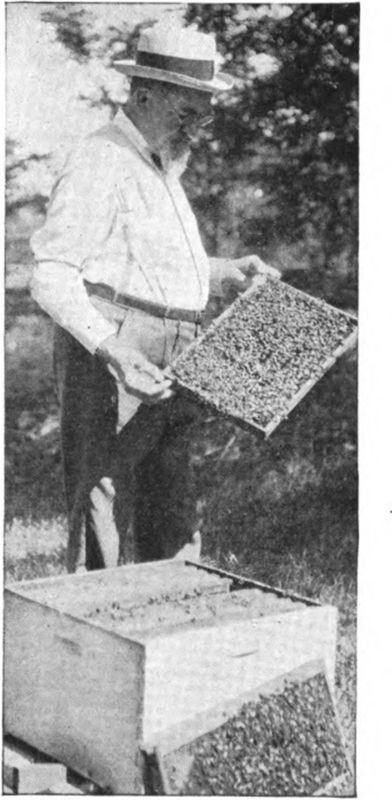
C. P. Dadant - Veteran Editor-in-Chief of American Bee Journal
The hive we recommend is the result of years of experience with hundreds of colonies of bees by the Dadant family. The senior Dadant is pictured here, and although an octogenarian, there is no more honest enthusiast about bees and honey in the world. A sample copy of his publication will be sent free if you address the American Bee Journal at Hamilton, Illinois.
Continue to:


My Books

