


Bees - How They Live and Work For You. Part 7. Conclusion
Description
This section is from the book "A Hobby That Pays - Bees - How They Live and Work For You", by G. B. Lewis. Also available from Amazon: A Hobby That Pays - Bees - How They Live and Work For You.
Bees - How They Live and Work For You. Part 7. Conclusion
Methods suggested in the books offered, and which you will want to read, are the honest accumulation of much experience. In our catalog we have tried to make plain, even to the novice, what each item is used for and how it may be used to secure direct financial returns from bees. We are, of course, bee enthusiasts but we also wish to be known as honest. Naturally we could not afford to make other than truthful statements.
Way back in 1863 when Wisconsin was yet a pioneer state, folks coming to Wisconsin to make their home brought along bees. They were far from sources of supplies and in those days transportation was expensive and uncertain. On the banks of the Rock river at Watertown, Wisconsin, there was started the small factory pictured at the left, to supply the needs of these and other beekeepers in states adjoining Wisconsin.
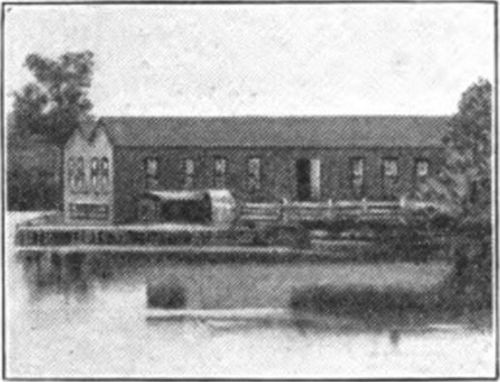
19. First Lewis Factory
After the many inventions that have enabled bee men to handle bees with less time and with more returns, honey production expanded rapidly. With this expansion came the necessity of expansion in the little factory where from the first the finest of bee equipment has been made with the greatest of care.
Below is a view of the modern plant now operated in the same city by the publishers of this booklet. Today more than ever the honey producer wants not only the most up-to-date equipment, but demands adequate packing, full worth for his money and prompt shipment. It has required the plant now occupied to insure this full service to the users of Lewis Beeware. The products of this plant are now distributed by several hundred dealers in this country through four direct factory branch warehouses. Goods are exported to foreign countries for use of members of the fraternity in other lands where honey production is as important as here.

20. Aeroplane View of Lewis Plant
So from this small beginning has grown the big plant now required to handle the demands of American beekeepers. You are invited to visit us whenever you come to Wisconsin's vacation land, as we are located just halfway between Milwaukee and Madison, Wisconsin's capitol. You will be interested to see the care that is used in securing the best available materials and processing them in such a way as to serve your needs best as a beekeeper. You will observe the careful inspection and sorting, the accurate count and packing and the facilities to handle the sudden demands of the honey producers in years of big crops.
In this small space we cannot tell the full story of Lewis Beeware.
However, we will help you toward your success as a honey producer, so you will understand why our friends suggested to us our Beeware slogan, "The Standard of the Beekeeping World."
Join Our Better Beekeeping Club
EACH year dozens of beekeepers avail themselves of membership in the Lewis "Better Beekeeping Club," described on the inside back cover of the current catalog. The nominal annual membership fee brings a world of bee information and helpful hints as to how you, too, may get more pleasure and profit from your bees. Members may purchase books at a saving and receive from time to time whatever free information Lewis offers. Be sure to read about this in your copy of the current catalog.
How To Booklets
Practical information on bees for those who have little time for reading. Price 3c each postpaid.
Any 6 for 15c, postpaid. Set of 18 for 25c, postpaid.
P121-"How to Manage Bees in Spring."
P122-"How to Control Swarming.
P123-"How to Buy Queen Bees." P124-"How to Start Beekeeping."
P125-"How to Locate an Apiary."
P126-"How to Feed Bees."
P127-"How to Transfer Bees." P128-"How to Care for Nuclei." P129-"How to Unite Bees."
P130-"How to Winter Bees Outdoors."
P132-"How to Care for Package Bees."
P133-"How to Extract Wax from Combs."
P136-"How to Control Wax Worms."
P137-"How to Make Increase." P138-"How to Produce Section Comb Honey."
P139-"How to Manage Bees in Fall."
P140-"How to Remove Bees from Trees."
P141-"How to Produce Extracted Honey."
Continue to:


My Books

