


Nectar Producing Flora And Nectar. Secretion. Continued
Description
This section is from the book "Honey Getting", by Edward Lloyd Sechrist. Also available from Amazon: Honey Getting.
Nectar Producing Flora And Nectar. Secretion. Continued
In these regions of irregular rainfall, commercial honey production must largely depend on the nectar from flowering trees or from irrigated, cultivated plants.
4. The Effect on Vegetation of Differences in Elevation and Latitude.
The characteristic feature of all tropical regions which are, in pan, composed of mountains, is the great variety of vegetation which ranges from the most luxurious tropical growths to the barrenness of the desert; from the plants and trees of the equator to those of cold alpine regions.
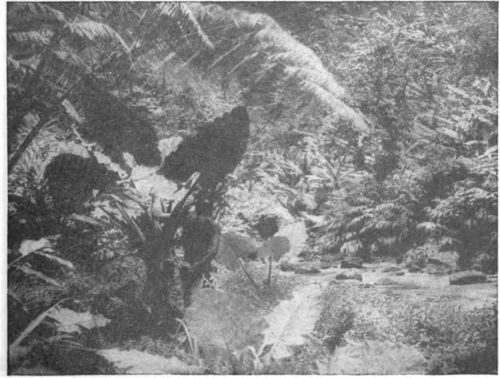
The varied and luxuriant vegetation of low, moist, hot lands. The man standing beside the taro plant gives a measure of the size of the leaves.
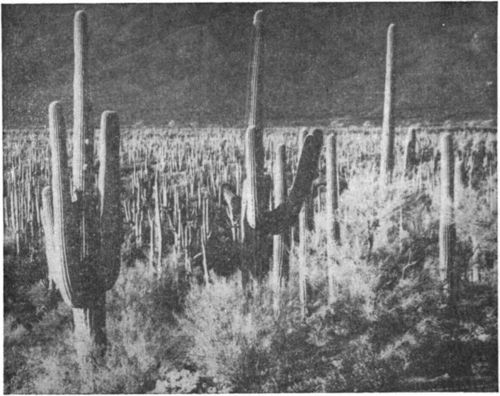
Sparse vegetation on dry, hot lands. Cactus forest. (National Park Service photo, from Natt N. Dodge).
Elevation and latitude may, therefore, well be considered together in their effect on vegetation and honey flow, because distance from the equator northward or southward, roughly corresponds to changes in elevation. As an illustration, the differences caused in the tropics by change in elevation are typical and cover the whole range of beekeeping in temperate and tropical countries.
Due to difference in elevation three rather distinct zones are found within the tropics: 1) The First Zone consists of low hot lands and has the most luxuriant vegetation. Here grow sugar cane, cacao, coconut palms, bananas, and tangled thickets of fruits, cabinet and dye woods, and clinging vines. In much of this area, especially in rain forests where there is practically continuous precipitation with almost no change in temperature, but little nectar is produced. The soil in these rain forests seems devoid of lime, one of the principal elements to be considered in honey getting, the frequent heavy rains having dissolved and washed away any lime that may have been in the soil.
2) The Second Zone is more elevated and has a mixture of temperate zone and tropical plants growing side by side. Pines grow beside coconut palms. Rice, coffee, bananas, oranges and vegetables thrive, while magnolias and gardenias bloom in the almost perpetual spring. In this zone considerable honey is produced.
3) The Third Zone comprises the colder tropical lands which are usually less productive of vegetation because of high elevation or, where there is enough heat, because of insufficient moisture. Here, unless there is irrigation, nectarbearing plants are scarce.
It will be noticed that many of the conditions in these three tropical zones are comparable to various areas of the temperate zones and sub-tropics where much honey is produced.
Continue to:


My Books

