


Three Principles Of Honey Getting
Description
This section is from the book "Honey Getting", by Edward Lloyd Sechrist. Also available from Amazon: Honey Getting.
Three Principles Of Honey Getting
Colony management has for its foundation three general principles:
1) To get each colony to its maximum honey-producing strength at the beginning of the period of blooming of the principal nectar-producing plants of the locality.
2) To keep the colony at this strength during the honeyflow, not allowing the working force to be divided by uncontrolled swarming.
3) To conserve the colony strength at all other seasons of the year so that it may become strong again at the right time.
These are the three great commandments of honey getting, and there are no others.
A beekeeper with a clear understanding of these principles is ready to work out their application to his own locality. He must know how the bees live and work in order to have them do the things he wants done.
A beekeeper can do almost anything with bees, and thus become a Bee Master, if he works in accord with their natural reactions to their surroundings*
The responses of honeybees to their surroundings are so invariable, and their habits of feeding on honey (or sugar), and pollen, so fixed, that man can succeed with them in no other way than by adapting his work to their needs.
Knowing bee behavior and the principles of colony management, the beekeeper must know what external conditions are present in his locality which will provoke a response from his bees. These conditions, such as number and duration of honey flows, depend largely on latitude and elevation coupled with cultivation, rainfall, and temperature.
In temperate climates there are beekeeping regions that range from the extreme cold parts of the United States and Canada to the almost tropical conditions of some southern parts of the United States and other regions near the tropics.
The development of nectar-producing flora and nectar secretion are influenced by 1) Cultivation; 2) Rainfall; 3) Temperature; 4) Elevation and Latitude.
This discussion of regional variations, including climatic conditions from north to south, or from colder parts of the temperate zone to tropical latitudes seems necessary to an understanding of the great variations in conditions which may be caused by the change of even a few miles in the locations of apiaries, and to indicate the economic advantages which may result.
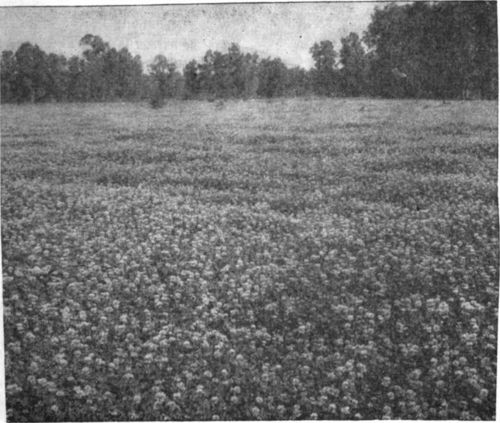
Acre after acre of clover pasture.
By attention to the topographical and meteorological conditions influencing the time of blooming and the distribution of nectar-producing flora, the beekeeper may locate his apiaries so as to have honeyflows coming in at different times, enabling him to give his various apiaries the needed individual attention; or he may, if transportation conditions make this possible, move his bees to take advantage of successive honeyflows in differing regions.
1. Cultivation
The development of commercial beekeeping in the United States has been almost coincident with the cultivation of large, compact areas of such nectar producing plants as the clovers, buckwheat, alfalfa, and orange.
These honey plants of temperate regions are mostly herbaceous plants dependent on regular rainfall or on irrigation, and almost confined to the well-settled, cultivated areas of the east, north and west. Wild nectar-bearing trees are rare except in the less cultivated regions of the south and west.
When any country develops and becomes more densely inhabited and more closely cultivated, and when waste land is drained or irrigated, the area of nectar-bearing herbaceous plants increases while trees and wild plants which produce nectar correspondingly disappear.
2. Rainfall
Upon the relation between the rainfall and the amount of water which a plant can use efficiently depends the development of rain forests, where rain is super abundant, and of desert areas where rainfall is scanty.
Mountains often show a dry side and a rainy windward or weather side. The coast mountains of a country may arrest the rain so that, in the interior, savannahs and steppes may develop on the drier lands, while the coast has luxurious forest vegetation. This is the condition of the western part of the United States.
Where a heavy precipitation is distributed throughout the year, evergreen forests prevail-conifers in the cold lands, broad-leaved evergreens in the tropics; but where rainfall in the tropics is very heavy but confined to a few months, deciduous forests prevail; and in these are some good nectar-producing trees, such as the mesquite and algaroba. When the hot and dry seasons coincide, and the rains come in the cooler season, the country will be poor in trees but rich in grass and bush land; while in districts with summer rains, even of the same amount there will be heavy forests and plains rich in trees.
All factors influencing the amount, distribution, and other distinctive features of atmospheric precipitation are of significance to plant development and nectar secretion. Such factors are especially topographical and include: -relief, or irregularity of the earth's surface, altitude above sea level, proximity to the sea, prevailing winds and their humidity. Winds are of much importance because they bring or carry off moisture. Wind has a drying effect which increases with its force. It dries the soil; dries plants; changes their form of growth, stunts them, and dries up nectar or prevents its secretion.
3. Temperature
The periodicity and abundance of nectar secretion is largely dependent on temperature, particularly contrasts of temperature, either between day and night, or during regular or irregular periods often due to rainfall or to change in direction or velocity of winds.
This periodic contrast of temperature together with the chemical composition of the soil, having particular reference to its lime content, has great influence on the copiousness of nectar-secretion.
It will be noticed, although there are exceptions due to local causes, that in the best honey producing regions, the nights are usually cool in comparison with the days. Especially is this true during the time of the principal honey-flow. In the warmer areas, nectar-secretion is possible at any season, but it is always associated with conditions that give rise to contrasts in temperature.
When days and nights are almost equally hot, little nectar can be expected.
In most regions, change of seasons causes periodicity, and plant life undergoes a seasonal period of rest.
In temperate climates this periodicity is due to change in temperature while in hot countries it is largely due to variation in rainfall. In the southern part of the United States and in California, there is often a long, midsummer dry period and a dearth of nectar separating an early and a late honey-flow; as one goes northward, the spring and fall honeyflows come closer together until, in the far North there is almost a steady flow from the beginning to the end of the season, although the season is short. Nectar production in the South during the midsummer period of continued high temperature day and night is usually so scanty that the more intense nectar secretion during the short northern summer produces a larger amount of nectar available to the bees.
In some hot areas with regular periods of rainfall, the seasons of growth or rest are as sharply defined as in any temperate region. As the season of rains approaches, but several weeks before the rain begins, vegetation springs up, flowers bloom, trees put out new leaves, and all is in readiness to complete the processes of growth and fruiting as soon as the regular rainfall comes. There are regions, however, where due usually to topographical conditions, the rainfall is so irregular in arrival that, should it be anticipated by preliminary growth of vegetation, disaster would result. In such regions a flora has been developed which either roots so deeply as to be independent of irregularities of rainfall, or which lies dormant until sufficient rain has fallen.
Continue to:


My Books

