


The Effect Of Varying Conditions On Behavior And Management Problems. Part 2
Description
This section is from the book "Honey Getting", by Edward Lloyd Sechrist. Also available from Amazon: Honey Getting.
The Effect Of Varying Conditions On Behavior And Management Problems. Part 2
Placing one or two frames of foundation at a time in the brood nest is the best way of giving aid, but no more foundation should be given than will be occupied by the queen as fast as drawn out; otherwise there will be sheets of foundation with the cells half drawn out, filled with honey, and sealed. Only under exceptional conditions, in such localities, should many frames of brood be taken out at one time and replaced by foundation.
3. Rate Of Colony Development
We consider here: -Small colonies: retarded colony development as the result of a slow, long season; the tendency of colonies to remain small and not build up to honey-storing strength; and the problem of keeping the colony at effective honey-storing strength over long periods of time.
A long-continued season of nectargathering seems to result in a less intensive activity of the queen, even of a young queen; and unless conditions are, or can be made similar to those of the northern season of active breeding for the great honeyflow which is to come, one cannot expect similar rapid breeding. The southern beekeeper is fortunate to have his bees accomplish in two or three months, the breeding of that population, which in the North, is the normal increase during the month or six weeks preceding the clover harvest. Even with abundance of honey in the hives at the beginning of the southern spring, the brood will not increase much until the first honeyflow is on, and then the colonies will, build up slowly; the brood chamber combs will become full of sealed honey and brood in scattered patches; and perhaps some honey will be stored in the supers. Usually, the maximum surplus is not stored from orange, tulip-tree, the first blooming of alfalfa or any equivalent early honey-flow because the bees are breeding up on it.
Under such conditions the problem is to get the sealed honey out of the brood chamber and give the queen room to lay. It may be extracted or put up for extraction after the brood has emerged. Too often the brood chamber combs are filled up again with honey even when there is plenty of room in the supers, since it is an exception, in warm climates, to have a queen quickly fill empty combs with eggs.
The true solution is to keep the colonies strong, as the above troubles occur particularly in small colonies such as are usual with beekeepers in the South and middle latitudes. Many of these permit their small colonies to go on, year after year, so weak as scarcely to survive the inactive season, and quite unable to build up during the summer into such colonies as the northern beekeeper secures easily. Indeed, many southern beekeepers do not know what a strong colony is and never realize that their colonies are chronically weak until some chance brings them into contact with northern colonies or northern beekeepers.
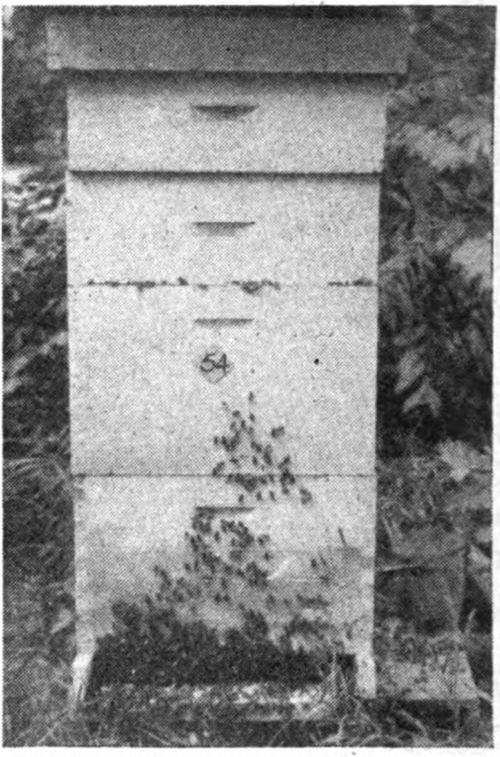
A populous colony in a clear brood nest, storing honey as good bees should. Later more supers will be needed.
With uncertain and intermittent honeyflows, colonies build up slowly and remain weak longer than in the intense, heavy honeyflows of the North. Every beekeeper, north or south, knows that his trouble comes from weak colonies, while the rousing, populous ones keep a compact brood nest and store honey in the supers as good bees should, instead of filling every empty cell in the brood nest with honey and thus crowding the queen, a condition which sometimes happens in the northern autumn when brood rearing is low and nectar secretion scanty.
All good beekeepers recognize that honey-storing strength of a colony is the important factor in getting large crops of honey, but the increasing difficulty in getting colonies to honey-storing strength as one goes from north to south has not yet been realized.
In mild climates, most beekeepers give their bees less careful attention than in cold climates, thinking that the bees can better take care of themselves. This is far from the truth, and wintering in the South is more difficult than in the North where it has been found that a strong colony in the fall, with plenty of good stores, will, if properly protected, be a good colony in the spring without special manipulation. It is doubtful if the successful northern -almost "let alone"-methods can be practiced in southern localities where the situation is often further complicated by the comparatively poor quality of winter stores.
The ability of a nucleus to build up, without help, into a full colony, may be taken as a natural index of the ease of making a success of beekeeping in any locality.
Wherever nuclei build up slowly, an important factor for success is to get a large population of young bees before brood rearing is discontinued in the fall. Without this maximum number of young bees in the fall, there is little hope of the colony reaching a satisfactory honeystoring strength in time for the main honeyflow the following season. The difficulty of building up nuclei into strong colonies increases gradually from the northern limits of honey production towards those regions where bees live easily in a wild state, often without accumulating large stores of honey.
Consequently, management must be modified in accordance with the increased time and care required to build up a nucleus into such a colony as produces a maximum crop of honey in the clover region, or in other regions where beekeeping is comparatively easy and where modern commercial beekeeping has had its greatest development.
4. Swarming
Swarming is influenced by location, honeyflow, and management.
When the commercial beekeeper in the warmer countries produces extracted honey by modern methods, swarming is almost eliminated. Not only does he provide plenty of room for eggs by the use of a CLEAR BROOD NEST, but he also gives ample room at all times for storage and ripening of nectar. Swarming, consequently, is usually limited to less than 5% of the colonies.
Continue to:


My Books

