


The Effect Of Varying Conditions On Behavior And Management Problems
Description
This section is from the book "Honey Getting", by Edward Lloyd Sechrist. Also available from Amazon: Honey Getting.
The Effect Of Varying Conditions On Behavior And Management Problems
Chief among the problems affected by regional differences are: 1) Length of the active period. 2) Brood rearing. 3) Rate of colony development. 4) swarming. 5) Queenless colonies. 6) Requeening and Supersedure. These will be taken up separately.
1. The Length Of The Active Period
Let us consider the length of the active period as affected by differences in nectar-producing flora and by variation in blooming seasons caused by uncertain and irregular rainfall.
While the intensification of the work of the honeybee in the colder climates may make its existence more difficult in the wild state and in the hands of careless men, it simplifies the problem of honey getting for the expert who can have his colonies at honey-storing strength at the time of the honey harvest, then quickly get a large crop of honey and have much time for leisure or for other beekeeping activities.
In northern lands with their rapid flow of white honey, conditions are ideal for producing a large crop of fine comb honey; while toward the south and in the tropics, the active bee season is longer and there may be several flows of greater or less importance separated by periods of dearth. There, comb building, sorting and ripening of honey pro ceed slowly and the production of fine comb honey is difficult.
As practically the same amount of honey can be stored in six weeks in the North as in six months in the tropics, \ the problems of the northern beekeeper are different from those which confront one who would keep bees successfully in the warmer regions.
The North has a short, rapid honey-flow. Bees must be at the peak of their strength at a time which varies little from year to year. All the colony energy must be directed to making honey during those few weeks of wonderful nectar secretion. After this exciting period, the queen rests, the hive population decreases and all activity should fall to a low level.
In the extreme South of the United States, as in the tropics, there may be long periods when nectar secretion is slow and yet all the regular colony activities must be maintained. Or there may be times of drouth during which the colony must be kept at effective working strength awaiting a rainfall and consequent blooming period.
In the North, such a drouth would end the honey prospects for the year; but in the South, the beekeeper may expect a crop from a later flow if he can keep his colonies strong until the long-deferred rains bring it on.
Keeping a colony strong during a long period is more difficult than to have it so during the few weeks of the northern honey season.
After the flow is over in the South, no compelling weather conditions cause the bees to become inactive and conserve bees and stores until the flow of the next year. During those long periods with no honeyflow, when for months the bees search for nectar and find little or none; when they must protect the combs from the melting heat of the sun; when they rob, or fight off robbers, a minimum amount of brood is being reared and the bees are aging rapidly. While a colony may be populous and appear fairly good, nearly all the bees will be old and the colony will be in the same condition a northern colony would be, in the spring time, if no young bees had been reared after the clover harvest in early summer.
The consequence is the same with this warm climate colony of old bees when nectar is to be had again as with the overwintered northern colony when it begins spring brood rearing. Nowhere can more typical cases of "spring dwindling" be seen than in the tropics where there has been no winter, but where the old bees, when they begin brood rearing, cannot replace themselves before they die.
Dwindling of colonies to nuclei, as a result of periods of dearth, is one of the most difficult problems of the warm-climate beekeeper. He must exercise the greatest care to keep a good queen in each colony; to stimulate brood rearing, if possible, during any short period of dearth, and to keep these small colonies from being robbed out or eaten up by the wax moth.
2. The Brood as Affected by Temperature
The northern beekeeper expects a strong colony in the spring to enlarge its brood nest regularly, keeping a compact form which the bees can cover and protect against sudden changes in tem-perature. Day and night temperatures rise with fair uniformity until, when the period of maximum brood rearing is at hand, the night temperature is such that a fair cluster of bees can protect a large area of brood.
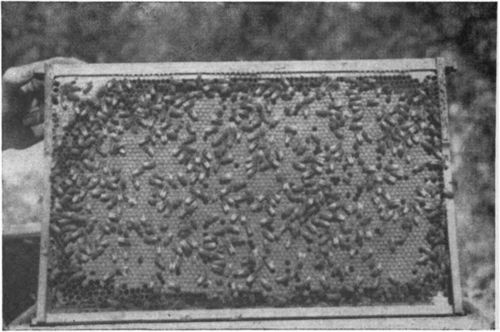
A good comb of brood from a CLEAR BROOD NEST where a good queen works under good conditions.
But when the brood-rearing period in a warm climate comes on, the small colony probably will have a comb of sealed honey alongside its brood nest; instead of this honey being removed, as the bees would do in a cold climate in order to keep the brood nest compact and protected, the queen simply passes over the comb of honey to some empty comb, laying a patch there and moving on to another spot having empty cells.
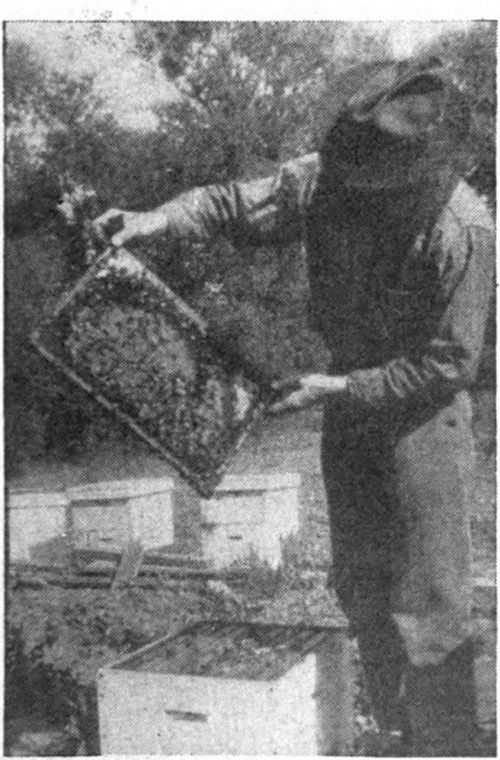
A backward colony; no clear brood nest, even the middle comb with sealed honey; often with sagging combs. The result is a honeybound brood nest, with restricted egg laying, even though the queen is good.
Therefore, one often finds in a warm climate, in a colony that has been left to its own devices, brood and sealed honey scattered throughout the hive. If a good queen has been confined to one story, even the outside surface of the outside comb may contain brood. Such a colony may have the equivalent of only six combs of brood. Little can be accomplished by removing this sealed honey and replacing it by empty combs because all cells except those needed immediately by the queen will be filled with incoming nectar.
Continue to:


My Books

