


The Effect Of Varying Conditions On Behavior And Management Problems. Part 3
Description
This section is from the book "Honey Getting", by Edward Lloyd Sechrist. Also available from Amazon: Honey Getting.
The Effect Of Varying Conditions On Behavior And Management Problems. Part 3
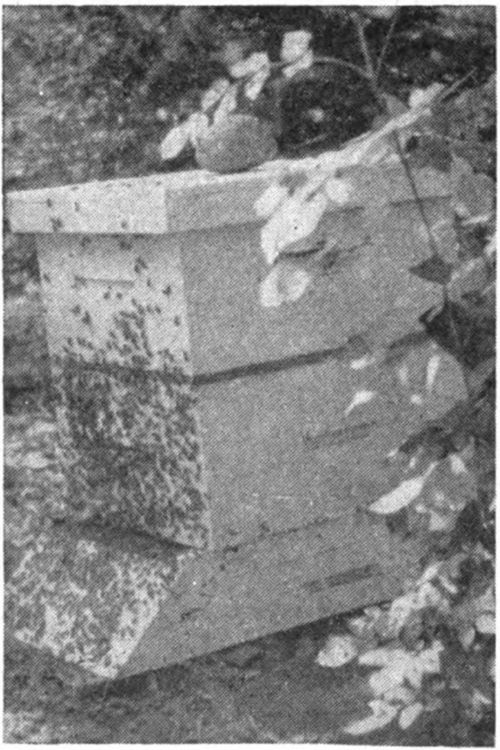
With only one super and an excluder, swarming may be expected. If the queen is clipped the first swarm usually returns.
It is true, nevertheless, that some beekeepers in these same regions complain of excessive swarming; but it is also true that this occurs where insufficient room is provided for storing and ripening honey and the brood nest allowed to become crowded instead of being kept clear for egg laying. Interruptions caused by changeable, unsettled weather or by sudden variations in the flow of nectar may also precipitate swarming.
Some warm-climate beekeepers provide only one super for storing surplus honey. This may result in forced cessation of nectar-gathering for a week or more while the honey in that super is being ripened and sealed. Swarming naturally results. A second cause for the same condition is a very moist climate in which, although several supers may be given each colony, quite enough when conditions are good for evaporating nectar, they still do not provide enough room for storage where, because of excessive humidity, the nectar is thin and requires a long time for evaporation. In such a locality, the building of much new comb and increased production of wax is indicated.
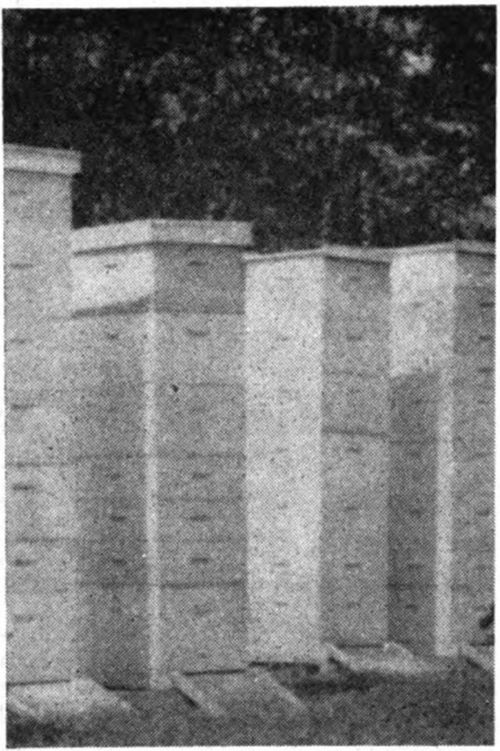
No indication of excessive swarming in this apiary.
The amount of super room needed varies greatly according to locality.
5. Queenless Colonies
The long brood-rearing season in warm climates, and the prevalence of robbing, result in many queenless colonies at inconvenient seasons.
It is often difficult to decide whether the loss is the direct result of the death of the queen; or whether her successor, if one was reared, has failed to mate; or whether the queen was balled or injured because of robbing or attacks of ants during a season of dearth. Even the opening of a hive by the beekeeper may cause a queen to be killed, and a branch of a tree falling on a hive, or any other unusual disturbance may have the same result.
A queen in the South or in the tropics may last six months or a year, somewhat dependent on how well the beekeeper succeeds in keeping up the strength of the colony and thus wearing out the queen quickly.
Besides the direct loss by queenlessness and robbing, there is much loss of combs from wax moth. Too often, when a weak colony is examined, one or more supers of comb will be found destroyed by wax moth larvae, only a small struggling nucleus remaining.
6. Climate Differences in Requeening and Replacement by Supersedure
Requeening and care that each colony has a good queen are even more important in the South than in the North; and 50 to 60% of queens in some hot areas, may disappear during a season without their successors beginning to lay.
Replacement of queens by Supersedure is much less frequent in the South than in the North, probably because colonies in hot countries tend to be smaller all the year around.
Loss of queens without attempt at Supersedure is common during those portions of the year when no nectar is being gathered. Then, for a long period, a queen, either old or young, may lay only a few eggs or none at all. A feeble queen may thus lay a few eggs daily, then suspend laying entirely, and finally die without the bees having made an attempt to supersede her. If a virgin is reared during a dearth when there are no drones, her repeated flights to mate subject her to danger from birds and predatory insects.
When the commercial beekeeper succeeds in keeping his colonies at maximum strength over long periods, the demand on the queen may be so great that she fails before a year old. If this failure comes normally, the queen is superseded; and, unless lost on her mating flight, the colony may survive though frequently, during a dearth, something happens to the virgin and the colony dies. It is important that the southern beekeeper be more certain than his northern brother that at the end of the year's honey getting each colony has a vigorous queen.
Every beekeeper, particularly in the South, should have on hand at all times a stock of young queens to replace any poor or missing ones so that, at the beginning of the honeyflow as well as at its close, he may know that each colony is queenright.
Continue to:


My Books

