


Section Comp Honey
Description
This section is from the book "Honey Getting", by Edward Lloyd Sechrist. Also available from Amazon: Honey Getting.
Section Comp Honey
When producing section honey, a different mechanical set-up is necessary but the principles of production are exactly the same.
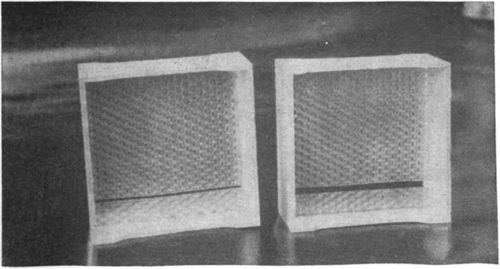
Full sheets at top of the sections, and starter strips at the bottom are best.
1. Prepare, during the winter, as many section supers as you plan to use. Use only clean, straight, separators. Others may cause brace combs. Put in sections and foundation shortly before time to use them. With the use of cellophane wrappers, wood of slightly off-color in a section is of less importance than in the days when the wood of a section was the first appeal.
2. Fill the sections with thin surplus foundation. To produce honey of the finest appearance, full sheets of foundation must be used, and in most cases, bottom starters are necessary. It is also necessary that the foundation be placed in the section with the cut edge of the foundation attached to the wood. The rows of cells will then run crosswise of the section, giving the comb a much better appearance than if the rows run vertically. This is important but is often neglected. The difference in appearance can be seen readily by taking two sections of honey of equally good appearance and giving one a quarter turn.
Small top starters are not profitable because combs built from them never compare in beauty with combs built from properly sized top and bottom starters. Drone comb also never equals worker comb in beauty, and a combination of the two is exceptionally objectionable. Bottom starters are usually needed in order to have the comb well fastened to the bottom of the section so it will grade well and stand shipping.
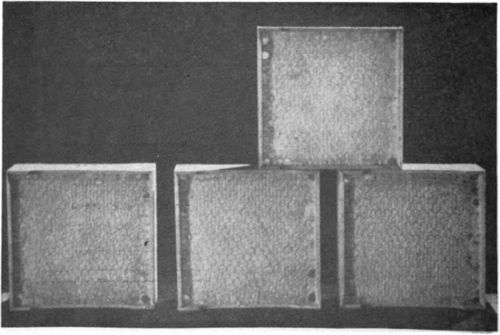
United States grade, fancy comb honey, or better.
After sections are filled with foundation they must be wedged or clamped in the supers so that they are perfectly square, or difficulty will be experienced when packing in shipping cases. Neglecting this point of having sections square results in many sections being cracked, cither in packing or during shipment. These hairline cracks result in slight leakage which disfigures the surface of the comb, soils the wood, irritates the broker and retailer, and lowers the price received by the producer. Much of the breakage in section comb honey can be prevented by the use of full sheets of foundation and bottom starters, and by careful squaring of sections in the supers.
3. Clearing section supers with bee escapes is good practice when local conditions do not cause the bees to cut open the cappings of sealed honey. If the honey is well sealed out to the wood, or if the bees have already removed all unsealed honey in the row next the wood, so that no unsealed honey remains with which the bees may fill themselves when escapes are put on, cutting of cappings is almost certain to follow.
In driving bees out of supers with smoke, it is important to have the smoker filled full of clean fuel to prevent ashes or soot from being blown over the combs and into cells partially filled with honey. This is of more importance than is generally realized. Much fine honey is marketed at a lowered price because of black specks in the cells, on the comb surface, or built into the cappings. The bees do not remove such man-made imperfections.
4. In removing filled sections from supers, care must be taken to loosen them without twisting, otherwise many fine sections will be damaged by slight cracking of the comb. These small cracks will be overlooked when grading, resulting in leakage and losses in transit.
Not until comb honey is packed so that it will reach the retailer in good condition can beekeepers expect an easy market, good prices, and low express or freight rates. Most breakage occurs between the freight car and the retailer, in places over which the shipper has no control. There is no remedy but for the producer to pack the honey in such a manner that it will reach the retailer with the comb absolutely dry. Cellophane packing is a good aid in securing good prices.
Profits
It will be noticed that nothing has been said about unfinished sections. There are none. Neither are there any sections with foundation in them to be carried over to the next season, with consequent losses; nor are any bait sections used, to result in low-grade combs; and there are almost no "go-backs" to be returned to the hives for finishing. Besides, the crop will be almost if not quite as much as if of extracted honey.
And if the season should be a poor one so that comb honey could not be produced profitably, the supers would remain in the honey house and the sections and foundation in their boxes, as good as new for the next season. The small loss in interest money would be much less than if time and labor had been expended in getting half a crop of low grade comb honey, while the crop of extracted might still be profitable.
By this plan, many little losses are cut, both in material and labor. All comb honey produced is uniformly of fancy grade. Not much effort is required to sell a few hundred cases of fancy comb honey direct to the retailer. In these things profit lies.
Continue to:


My Books

