


Producing Limited Quantities Of Bulk Comb. Honey At Low Cost
Description
This section is from the book "Honey Getting", by Edward Lloyd Sechrist. Also available from Amazon: Honey Getting.
Producing Limited Quantities Of Bulk Comb. Honey At Low Cost
I worked out this plan for myself in California, and then found other people using the same plan. It is always good.
The producer of extracted honey has his regular equipment, and all that he needs besides is the number of section supers he thinks he can use profitably, or an equivalent number of shallow supers with special frames for bulk comb honey. These are used by fastening foundation in with melted wax but they are safer for transportation if the comers of the top bars are cut out in the usual way, and the foundation nailed in and waxed afterwards, because one wants no sagged or warped combs when producing fine bulk comb honey.
The foundation should be put into the frames not long before required, in spite of the rush of labor at that time. The results will be better because the bees will start work more quickly and finish the combs more smoothly than if the foundation had been in the frames for months.
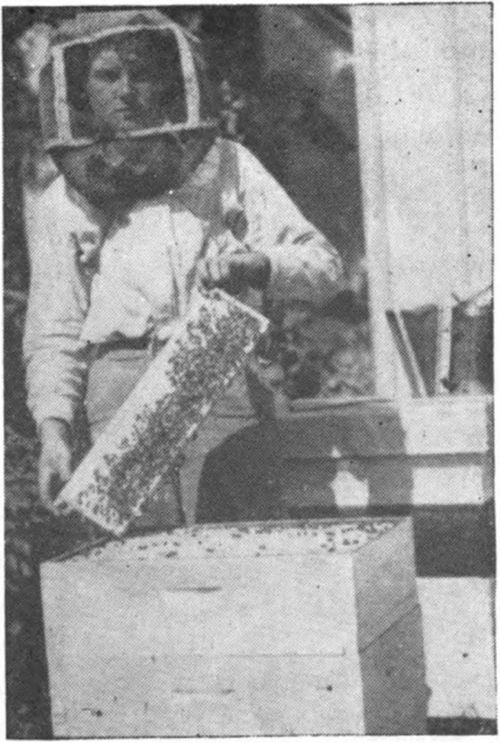
Bulk comb honey in the frame; fancy comb honey can thus be produced at a low cost. (Photo from L. R. Stewart. )
The foundation should extend only to within half an inch of the bottom bar and to a quarter or an eighth of an inch from the end bars. Then it will hang perfectly straight and will be fastened only lightly to the end and bottom bars, making cutting out easier.
When the honey season begins, let all colonies work in the regular extracting supers. After the full flow of white honey has well begun, select a number of colonies that are doing the best work in the supers, building and capping combs satisfactorily. Then, set off all the extracting supers and place on the colony a queen excluder, unless you know you can get satisfactory results without, and on that place two to four of the special supers. If one of the set-off supers is a food chamber or other super pretty well filled with honey, place it above the comb honey supers. On top of this place a bee escape, with the remaining supers on top of the escape board. Remove these supers when the bees have left them.
Do not crowd the bees too much, just enough to start them on the foundation, and then remove the food chamber or extracting super and give the colony as many more supers as needed, so that the combs will not be built too thick and fastened with burr combs to the frames below.
It is best to take off honey with bee escapes so that any leakage is cleaned up before the honey is taken from the hives.
With this plan of producing comb honey, no supers are added after the first lot has been put on. As soon as supers are completed, they are removed, and the remaining supers concentrated on those colonies which are doing the best work in finishing the combs. All should be off the hives before the end of the honey flow. Thus there are no unfinished combs; all are full and of even thickness.
Return the colonies to extracted honey as soon as they have finished their set of comb honey supers.
When the honey has been removed and packed, the supers are cleaned and set away in a clean place. closed up tight, ready for the next year.
It goes without saying that when the comb honey supers are put on, the brood nest should be CLEAR, that is, in the best possible condition for prevention of swarming and for storing honey in the supers. The brood chamber should be well filled with brood, not unsealed larvae, but brood that will soon emerge and give room for more egg laying. Full combs of honey should be taken out and replaced with frames of brood if possible, or with foundation, but not with empty combs. But do not remove combs and replace with others unless you know how. A single comb in the wrong place may induce swarming and lose you the crop.
A comb with some pollen in it may cause the brood nest to be divided into two parts, one occupied by the queen and the other in just the right condition to have queen cells built in it-and then comes swarming! I have seen a hundred colonies forced to swarm within a few days by such unwise upsetting of the clear brood nest. Breaking up the normal arrangement of the brood nest is bad enough in getting extracted honey; but when working for comb honey, it is disastrous.
Examine about ten days after putting on comb honey supers, looking for queen cells and seeing that all is well otherwise. If any colonies are not doing well with comb honey, return them to working for extracted at once and transfer the comb supers to colonies that are already doing good work on comb honey and which need room, but don't be tempted to put them on new colonies and thus confuse the working of your plan. Low cost of production is obtained by having uniform colonies, working them uniformly and not doing special work with a few colonies, that may have started later or that have swarmed. If a colony swarms, put it back on extracted honey.
That is all there is to producing a limited quantity of comb honey in shallow frames.
Continue to:


My Books

