


Rearing And Maturing Drones
Description
This section is from the book "Instrumental Insemination Of Queen Bees", by Otto Mackensen, Kenneth W. Tucker. Also available from Amazon: Instrumental Insemination Of Queen Bees.
Rearing And Maturing Drones
Inducing a colony to produce drones is not always easy. Young queens are often more reluctant to lay drone eggs than older ones. There is considerable variability among stocks and individual queens in the ease with which drone eggs are obtained. Early in the season drones can usually be obtained in abundance from any queen because they are naturally produced at this time of year in preparation for swarming. Later in the season and during pollen dearth periods, colonies are often very reluctant to produce drones. At such times it may be necessary to stimulate them by feeding pollen and syrup with pollen added, and creating a crowded condition by adding bees or reducing the size of the hive. At times when the nectar flow is extra heavy the bees will fill the drone comb with nectar. At such times the queen can be restricted to one brood chamber below an excluder and dark empty combs placed above. By extracting the drone comb gently, the thin nectar can be removed without destroying eggs and young larvae that might be present in some of the cells, thus giving the queen a greater opportunity to lay in the drone comb. The queen can be forced to lay on a drone comb by confining her to the comb within a queen excluder cage; however, one might be disappointed to find that the queen has deposited only fertilized eggs. It is best to create conditions that make the queen desire to deposit unfertilized eggs.
The importance of pollen for rearing and maturing drones cannot be overemphasized. While an abundance of pollen stored in combs often seems to suffice, some operators insist on adding more pollen in the form of moist pollen cake (without nonpollen extenders), or 25 to 50 percent pollen in sugar syrup. Pollen syrup is better sloshed daily over the top of the frames, where it will be consumed quickly, than fed in feeders, where it may spoil.
After emergence, drones can be matured in various types of nursery colonies or in cages. The simplest method is to set the drone producing colony in a location sufficiently isolated from other colonies to prevent undesired drones from drifting in and permitting the drones to emerge in this colony and fly freely.
In situations where some drifting is likely to occur, the drone comb can be caged in an excluder cage permitting the drones to emerge in the drone producing colony or in an incubator, marked as they emerge, and permitted to fly from their original colony or from any convenient colony. The drones can be sprayed with lacquer or enamel from a pressure can using a splatter head in place of the usual spray head. By using different colors a number of kinds of drones can be held in the same colony. Such drones, if caught as they return from the field, will be free of feces and therefore more pleasant to handle than confined drones and less likely to carry disease.
A method we use to mature drones in large numbers is as follows: A drone nursery colony is made up when the drones are nearly ready to emerge. A standard Langstroth two-story hive is used. Excluders are placed just above the bottom board and between the two hive bodies. The colony is made up with two or three combs of worker brood (all stages), two or three combs containing honey and abundant pollen, and 4 to 5 pounds of bees. The combs, including the comb of drone brood, are placed in the lower body. Unwanted drone brood in the worker brood combs is killed at time of installation and 10 days later when young drone brood that was overlooked is old enough to be easily seen. Other combs are added later if needed. The bees are released from a screen cage in the second body and, as they pass through the excluder to the combs below, the unwanted drones among these bees remain above the excluder and are lifted off the next day with the upper hive body and destroyed. An auger hole in the hive body wall above the entrance, 1 inch in diameter, covered with excluder, permits taking drones into small cages during the afternoons for use in insemination.
The bees rear their own queen which remains virgin because she cannot escape through the queen excluders to leave the hive to mate. Her presence prevents the development of laying workers. When the drones have been utilized, the colony is disposed of or the excluder removed for the virgin to mate and establish a colony.
During the afternoons the drones attempting to leave the hive crowd the forward part of the excluder leaving the rear part for the worker bees to pass through thus preventing clogging of the entrance. All manipulations are made early in the morning while drones are not normally flying. The three most important requirements of the drone nursery colony are ample young bees, ample pollen and absence of a laying queen.
As described, such a nursery colony will take good care of about 1, 500 drones-the number that might emerge from half of a standard Langstroth comb. A larger colony should be established for a larger number. When the desired number of drones has emerged, the drone comb can be removed to restrict the age span, or the drone comb can be moved to a new unit every few days so that all the drones in a given unit will mature at about the same time. For best results, confined drones should be used soon after they mature (between 12 and 20 days old) although they can be used as early as sperm can be obtained.
The above method is especially useful when large numbers of drones are needed. When only a few drones of each of several kinds are needed, it may be more convenient to mature them in cages in a nursery colony like the one des-scribed for queen storage. In fact, drones and virgin queens can be kept in the same colony. A drone maturing cage (fig. 13, B) has a screen which slides out; the other side is covered with excluder material. The cages are placed in the colony in holding frames with the excluder facing a comb of unsealed brood. The drones can be emerged from drone brood in cages in an incubator and transferred to the storage cages soon after emergence, or newly emerged drones can be collected from the breeder colony.
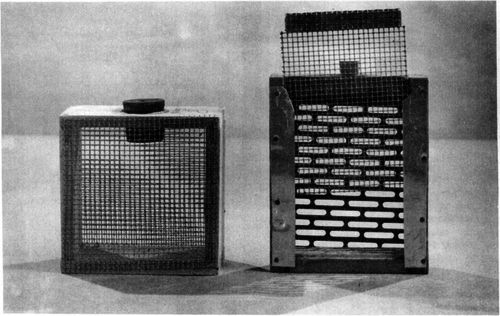
Figure 13. -A, Drone collecting cage; and B, drone maturing cage.
Continue to:


My Books

