


Storing And Shipping Semen, Maintenance Of Queens, Maintaining Queens In Nuclei, Maintaining Queens In Nursery Colonies
Description
This section is from the book "Instrumental Insemination Of Queen Bees", by Otto Mackensen, Kenneth W. Tucker. Also available from Amazon: Instrumental Insemination Of Queen Bees.
Storing And Shipping Semen, Maintenance Of Queens, Maintaining Queens In Nuclei, Maintaining Queens In Nursery Colonies
Storing And Shipping Semen
Semen can be shipped long distances for use in instrumental insemination. Successful inseminations have been made with semen shipped between the United States and Europe and between the United States and Brazil.
The technique is as follows: The semen of many drones (30 to 40) is placed in a 2 mm. diameter capillary tube, a syringe load at a time, and centrifuged just enough to force the semen down to the closed end and eliminate air spaces. Mucus must be scrupulously avoided. The open end is then sealed over a flame 5 to 8 mm. above the semen while care is exercised not to over heat the semen and at the same time leaving a minimum air space. Properly protected, such tubes of semen can be sent by airmail in an ordinary letter envelope. To use the semen, the tube is broken in such a way that the first 1 to 2 mm. of semen next to the air space is discarded and the remainder of the semen is taken into a syringe as usual.
By similar methods, but with antibiotics added (streptomycin sulfate or tetracycline hydrochloride), some of the sperm has remained capable of fertilization for 16 to 18 weeks.
Maintenance Of Queens
Queen rearing will not be dealt with here except to emphasize that large queens are more easily inseminated than smaller ones and that if one spends the effort involved in instrumental insemination one should start with the best. For queen rearing methods the reader is referred to the many books that have been written on the subject.
There are several ways to maintain queens for instrumental insemination. Some methods, which the reader can modify to suit his convenience, are described below:
Maintaining Queens In Nuclei
A method we use is as follows: Mature queen cells are placed in vials (fig. 12, A) and kept in an incubator at 35° C. until emergence. The neck of the vials is just large enough to receive the cells, but not the wooden cell bases to which they are attached. In the bottom of the vials is placed a 14-inch layer of coarse sawdust or fine wood shavings, to absorb moisture, and a small pellet of queen candy. As the queens emerge a wing is clipped on each and a color mark placed on the dorsum of the thorax for identification of mating groups. They are then confined to holding cages (fig. 12, B) and placed individually in the center of the brood nest of previously prepared nucleus colonies. The nuclei are ''baby" frame size (9 1/2-inch top bar; 6 1/4-inch depth) and when first established, are composed of a comb each of honey and brood plus two empty combs and 3/4 to 1 pound of bees. Before adding them to the nuclei, the bees are sifted through a queen excluder and all drone brood is killed to eliminate drones that would otherwise clog the excluders, which must be kept over the entrances until the queen starts laying. The brood is examined between the seventh and 10th day after the nuclei were made up, and all emergency queen cells are destroyed. The queens are taken to the laboratory in their cages, several at a time in convenient numbers for each insemination or carbon dioxide treatment. After the last treatment, each queen is returned to her nucleus by simply dropping her into the cluster of bees while still anesthetized, or the cage is opened and placed into the nucleus to be removed later when the queen has revived. In cool weather the cage is opened and placed within the cluster. Nuclei in which queens are lost are removed from the queen yard. Only nuclei from which laying queens have been recently removed are reused.
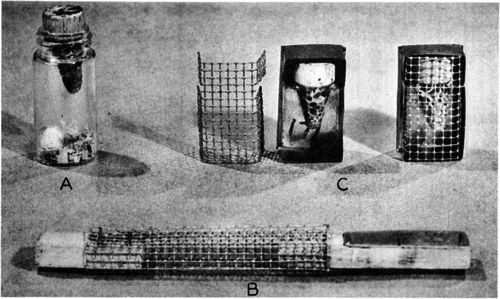
Figure 12. -Containers used in queen handling:. 4, Vial used for queen emergence in an incubator; B, cage for holding queens individually in nuclei; and C, cage used for queen emergence in an incubator and for emergence or storage in nursery colonies.
If the queens are permitted to run loose in the nuclei, it is best to put the queen cells directly into the nuclei and clip and mark the queens as soon as they emerge while they are still recognizable as newly emerged queens. This method requires spending some time finding the queens, and there is always the risk of a stray queen being mistaken for the desired one. An advantage is that the virgin queens destroy any emergency queen cells that have been started.
The nucleus hives we use have room for 11 combs. We start the nuclei with four combs and add more as needed. We find the extra space convenient during insemination and carbon dioxide treatment. By adding supers these nuclei can be permitted to develop into small colonies suitable for wintering breeder queens.
Maintaining Queens In Nursery Colonies
When queens are maintained in nursery colonies, the mature queen cells are put into individual cages (fig. 12, C). The cages are placed into holding frames, which are put into a strong queenless colony. Only virgin queens are kept in this colony. The virgin queens emerge into the cages and are fed by worker bees through the mesh of the cages. When about a week old, the virgins are taken from the nursery and inseminated. After insemination, the queens are each caged with a few worker bees and kept in another nursery colony for at least 2 days. A day after the nuclei to which they will be introduced have been made up, the inseminated queens are given a treatment with carbon dioxide and introduced into nuclei. These queens should be introduced so that they are not released until they are ready to lay.
The nursery for the virgins and that for the inseminated queens are made up and maintained similarly to queenless cell builder colonies. There should be an abundance of bees, honey and pollen, and two combs of unsealed brood renewed each week. The caged queens should face the unsealed brood. The nursery should be fed sugar syrup and pollen in the absence of natural nectar and pollen flows.
The advantage of maintaining queens in nursery colonies is that the queens are quickly located for inseminations and carbon dioxide treatments. The main disadvantage is that the queens may have excessive accumulation of feces in their rectums and be difficult to inseminate. Also, loss of queens during introduction is a problem with this method.
Continue to:


My Books

