


Syringe, Sting Hook And Ventral Hook, Valvefold Probe And Sting Depressor
Description
This section is from the book "Instrumental Insemination Of Queen Bees", by Otto Mackensen, Kenneth W. Tucker. Also available from Amazon: Instrumental Insemination Of Queen Bees.
Syringe, Sting Hook And Ventral Hook, Valvefold Probe And Sting Depressor
Syringe
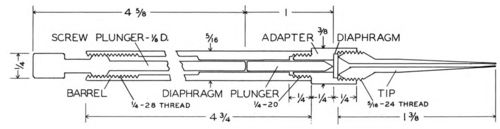
Various types of syringes have been used during the development of the insemination technique. The Mackensen syringe (fig. 7) is the one most commonly used today. The barrel and plunger are made of stainless steel. The plunger is constructed in two parts so that when the screw plunger turns, the diaphragm plunger does not turn nor bore into the diaphragm. The diaphragm is made of rubber one-sixteenth inch thick. The tip and adapter are made of clear plastic. At its point the tip has an inside diameter of 0.005 inch and an outside diameter of 0. 009 inch. This is about as small as the outside diameter can be made and still permit an inside diameter large enough for reasonably easy semen collection. Just inside the point, the inside diameter gradually enlarges for a distance of five thirty-seconds inch and then continues at a uniform bore of 0. 031 inch. The tip is graduated in microliters and has a capacity of 10. With the 5/16-inch base, still larger capacities can be obtained by increasing the diameter of the uniform bore.
In operation the tip and adapter socket are filled with physiological salt solution, the tip is screwed into the adapter against the rubber diaphragm, and the adapter is then screwed into the syringe barrel socket. When the screw plunger is advanced, it causes the diaphragm plunger to push the diaphragm into the cavity at the base of the tip thus forcing the saline solution out. The semen is then taken in by retracting the screw plunger. Thus, the saline solution acts as a liquid plunger.
Originally the piece between the tip and barrel was the same diameter as the barrel and was simply an extension that could be omitted. When the tip was screwed directly into the barrel a 1/2-inch-long diaphragm plunger was used. When it was found that the old style tips with 1/4-inch-diameter base did not have the capacity desired by modern workers, the base was enlarged to five-sixteenths of an inch and the connecting piece correspondingly. Thus, this piece became an adapter.
The adapter is a great convenience when sterilization is required as in a series of individual matings or to prevent the spread of disease. Several adapters and tips can be prepared, used one by one, and all cleaned and sterilized at the same time.
Sting Hook And Ventral Hook
Two hooks are used to hold the sting chamber open and the sting out of the way during the operation. Each hook is secured to a long handle, which slides within its hook holder. The critical parts of these instruments are shown enlarged in figure 8. The ventral hook is mounted to the left of the operator and is little more than a bent wire that hooks over the ventral plate. The sting hook is mounted to the right of the operator. It has an enlargement at the end which fits into the triangular area between the sting lancets and extends underneath them (fig. 2). It is used to pull the sting dor-sally exposing the vaginal orifice. These hooks may vary considerably in dimensions and shape, and different workers in instrumental insemination have their preferences. One should be prepared to make these hooks out of spring temper brass wire. Suitable tools for this purpose are number six cut files of round, oval, and flat shapes, obtainable from any jeweler.
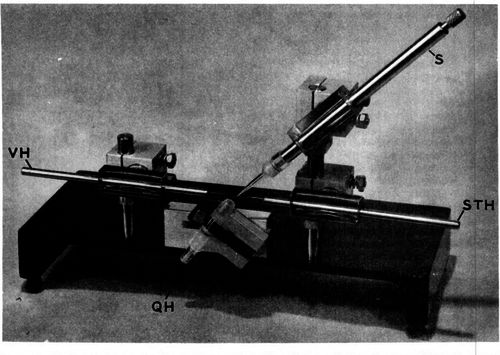
Figure 6. -Manipulating apparatus viewed from operator's side: QH, queen holder; S, syringe; STH, sting hook; and VH, ventral hook.
Syringe

Queen Holder
Figure 7. -Structural details of syringe and queen holder. Dimensions are in inches.
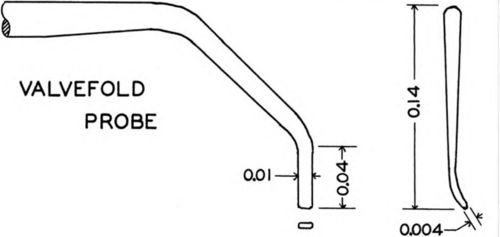
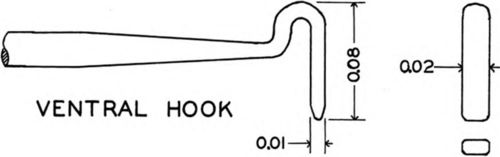
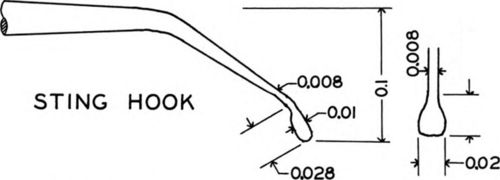
Figure 8. -Structural details of valvefold probe, ventral hook, and sting hook. Dimensions are in inches.
Valvefold Probe And Sting Depressor
The valvefold probe (fig. 8) is used to press the valvefold ventrally to make way for the point of the syringe on its way to the oviduct. There are two 45° bends on a plane with the main stem of the instrument instead of one 90° bend to minimize obstructing the view. The last
0.020 inch is bent counterclockwise about 30° when viewed toward the handle. The sting depressor is simply a needle that is used to depress the sting while the sting hook is placed. These instruments can be mounted in pin vices or other suitable short handles.
Continue to:


My Books

