


Don't Plunge
Description
This section is from the book "A Living From Bees", by Frank C. Pellett. Also available from Amazon: A Living From Bees.
Don't Plunge
Yesterday we had a caller, a young man who told an interesting story. A few years ago he was a shipping clerk in an eastern city. He became interested in the stories he heard of beekeeping in the sweet clover regions of the West. When he saw the honey that came from there, light in color and mild in flavor, and of uniform quality, so different from the amber colored and strong flavored product of his vicinity, he became enthusiastic.
With little money, he secured an old Ford car and with the daring and enthusiasm of youth, set out on the long journey of more than a thousand miles to become a beekeeper in the sweet clover fields of the Northern Plains. He could not foresee all the obstacles which he would be called upon to meet, a stranger in a new country, in a new line of business, and far from all his friends. The remarkable thing is that he overcame them all and the past season harvested with his own bees five carloads of honey.
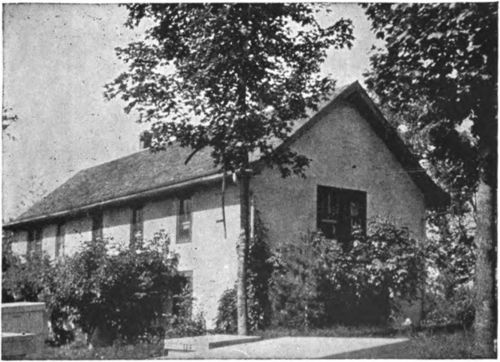
Honey house at Jager apiary in Minnesota.
This story is not told with the thought of pointing to him as an example of what can easily be done with bees, for even in these highly specialized days, there are few men who are able to secure five carloads of honey in one season. The significant fact is that the bees furnished their own capital and built up a substantial business from a very modest beginning. Nearly every successful beekeeper started with a small outlay and built up with the earnings of the bees. Not every one is adapted to beekeeping and there are many failures among those who fail to grasp the fact that beekeeping requires careful attention to details. That one can begin with a very small outlay and build up slowly gives a special opportunity to determine one's fitness and interest in the business with little risk.
It would seem that an enterprise which can furnish its own capital as it builds up slowly should very promptly repay borrowed capital which would permit of much more rapid growth. Strange as it may seem, it seldom has worked out that way. Those who have been content with the small start and the slow growth have learned their lessons as they progressed. Mistakes have not been serious because there was little at stake. Those who have plunged into beekeeping on borrowed capital without previous experience have nearly always met some disaster which proved their undoing.
Another very important reason appears to be the fact that when a business grows up naturally, it stops its expansion when it reaches the limit of its owner's capacity for management. Not long since a large scale honey producer remarked that many beekeepers are successful with small apiaries and yet fail dismally when they expand to the point where they must depend upon hired help and divided responsibility. Large scale honey production is a business in which comparatively few can succeed, yet uncounted thousands find pleasure and profit with small apiaries kept as a hobby or as a sideline source of income.
The man who manages a small apiary in his spare time finds a net addition to his income. The one who has a large scale business and depends upon hired help, has many expenses and the overhead cost of operation gets him into the same difficulties felt by nearly every other line of business.
There are many indications that the day of high specialization is passing and that we will return to something of the simplification and diversification of other days.
There are many who are finding compensation in circumstances which compelled them to find relaxation in simple things. A physician tells of a prominent society matron who has found so much interest in her garden that he credits it with saving her life. The change to active outdoor life has brought relief from a very serious disorder.
Forty years ago beekeeping was a hobby with a large number of business and professional people. The bee magazines were filled with animated discussions written by men and women of this type. Of late the industry has suffered for the lack of enthusiasm offered by the hobbyist. It has tended more and more to become a commercial enterprise followed by those whose only interest was in the big crops of honey which could be converted into substantial showing at the bank. Now we see signs of returning interest on the part of the class who find as much interest in the bees as in their honey. This is a healthful sign, for the individual, for the industry and for the nation. It is to be hoped that those who see signs of another boom ahead are mistaken. For every action there is a corresponding reaction and booms are followed by depressions. It is far more comfortable to move along slowly and sanely with time for our gardens, our bees and our neighbors.
Continue to:


My Books

