


Famous American Beekeepers
Description
This section is from the book "A Living From Bees", by Frank C. Pellett. Also available from Amazon: A Living From Bees.
Famous American Beekeepers
It is difficult to measure the merits of the service rendered by our contemporaries. As we view the activities of the men now active in the field of beekeeping, we wonder whether any one of them will make a contribution sufficiently important to insure a place among the immortals. It seems exceedingly doubtful. There are many men who are well known to their fellows who will be quickly forgotten once they have passed off the stage of action.
As we look back over the pages of beekeeping history so far written in this country, we can find the names of but six men who seem likely to be long remembered for service to their craft. Some of these may be known only to students who delve into musty old volumes in search of information concerning the origin of important matters.
Only one seems entirely sure of a permanent place in the memory of men who live by the labor of the bees. Langstroth's invention was so revolutionary and has resulted in such profound changes in the business of honey production, that his contribution can never be forgotten so long as anything resembling the present system of beekeeping continues. He is the one American beekeeper whose name is secure in its position in the history of American agriculture.
The other five have made lesser contributions and will continue to receive a tribute of regard long after most of us who have followed them have been forgotten. Samuel Wagner, who founded the American Bee Journal, the first beekeeping publication in the English language, made available the discoveries of his fellows. He made a greater contribution than is generally known.
Moses Quinby, the first man to demonstrate that honey production could be followed successfully as a source of livelihood is another whose name will not soon be forgotten. Charles Dadant, who introduced the new American discoveries and methods, to European beemen, attained world wide fame among the followers of the craft and thus insured a place for himself among the honored few.
A. I. Root, through his enthusiastic leadership, aroused thousands of new recruits and stimulated an interest which otherwise would have been slow in developing. G. M. Doolittle, through his practical methods, made commercial queen rearing easy and this was no mean achievement.
Among the others, there is no reason to believe any of them will be remembered a century hence, when a new generation are too busy with their own affairs to remember anything but the most outstanding work of our time.
There are a number of men to whom we of this generation owe more than passing interest. Dr. C. C. Miller, the most popular writer on bees of his day, entertained and assisted us all. His lucid instruction made our work easier and kindled anew our enthusiasm for our work. We loved him for his kindly spirit and the modest claims he made for himself. No beekeeper was better known to men of his time. The Memorial Library at the Wisconsin University marks an unusual tribute of his fellows and it is to be assumed that this will have some measure of permanence, but memorials alone do not assure lasting fame.
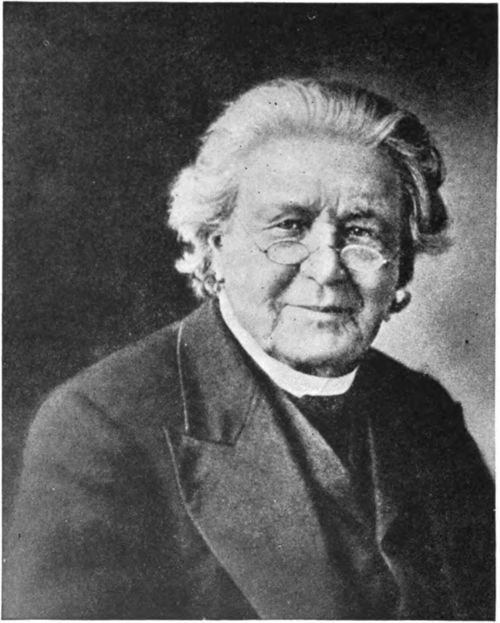
Rev. L. L. Langstroth, inventor of the movable frame hive.
Captain Hetherington and Adam Grimm were two widely known commercial beemen of a generation ago. Both were successful and both were very extensively engaged in honey production. As pioneers in the then new business of beekeeping on a big scale, they attracted wide attention and received much publicity through the bee magazines. Both were worthy men, but their names are seldom mentioned now and there is no reason to believe that they did anything which will long be remembered.
John Harbison developed a similar business in California and for a time was one of the best known beekeepers in America. He was the first to develop beekeeping on a commercial scale on the Pacific Coast. In 1857 he took 67 colonies of bees from Pennsylvania to California by way of the Isthmus of Panama and succeeded in moving them this great distance with the loss of only five colonies. He was a master beekeeper and demonstrated his understanding of the fundamentals of beekeeping by uniting the weak colonies on arrival, even though bees were selling for $100 per colony at the time. With fifty colonies, he soon had a thriving apiary and honey was selling at a dollar per pound.
Later when railroads were opened across the mountains, he shipped large crops of honey to eastern markets and attracted many eastern beekeepers to California as a result. On one occasion he shipped a trainload of twenty-three cars which created a sensation. At that time, few beekeepers in the east produced honey in large quantities.
Although Harbison is remembered principally for his pioneering in California, he is credited with the invention of the section box for honey.
Continue to:


My Books

