


General Requirements, Mistakes In Marketing, Price Quotations Vary, Variation In Quality, Tests In Illinois, Honey In Wine
Description
This section is from the book "A Living From Bees", by Frank C. Pellett. Also available from Amazon: A Living From Bees.
General Requirements, Mistakes In Marketing, Price Quotations Vary, Variation In Quality, Tests In Illinois, Honey In Wine
General Requirements
The writer interviewed a number of dealers both wholesale and retail. When asked for some general advice to the honey seller they agreed on the following:
Sell through a firm that specializes in honey, for such a firm can get a better price. Be very careful about grading and packing and use corrugated paper lining for the shipping cases to catch drip. All agreed that in general comb honey sells better in bright wood shipping cases with glass, than in cor- ruga led paper cases, and usually arrives in better condition.
The railroad claim agents gave the following advice in regard to shipping: Use only factory-made shipping cases and load the honey so that the combs will be parallel with the rails. This will place the shock of shipment on the edges instead of face of combs. Use cement-coated nails since they hold better, and use cushioned carriers. Stencil name and address on the package instead of using a shipping tag put on with tacks. Tags often get rubbed off and the shipment goes astray while the stenciled address cannot be lost. Also avoid as far as possible the shipment of comb honey in cold weather.
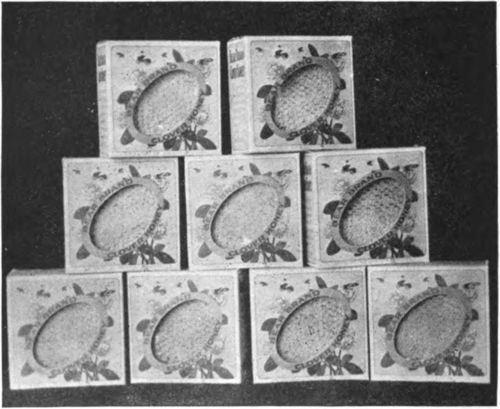
Fancy comb honey in individual wrappers.
Mistakes In Marketing
Since beekeeping is becoming more and more a specialized business, a ready and stable market is of the highest importance to the producer.
Under present conditions there are few industries with such an uncertain market as has the beeman. A few well managed central packing plants where honey could be graded and packed and distributed to the trade would do more to remove the uncertainty facing the beekeeper than any other development. Such markets must come before there can be any stability in the industry. As honey is now marketed, there is little inducement for any agent to push its sale, since he has no protection in the way of an established price. His only safety lies in buying below the market so as to be able to undersell his competitor. The beekeeper himself is largely to blame for this condition.
Price Quotations Vary
Once a western distributor of food products decided to add honey to his line. He accordingly asked for prices from prominent honey producers for a car of honey. Although he was prepared to pay the highest price asked, the great variation in quotations made him afraid to buy at any price. Since no two producers were agreed as to the value of their product, he decided that no matter what he did pay, others would buy for less and be able to undersell him in the market. Instead of honey he bought a commercial syrup which sells at a steady price.
Variation In Quality
Another reason why central distributing plants will be necessary is the great variation in the quality of honey. Consumers demand a uniform product.
There has been much complaint of the failure of honey recipes commonly offered to the public. Much of this failure is due to the different kinds of honey available. A housewife works out a recipe with sweet clover honey and gets a fine result. The recipe is given to the public through the newspapers or over the radio with no hint as to the kind of honey required. Another housewife tries it with buckwheat or heartsease honey and the result is a serious disappointment.
Tests In Illinois
Professor Tracy and his associates at the Illinois Experiment Station found a great variation in results with different kinds of honey when they were working with ice cream. Some kinds of honey proved unsatisfactory for use with ice cream.
Although honey is a very old sweetening agent, little is known of its use in combination with other food products. Some provision must be secured to work out the proper kinds of honey for all the known uses and the facts be made known. Not only must the facts be known but the honey must be distributed through some agency which will insure that only the right kind of honey will go to the customer to serve the purpose which he may have in mind.
Honey In Wine
The results of a mistake of this kind are well shown in the experience of our Canadian neighbors where honey was used in the making of wine. With the mild and light honeys, the wine was of good quality and met every test. After a large amount of honey had thus gone into the making of wine, a few cans of buckwheat honey were allowed to go in. The wine resulting from the use of the dark and strong honey was so different that it upset the whole enterprise and the loss of much of the wine market for Canadian honey resulted.
Continue to:


My Books

