


Must Avoid Mistakes, Diseases And Enemies Of Bees, American Foulbrood, European Foulbrood
Description
This section is from the book "A Living From Bees", by Frank C. Pellett. Also available from Amazon: A Living From Bees.
Must Avoid Mistakes, Diseases And Enemies Of Bees, American Foulbrood, European Foulbrood
Must Avoid Mistakes
It is only by marketing through central packing plants that mistakes of this kind can be avoided. Doubtless getting the wrong quality of honey for a special purpose has resulted in the permanent loss of thousands of customers.
When honey is sold through regular channels as dairy products are now handled, a large part of the present difficulty of getting a uniform and dependable quality to the consumer will be removed.
Diseases And Enemies Of Bees
Disease is not a pleasant subject but one who would live from the labor of the bees must be on guard against the day when he must deal with it. Diseases of the brood are the most serious and the most common. Of these there are three which are likely to appear in any part of the country. The young larvae are affected at an early age and die before reaching maturity. In severe cases the entire colony may perish.
American Foulbrood
The most widespread and most serious of these brood diseases is American foulbrood. The spores of the disease are carried to the young bees in the food. The organism is known as Bacillus larvae. Recent investigations indicate that only very young larvae of not to exceed two days old contract the disease. They usually complete larval growth and spin their cocoons before death occurs. When opening a hive in which this disease is well advanced one will at once notice certain characteristic conditions. Sunken, discolored and perforated brood cappings are evidence that something is seriously wrong. The dead matter remaining in the cells is coffee colored and molasses-like in consistency. If a toothpick is inserted in the mass the remains will stretch out like glue for half an inch or more before breaking.
In time the remains dry down to leave only a tenacious scale attached to the lower side of the cell. This scale is difficult to remove and in advanced cases the brood combs will have so many of these scales that only a small part of the comb area is left for brood rearing.

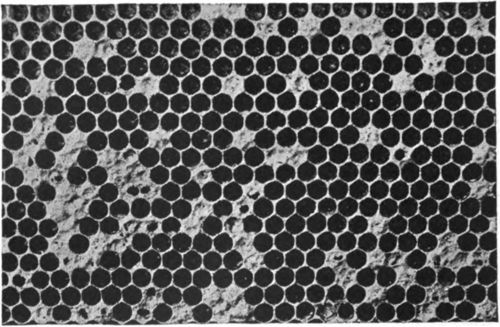
Appearance of healthy brood.
While it is possible to save the bees from an affected colony by removing all combs and honey and hiving them on fresh foundation, it often happens that the disease will reappear. In recent years authorities have been generally agreed that it is better to burn colonies affected with this disease, saving only the shell of the hivebody, supers, top and bottom. These are scorched with a flame torch to insure destruction of all spores. Some authorities burn everything including the hives.
American foulbrood in advanced stage.
As insurance against this disease it is wise to secure bees that are known to be resistant to it. Apparently there is no such thing as immunity but some strains of bees are highly resistant and seldom acquire it from ordinary exposure. In localities where disease is common far less loss is likely to occur by the use of resistant stock.
While resistance has been found to some extent in all three of the races, Italian, Caucasian and Carnio-lan, which are common in this country, it seems to be more general among the Caucasians. Some strains of bright yellow Italians appear especially susceptible.
Beekeepers who have resistant stock and who at the same time follow the accepted methods of dealing with it when found, report but slight loss from American foulbrood.
European Foulbrood
European foulbrood, (Bacillus pluton) has been very serious in some sections in years gone by. However, in recent years certain strains of Italian bees have been found to be so highly resistant to it, that it has all but disappeared in large areas.
This disease often appears suddenly and heavy losses follow in a very short period of time. It is more severe in times of dearth and often improves rapidly with the start of a good honeyflow.
European foulbrood is less constant in its symptoms than American foulbrood and is not so easily recognized with certainty. The larvae die while still coiled in open cells and few cells with dead larvae will be capped. The dead larvae are dull white or yellow in color and look like drops of pale butter. There is little of the foul smell that is evident in advanced cases of American foulbrood although there may be a disagreeable sour or yeasty odor. In American foulbrood the disease is usually confined to worker brood while this disease attacks drone and queen larvae with equal readiness.
The accepted treatment is to unite diseased colonies to make them strong enough to overcome the disease and to requeen with resistant stock. Burning of equipment is not advised with this disorder, neither is there any advantage in changing the bees into new and fresh hives as formerly commonly practiced with American foulbrood and known as "shaking. "
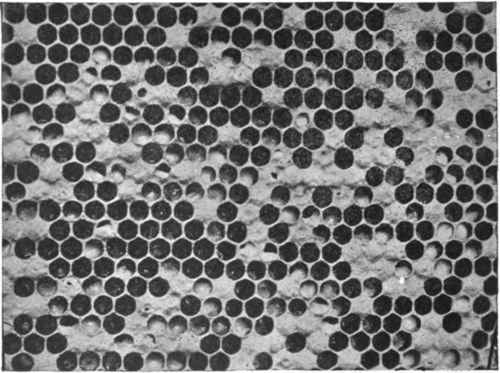
Brood a fleeted by European foulbrood.
Continue to:


My Books

