


Sacbrood, Disease Of Adult Rees, Spray Poison, The Wax Moth
Description
This section is from the book "A Living From Bees", by Frank C. Pellett. Also available from Amazon: A Living From Bees.
Sacbrood, Disease Of Adult Rees, Spray Poison, The Wax Moth
Sacbrood
Sacbrood is a relatively mild disease which appears to be everywhere present but which rarely becomes really serious. The dead larvae are fully grown and in most cases the cocoon has been spun. As the name indicates the dead matter appears in the form of a sack of liquid which can readily be lifted from the cell. The color is grayish white or light brown.
The trouble usually disappears with the coming of the honeyflow and except in severe cases the beekeeper pays little attention to its presence. Requeening is the usual treatment and in most cases is likely to be entirely successful. The author has seen cases where Sacbrood appeared in the same hives year after year until new queens were given after which it was seen no more.
The novice is likely to be much confused as to the cause of dead larvae which he may find in his hives. In addition to death by disease, chilling, starvation, spray poison and other causes may destroy the brood. Only experience will enable the beekeeper to tell at once what the trouble may be. For this reason it is well to take a piece of comb about four inches square and containing a typical sample of dead larvae. This should be mailed to the Bureau of Entomology, Washington, D. C. for examination. A report on such a sample will enable the owner to know for sure what his difficulty may be and enable him to give the proper treatment.
Disease Of Adult Rees
There are several diseases of adult bees but the beekeeper is rarely able to distinguish between them. Symptoms are much alike no matter which disease may be present and even the experts are likely to be uncertain in many cases.
Nosema disease is probably the most common. This is especially prevalent in the north in late winter after the bees have endured a long confinement. It usually disappears when warm weather comes and the bees are busy afield. Much remains to be learned regarding adult diseases and no dependable treatment is available other than to follow the usual practice of requeening feeble colonies and keeping the bees strong as possible.
Spray Poison
In the vicinity of orchards where arsenate of lead is applied to the fruit trees for control of insect pests the bees are often killed in large numbers when the trees are blooming. The bees also are poisoned by sipping the moisture from the trees or the cover crops on the ground below when they seek water. Similar losses occur in the vicinity of cotton fields where large scale poisoning is carried on. The only remedy is to move the bees away at the time the poison is applied or make sure that the poison is spread at a time when the bees are not likely to visit the plants to be protected.
The Wax Moth
One of the best known among the enemies of the honeybee is a little gray moth, or miller, which remains hidden by day and flies about at night. This insect appears harmless enough, as it can neither bite nor sting, and once the bees can reach it they can destroy it without difficulty. It becomes a menace to the bees through its offspring, which tunnel through the combs and gradually undermine the security of the hive. Strong colonies of bees in normal condition seldom suffer from the attacks of the wax moth, as the invaders are driven out before they can establish themselves. In weak colonies, however, where the bees are unable to guard every part of the hive properly, the moths may encompass their destruction.
The little mother moth is extremely active. She is quick to take flight and escapes if danger threatens her. She is likewise quick to take advantage of an opportunity to slip unnoticed into the hive and, hiding in some unoccupied corner, deposit her eggs. The eggs are laid in well-protected cavities and are securely glued to the support. If undisturbed, she is likely to lay several hundred eggs before leaving the hive. The little larvae are so small and white as to be easily overlooked even by a careful observer. It is not surprising that the bees do not bother about them at once, since they immediately burrow into the wax and hide themselves next to the midrib of a convenient comb. They are gross feeders and grow rapidly. As they feed upon the wax and upon the stored pollen which the bees have provided for their own young, the wax moths tunnel through the combs, spinning galleries as they go.
At this stage they are no longer able to keep hidden from the bees, and, in populous hives, their tunnels are followed, the webs are torn out and the moth larvae driven from the hive, where they perish from hunger or cold or are devoured by birds. Catbirds in the apiary may often be seen at the entrance of the hives looking for these fat worms which the bees dislodge.
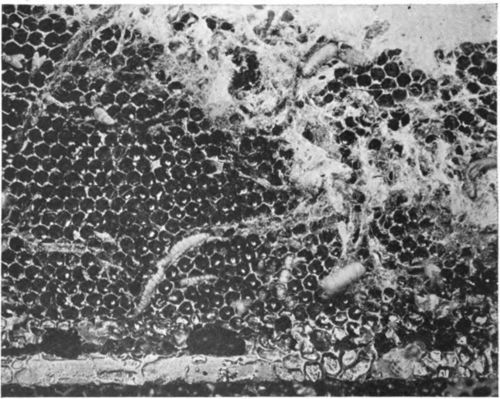
Larvae of waxmoth as they tunnel in the honeycombs.
If the bees are weak in numbers, the moths soon become so numerous that the bees are unable to cope with them and the combs are soon a mass of webs. Each moth larva spends from five to six weeks in thus tunneling through the combs, and when its larval growth is completed, it spins a cocoon under the hive cover, between the frames or in a convenient corner, sometimes gnawing away a portion of the wood to provide a safe retreat. Masses of these cocoons are soon present, and about two weeks later the adult moths begin to emerge and a new cycle is started.
By this time the wreck of the colony is complete. The few bees remaining are hopelessly discouraged and make little attempt to defend the hive against any intruders that may chance to disturb them. Thus it comes about that an enemy which could have easily been dislodged in the beginning intrenches itself so effectively that the bees are helpless against its advance. From such a hive will soon come forth hundreds of the gray moth millers, to explore every hive for a long distance around, in search of secluded corners where they may deposit their eggs and thus start a new cycle of destruction.
In the Northern States the period of breeding of the moths is comparatively short. It is only those insects which are so fortunate as to find a safe retreat within the area which is warmed by the cluster of bees in the hive during the winter period, that sur-vive. In the South, where the winters are mild, the breeding continues to some extent throughout the year and the damage is correspondingly greater.
Continue to:


My Books

