


Times Of Scarcity, Feeding For Queen Rearing, Preparation Of Feed, Feeders
Description
This section is from the book "A Living From Bees", by Frank C. Pellett. Also available from Amazon: A Living From Bees.
Times Of Scarcity, Feeding For Queen Rearing, Preparation Of Feed, Feeders
Times Of Scarcity
It frequently happens that a period of dearth will come in summer when normally the bees would be storing. At such times care should be used to insure ample stores. When the weather is cold or wet so that the bees cannot fly there is danger that stores will be consumed in brood rearing and the colony will perish. This is a very common occurrence where bees are kept in small hives or whose owners give them little attention.
Almost every season there will be times during the summer when no honey is coming to the hives, and if this condition prevails for any length of time the owner should guard against starvation.
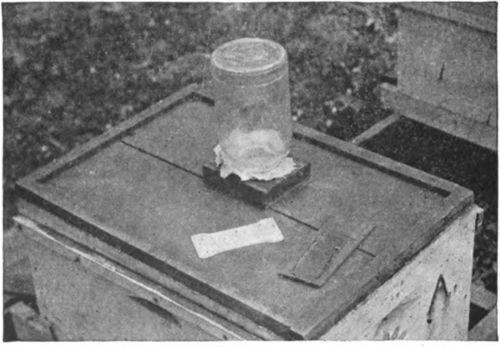
Feeding with fruit jar in top of hive used for queen rearing.
Occasionally there will be a year when little honey is stored all season through. At such times there is likely to be great loss, for too often the beekeepers depend upon the bees to provide for themselves and fail to make provision for feeding. It is no more foolish to permit cattle or hogs to die for lack of food than to permit the bees to do so. They will harvest enough honey in a few weeks of good honeyflow to tide them over a very long period of adverse conditions.
Feeding For Queen Rearing
At any time when honey stops coming in, the queen will check her egg laying. The queen breeder who wishes to rear queens at such times will find it necessary to feed the bees even though there is plenty of honey in the hives. Brood rearing must continue normally if queen rearing is to be successfully carried on and a small amount of thin syrup fed daily will give the bees a feeling of prosperity which is helpful. When fresh feed is constantly available the queen is likely to continue with her egg laying in a normal manner and the bees will care for the developing queen cells in finishing colonies or mating nuclei. At times when scarcity is evident the bees are slow in their attention to the cells and may even tear most of them down and remove the young larvae.
Preparation Of Feed
For winter stores the best possible food is the sealed honey which the bees have prepared for themselves. It is a wise plan to set aside enough combs of sealed honey at time of extracting to meet any demand. If honey is lacking then a syrup made from granulated sugar is the next best thing. Syrup is the best feed for stimulating colony activity for queen rearing.
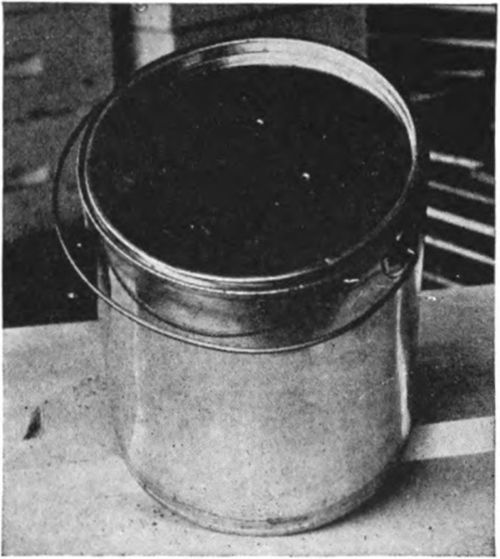
Friction top pail with holes in lid for feeding.
For winter stores a heavy syrup should be used, as heavy as can readily be prepared. A syrup of two parts sugar to one part water requires little effort on the part of the bees to evaporate excess moisture. For summer feeding a thinner syrup is to be preferred. One part sugar to one part water or even thinner will serve very well for feeding at any time when the bees are flying freely.
The novice often feeds his bees with corn syrup, molasses or other sweet with the mistaken idea that bees can make use of any sweet substance. Such experiments often result in the death of the bees if they are confined to the hive without a flight for any length of time. It is not safe to buy honey for feeding because of the danger of bringing disease to the bees from some infected colony.
By stirring the sugar in boiling water it will dissolve freely but it should not be given to the bees until all granules are fully dissolved to avoid waste of sugar.
Feeders
Formerly feeders of many kinds were offered by bee supply dealers but these have nearly disappeared from the market. The five-pound friction-top tin can is now almost universally used. An empty super or hive-body is placed on the hive and one or more of these pails filled with syrup. A few small holes are punched in the covers and the pails turned upside down over the cluster of bees. The bees remove the syrup and store it in the combs when the pails and empty supers can be removed.
One feeder which is still used to some extent is the "Brother Adam Feeder" which was developed in England by Brother Adam of Buckfast Abbey. It is made like a super with tight bottom and fits directly over the hive. It will hold enough syrup to meet almost any emergency and can be given at one time and require no further attention except to remove the feeder when empty. There is a wood block inside with a small hole that permits the bees to enter the feeder directly from the cluster, secure their load and return without interference. Since the feed is above the cluster there is little danger from robbers and the capacity of the feeder avoids the necessity of frequent refilling.
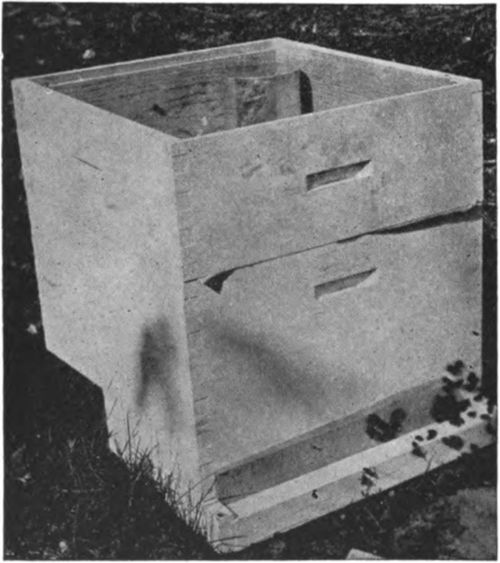
Feeder in place in empty super. In cold weather syrup should be placed directly over cluster.
This feeder is especially well adapted to use where new colonies of bees are started on comb foundation from packages of live bees. With an abundance of feed within the hive the bees can build their combs and establish themselves with a minimum of disturbance.
Providing Pollen
There is no entirely satisfactory substitute for natural pollen as food for bees. However, recent investigations have established the fact that soybean flour can be used to supplement natural pollen. Soybean flour from which the fat has been extracted mixed with dried skim milk at the rate of four pounds of flour to one pound of dried skim milk is recommended by Tanquary and Haydak as the result of extended investigations at the University of Minnesota.
They report the best way to feed is to place the dry flour in shallow trays in the open sunshine in a spot well protected from wind. When brood rearing is in progress the bees collect the substitute readily and carry it to the hive in quantity.
Continue to:


My Books

