


Cappings Melters And Settling Tanks, When Bees Must Be Fed, Reserves Like A Bank Account
Description
This section is from the book "A Living From Bees", by Frank C. Pellett. Also available from Amazon: A Living From Bees.
Cappings Melters And Settling Tanks, When Bees Must Be Fed, Reserves Like A Bank Account
Cappings Melters And Settling Tanks
When extracted honey is produced on an extensive scale there is a large accumulation of cappings. To separate the honey from the cappings and secure the wax is a bothersome job except by means of the capping melter. When the melter is used the wax goes directly into a heated container as the cappings are cut from the comb. The temperature is high enough to melt the wax and permit the honey to run into a separate tank. Great care must be used to prevent overheating of the honey which reduces the quality. Many beekeepers dislike the cappings melter because of the difficulty in operation without getting the honey too hot.
Large outfits usually make use of a honey pump to move the honey from the extractor to the settling tanks where it is permitted to stand for a few hours until all wax particles have time to rise to the top. The honey is drawn off from the bottom of the tanks, usually into sixty pound cans in which it is moved to market.
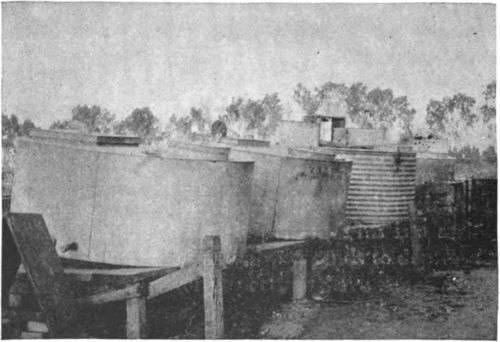
Outdoor storage tanks for honey in Southern California.
When Bees Must Be Fed
At any season there should be an ample reserve of stores in the hives to carry the bees over a period of adversity. I have seen very strong colonies lost in early June, just at the start of a heavy honeyflow, because a sudden change in weather brought a prolonged period of rain when the bees were unable to leave the hive. With a big cluster of bees and the combs filled with hatching eggs and emerging brood, the rainy weather brought disaster to the best colonies in the apiary.
Although under normal conditions the bees can be depended upon to provide their own food and a surplus as well, there are times when it becomes necessary for the beekeeper to provide them with food. Fortunately it is easy to provide a substitute for honey but a shortage of pollen is more serious.
Fifty years ago much space was given in the bee magazines to a discussion of pollen clogged combs and numerous suggestions were offered for disposing of the surplus pollen. Now it seems strange that the beemen failed to recognize the value of this stored pollen. Since pollen is the source of the protein in the food of bees it is essential to the rearing of brood.
C. L. Farrar 1 has shown that "Surviving colony population at the time new pollen became available in spring were nearly proportional to the amount of reserve pollen provided in the fall. "
1 American Bee Journal, p. 452-5, 1936.
Farrar contends that less than fifty square inches of stored pollen in the combs is a negligible reserve. He further states: "Pollen reserves of 300, 600 or 1, 000 square inches, depending upon the locality, may be considered equally as necessary as large clusters of young bees, vigorous queens 60 to 70 pounds of honey of good quality, and adequate protection for insuring ideal wintering. "
At the start of winter, colonies which lack at least fifty pounds of sealed honey should be fed sufficient sugar syrup to make up the shortage.
Swarms which issue late will often be unable to gather sufficient honey to carry them through until the following spring. They must either be fed or united with stronger colonies with ample supplies. A large cluster will winter on relatively less honey than a small one and be stronger in spring. The reason is at once apparent. The source of heat of the colony is the honey consumed and it will require a larger consumption of food to maintain the temperature of a small cluster than a large one, just as less fuel is required to warm a room full of people, than one in which few people are present. The stronger colony, however, is likely to use more honey in brood rearing since honey disappears very rapidly when brood rearing is in progress.
Reserves Like A Bank Account
It never pays the beekeeper to remove too large a portion of the honey from the hives. A liberal supply always available is the best possible insurance of the prosperity of the bees and honey in the hives is like money in the bank.
It often happens that an insufficient quantity is left for the bees when surplus is removed. Before the bees are left for winter a careful examination should always be made to make sure that a plentiful supply is left. An equivalent of eight to ten Langstroth frames of sealed honey is not too much. It is of course impossible to carry that amount of honey in a single storey hive of that kind and for that reason it is now the common practice to use double hive-bodies with Langstroth equipment. It is far safer to leave more honey than is used than to take chances on an insufficient supply.
If the winter is mild and spring comes early the bees will not require heavy stores but if March and April are cold and backward a surprising amount of honey will be needed to get the bees ready for the honeyflow from white Dutch clover or other source that begins to yield in late May or early June. When the bees are put away for winter, stores should be sufficient to carry them until fruit bloom at the end of April.
Continue to:


My Books

