


The Hive Tool, Bee Escape, Queen Excluders, Other Equipment, The Extractor
Description
This section is from the book "A Living From Bees", by Frank C. Pellett. Also available from Amazon: A Living From Bees.
The Hive Tool, Bee Escape, Queen Excluders, Other Equipment, The Extractor
The Hive Tool
The value of a hive tool cannot be measured by its cost. While many persons get along with a small chisel or screw driver, the cost of a special hive tool is so slight and it can be put to so many uses that one cannot afford to be without it, even though he have only two or three hives of bees. The hive tool is used to loosen the cover, pry up the frames, scrape off the burr combs and bits of wax or propolis attached to unnecessary and inconvenient places, and for many similar purposes. If one has a box or can in which to drop all stray bits of wax he will keep his frames in better condition and make his work easier and pleasanter, while at the same time saving wax that would otherwise go to waste.
Bee Escape
It is so easy to remove surplus honey from the hive by the use of bee escapes that they are very generally used by comb honey producers and by many extracted honey men as well. Delicate spring wires make it possible for the bees to go down through the escape but they are unable to return. By placing a honey board containing an escape under the super the bees will go down into the hive within a few hours, and the super can be lifted off and the honey removed without annoyance from fighting bees. If the super is removed without using an escape it will be full of bees which must be driven out. It takes time, is unpleasant and also results in some damage to the honey, as the bees will gnaw the cappings when smoke is used to drive them out. This is unimportant with extracted honey but in comb honey spoils the appearance.
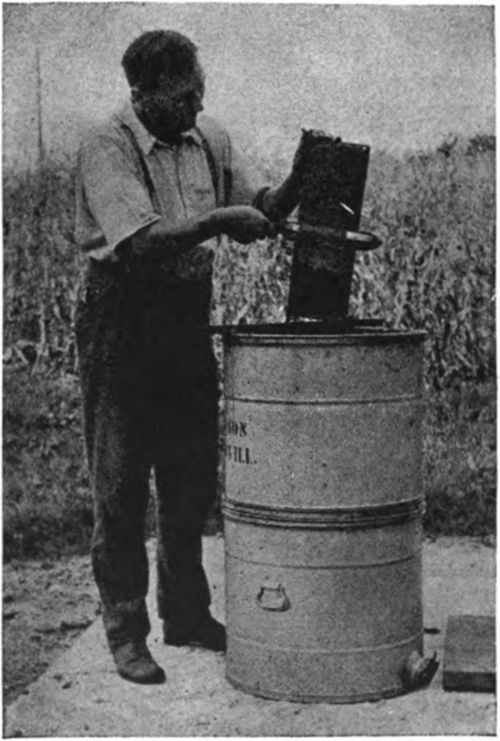
Uncapping combs in preparation for extracting.
Escapes are inexpensive, and if one has but a few colonies of bees he can get along with one or two by taking more time and removing the honey from one hive at a time.
Queen Excluders
There are times when a queen excluder is very useful. The excluder is so constructed as to permit the passage of worker bees but queens or drones which are larger are unable to get through. With an excluder between hive-bodies the queen is prevented from passing from one body to another and is prevented from entering the supers by similar means. It must be used with some care to avoid disrupting normal activities within the hive and there are many beekeepers who seldom find them useful. Their presence interferes somewhat with the free movement of the bees and may interfere with the progress of honey storage to some extent. A few are worth while for use on special occasions but there are few beekeepers who use them as staple equipment to be used with every hive.
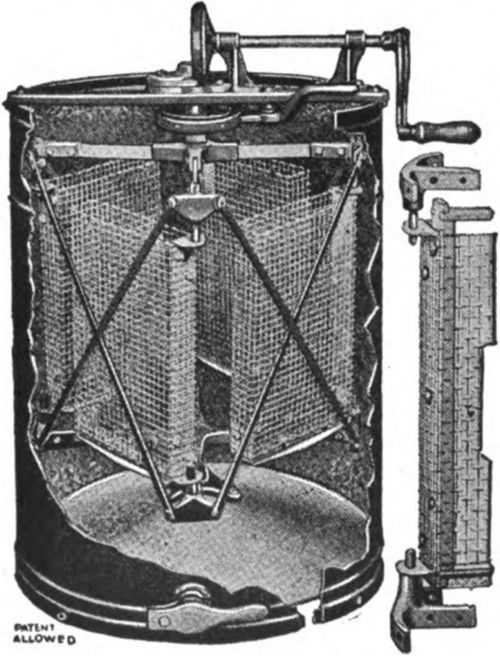
Hand extractor which holds four frames.
Other Equipment
For comb honey a section press and foundation fastener will be needed. This and other minor items will be found described in every catalogue of bee supplies. The novice will find it to his advantage to visit the nearest dealer to see a demonstration of their use.
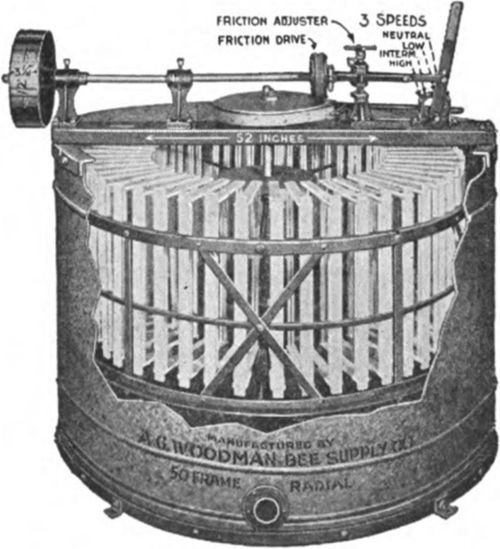
Radial extractors are of large size and remove the honey from thirty to fifty frames at one time.
The Extractor
For the production of extracted honey an extractor, of course, is necessary. A small two-frame machine will be sufficient for the small apiary.
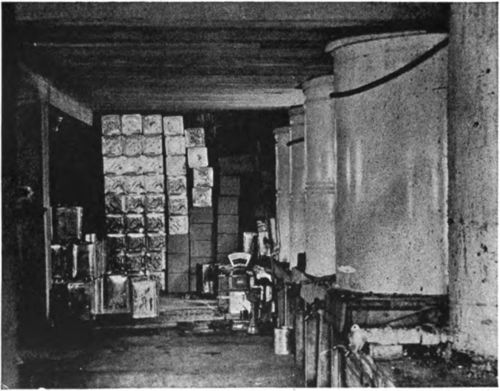
Storage tanks in mid-west honey house, Littlefield apiary, Exira, Iowa.
Where electricity is available a power driven machine should by all means be secured since it saves hard labor and does a much better job because of steady and uniform motion. A commercial apiary will need at least a four frame machine and if honey production is carried on extensively a large radial machine will be indicated.
To extract the honey the beekeeper takes the combs of sealed honey from the hive and carefully cuts the cappings from both sides, with a warm knife. The frames are then placed in the baskets of the extractor and turned rapidly. The motion of the baskets whirling inside the big can throws the honey out of the comb. It is then drawn off through a faucet at the bottom of the extractor.
Extracted honey differs from strained honey in thus being thrown out by centrifugal force, instead of having the combs crushed and the honey strained out through a cloth as was the case before the invention of the machine. When honey is extracted the combs can be returned to the bees to be filled again, while in the old days the combs were destroyed, and more or less foreign material mixed with the honey.
Continue to:


My Books

