


Tools For The Beekeeper, The Smoker, Protection From Stings
Description
This section is from the book "A Living From Bees", by Frank C. Pellett. Also available from Amazon: A Living From Bees.
Tools For The Beekeeper, The Smoker, Protection From Stings
Tools For The Beekeeper
The equipment which the beginner should buy will depend upon the extent to which he later expects to engage in honey production, and whether he expects to produce comb or extracted honey. If the intention be to engage in beekeeping on a commercial scale as soon as possible, a careful survey should be made of the local flora and a study of beekeeping systems should be made before starting, in order to avoid purchase of equipment which may later be discarded.
Equipment suggested in this chapter will be more especially for the novice who wishes to start with only a few bees. The advice will be sound, however, for the one who wishes to develop a commercial enterprise. If only standard equipment is used it will be necessary only to increase the amount as the business is extended.
The Smoker
The first implement that the novice should buy is a good smoker. If he has black or mixed bees, it will be next to impossible to control them without smoke and it is unsafe to depend upon working with even the gentlest bees without such an implement within reach.
To appreciate the value of smoke in bee control it must be remembered that the beehive contains a highly organized community. While apparently there is no overlord to direct the work, each individual bee fills a place in performing the duties of the hive. As mentioned elsewhere, some are nurses, some are foragers, some are guards, etc. Probably every bee that lives out her normal life cycle performs all of these duties at some period of her life. The only division of labor seems to be one of age. The young bees feed the larvae, secrete wax and clean the hive, while older ones go afield for needed supplies.

Bee Smoker.
Aside from this general division of labor between young and older workers, the bees seem to take hold wherever inclination leads, or where the need is most pressing. Since the prime object of the labor of the community is to accumulate ample stores, guards are very important to the safety of the hive. On the approach of strange bees or strange men, these guards are likely to use their stings vigorously to prevent looting of their treasure.
By the use of smoke, the beekeeper can quickly disorganize the whole community and tear the hive to pieces without resistance. If the bees are blacks or hybrids, much more smoke will be necessary than with gentle Italians or Caucasians. By placing the nozzle of the smoker at the front of the hive and blowing a few puffs of smoke into the entrance, then removing the cover and blowing more over the tops of the frames, even cross bees are likely to be quickly quieted and to lose all thought of defence.
Care should be used not to use more smoke than is necessary, a very common fault with beginners. With gentle bees it may not be necessary to use smoke at the entrance, but only a little across the top of the frames when the cover is removed. During a honeyflow there are times when with slow and careful movement it is often possible to manipulate the hives of gentle strains without using any smoke.
With a little experience one soon learns to judge by the behavior of the bees how much smoke is needed. It is important to smoke the bees before any jar is given to the hive in order to demoralize the bees before they start defensive action. Once the bees are aroused it is difficult to subdue them and it is better to wait until a later time and try again.
When the smoke is blown into the hive the bees rush about in confusion for a moment and then seek the cells of open honey. They fill their honey sacs as though preparing to swarm. When a worker bee has a load of honey she seldom shows any desire to sting. Swarming bees are usually gentle. When about to depart from the hive each bee will take a load sufficient to provide for many days after the home is reached.
Protection From Stings
While experienced beekeepers often work among the bees without protection, especially during a honeyflow, it is unwise for the novice to do so. The experienced beeman is so familiar with the habits of the bees that he is not likely to disturb them under conditions that will arouse serious resentment. On the other hand, the novice may be surprised by a furore of excitement in the hive and numerous stings, even though he approach the hive exactly as he may have done on other occasions without seeming to attract much notice from the bees. The inmates of the hive are very responsive to changes in the weather, or other conditions, and their temper varies accordingly. During a bright day when there is a honeyflow they may be gentle, while on a chill or cloudy day when no honey is coming from the fields, they may be cross and easily aroused.
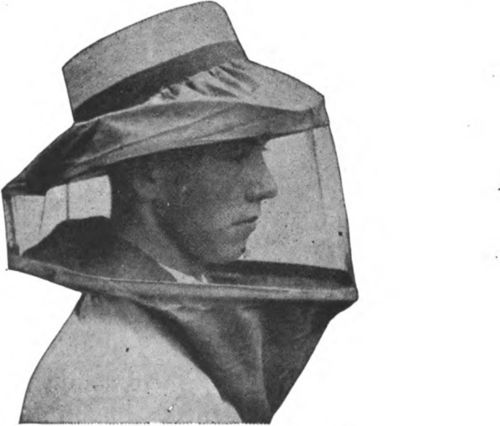
A good veil is essential for protection from stings.
A veil that will prevent the bees from reaching the head is easily made at home, or one can be bought from any dealer in bee supplies. While mosquito bar sewed to the rim of a straw hat will serve the purpose, it obstructs the vision and is not nearly as good as wire screen. An apron sewed to the bottom with a draw string in it prevents the bees from crawling under.
Some kind of gloves should also be worn to protect the hands. Any protection that will prevent the bees from reaching exposed parts of the body, while permitting freedom of action and unobstructed sight will answer the purpose.
Continue to:


My Books

