


Causes Of Winter Loss, Essentials, How To Stock An Observation Hive, How To Provide A Good Smoke
Description
This section is from the book "A Living From Bees", by Frank C. Pellett. Also available from Amazon: A Living From Bees.
Causes Of Winter Loss, Essentials, How To Stock An Observation Hive, How To Provide A Good Smoke
Causes Of Winter Loss
Starvation is probably the most common cause of winter loss. It is difficult to realize the amount of honey that will be needed to carry a strong colony from the close of the honeyflow in September or October until new forage is available in April or May.
In shallow frames of the Langstroth pattern it often happens that the bees consume all the honey above the cluster and because of low temperatures are unable to move over to the adjoining combs where ample supplies may still remain. By wintering in two story hives with the upper body full of stores this danger can be overcome.
Spring dwindling is a common complaint where bees have been given insufficient stores. Because of lack of sufficient pollen the bees are unable to replace their losses and before sufficient new pollen is available in the field, the colony has become too weak to maintain itself.
Colonies with disease are of course especially susceptible to winter loss. Already weakened they are poorly prepared to stand the additional strain of low temperatures. The fall examination should reveal cases of disease which should be eliminated before cold weather.
Another common cause of loss is disturbance by mice which enter the hive in cold weather and gnaw the combs. The presence of the animals when the weather is cold disturbs the bees and causes them to break the cluster with disastrous results. Entrances should be provided with guards of coarse wire screen of about one fourth inch mesh or reduced to a height of one fourth inch which will prevent mice from entering. The least shrew is a very small animal that feeds upon insects and which can enter a very small space. Since they do not gnaw the combs there is little evidence of their presence but indications are that at times they may be troublesome.
Essentials
To review, successful wintering requires the following:
1. Wind protection.
2. Ample stores of both pollen and honey.
3. Young queens.
4. Large clusters of young bees.
5. Upper entrance to permit escape of moisture. Lower entrance should be reduced to small size but left open to permit removal of dead bees.
6. Some additional protection in the way of tar paper or packing case is helpful.
How To Stock An Observation Hive
There is much interest in an observation hive which permits one to see the family life of the bees. Such hives can be bought from dealers in bee supplies or can be made by one who is handy with tools. Usually they contain only one frame to permit observation of every activity.
It is best to stock such a hive at the start of warm weather as there is some difficulty in maintaining such a small colony when no honey is to be had from the field. If a comb well filled with sealed brood with a ripe queen cell can be found, it is best for the purpose. Take such a comb with as many adhering bees as possible and set in place in the hive. If the entrance can be closed with screen and the hive placed in a dark cellar for two or three days, the bees are more likely to remain.
The hive should be so placed that the entrance opens outside to permit free flight of the bees without annoyance to the observer. An opening through the window sash is commonly used and may be made by boring a hole with a half inch augur. The hive must be fitted closely against the opening to prevent escape of the bees inside the room.
How To Provide A Good Smoke
A wide variety of fuels are used in the bee smoker. It is highly desirable to have a lasting smoke that won't go out when the smoker is set aside for a few minutes. Rotten wood from basswood or similar tree is about the best. Once lighted it continues to burn as long as any fuel is left in the smoker.
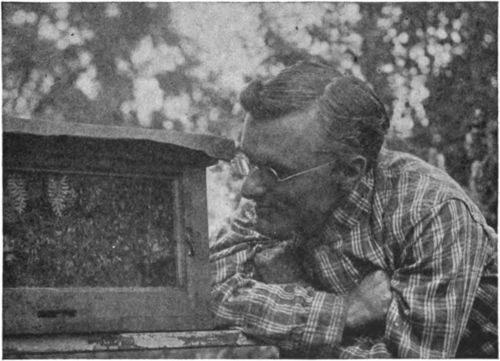
There is much of interest in an observation hive which permits one to see the family life of the bees.
Burlap is commonly available and serves fairly well although it requires more attention to keep it burning. A little propolis or burr comb added to the burlap adds to its efficiency.
Clean cotton rags dipped in saltpeter solution make excellent smoker fuel. A tablespoon of saltpeter dissolved in about a gallon of water in which to dip the rags will provide material for long use. A supply of rags dipped and dried will burn without flame.
Where sumac is available, the seed clusters, called sumac bobs, are commonly used for smoker fuel. Greasy waste such as may be found in the average garage is sometimes used, but the smoke is often offensive to the bees and does not quiet them like rotten wood or cotton rags.
Fine planer shavings are a very common source of smoker fuel, and are usually available in abundance at any wood working shop. They often burn too fast and burst into flame easily. Too often one has a big smoke for a few minutes, only to find the fire out when the smoke is most needed.
Continue to:


My Books

