


How To Install Package Bees, How To Unite Bees, How To Transfer Rees
Description
This section is from the book "A Living From Bees", by Frank C. Pellett. Also available from Amazon: A Living From Bees.
How To Install Package Bees, How To Unite Bees, How To Transfer Rees
How To Install Package Bees
The packages should be examined at the express office on arrival and, if in bad condition, the facts should be noted on bill of lading by the agent and sent to the shipper, to permit him to secure satisfactory adjustment of any damage in shipment.
If the weather is cold the bees should be warmed and fed and become quiet before hiving. Feeding should be done in a warm room by means of a sugar syrup made of equal parts of granulated sugar and water. The feed may be spread on the screen of the package by means of a paint brush or sprayed on the screen with a garden spray or fly spray. Warm syrup should be given in cold weather.
If the bees are warmed without feeding, they become very restless and make fruitless efforts to escape from the cage. If released in this condition, there is much drifting and many are lost.
When the bees are fully gorged and will take no more syrup, they will cluster quietly and then are ready for release. The prepared hive should be placed in the position where the colony is to remain. If drawn combs are available, the bees will have a much better start, but lacking them, full sets of frames with full sheets of foundation should be used. Remove cover from hive and take out about four frames from one side. Remove cover and feeder can from package and with a sharp jar, shake the bees into the open space in the hive.
The queen with attendants will be in a small cage suspended by a wire in the middle of the cluster and should be taken out before shaking out the bees. Enough syrup should be sprayed over the face of the queen cage to wet her to the point where she is unable to fly. The wire from the front is then removed and she is dropped on the pile of bees in the bottom of the hive. The hive cover is then replaced until the bees have clustered and become quiet. Later the frames can be replaced without disturbing the bees.
If the bees are hived on drawn combs with sealed honey, they will require little attention, but when hived on foundation, they must be fed liberally with sugar syrup until such time as nectar in abundance is coming from the field. Sufficient stores should be provided to carry the bees safely to the honeyflow. Ten pounds or more of sugar will likely be required. This may be given as directed in chapter on feeding.
How To Unite Bees
When for any reason, it is desired to unite two colonies of bees, some care is necessary to avoid fighting. The most common way is to remove the cover of the stronger colony and place a sheet of newspaper across the top. With a pencil or stick punch one or two small holes in the paper and then remove the bottom board from the hive with the weaker colony and set it on top of the other. Leave the bees undisturbed until they have removed the paper and the clusters have joined.
If one has a choice of the queens, the poorer one should be removed before uniting. Usually however, it is left to the bees to decide which queen shall remain as head of the colony under the assumption that the most vigorous one will survive.
How To Transfer Rees
In an earlier day before comb foundation was so readily available, the beekeeper would often go to a great deal of trouble to cut out all usable comb when transferring bees from boxes or cavities and fit it into new frames. Now, however, such combs are little valued since they are interior to newly built combs drawn from full sheets of foundation.
In saving the combs, it was the practice to lay the frame on a smooth surface and fit in the pieces of comb containing brood and honey to occupy all available space. It was then tied in place by wrapping with cotton string. When the frame was hung in the hive, the bees would attach the comb to the wood and remove the strings.
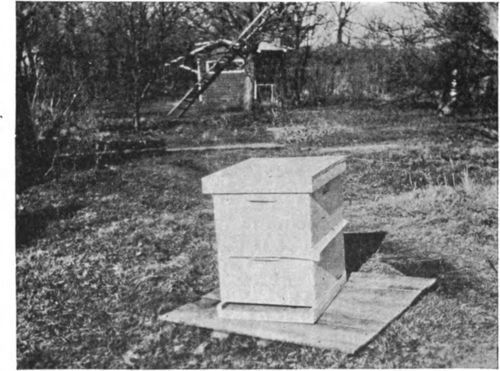
The simplest way to unite bees is to set one hive above another with a sheet of paper between the two brood nests.
Of late it has become the practice to permit the bees to build new comb on full sheets of foundation. To accomplish this result the top of the box is removed and as much empty comb as possible taken away. At the start of the honeyflow, the bottom of a new hive equipped with full sheets of foundation is removed and set directly over the box to be transferred. Some care is necessary to close all openings so that the box and the hive will fit well together. As the new honey comes in, the bees will draw out the combs above and the queen is likely to move upward and continue her normal activities on the new combs. As the season advances, the brood emerges below and the box can then be removed.
It often hastens action if the box is turned upside down at the start, thus providing an abnormal condition in the brood nest and giving the bees an added incentive to move upward.
If the season is well advanced and there is a good cluster of bees in the box, a good way is to prepare the new hive and remove the top. Both bottom and top of the box containing the bees are removed and the whole set over the new hive. A hive cover which will fit snugly over the box with bees is then used as an acid board. A few drops of carbolic acid may be sprinkled over the inside of the cover and then replace it over the box of bees. If the sun is shining and the weather is warm the bees will quickly desert their combs and move down into the hive below. As soon as they have gone below and one is sure that the queen is with them, the box of combs may be removed and set to one side until all the brood has emerged. After 21 days when all brood has emerged the bees may be dumped in front of the new colony and the box broken up and removed.
Carbolic acid is dangerous and requires caution in its handling. When using an acid board to drive the bees, it should be removed as soon as it has accomplished its purpose. One must be careful also that none of the acid comes into contact with the skin as it makes severe burns.
Continue to:


My Books

