


Wintering The Bees, Cellar Wintering, Packing Outside
Description
This section is from the book "A Living From Bees", by Frank C. Pellett. Also available from Amazon: A Living From Bees.
Wintering The Bees, Cellar Wintering, Packing Outside
Wintering The Bees
After the close of the honeyflow the bees should be prepared for winter as early as possible in order to avoid disturbing the colony after the normal activities of the summer have ceased. Care must be taken to insure plenty of honey to last the bees through the long months when no honey comes to the hive. In the northern states it is unsafe to depend upon less than forty pounds and the author feels that double that amount is desirable. This large amount will insure a sufficient supply for early brood rearing and carry the bees safely through an unfavorable spring.
The quality of the store is important, especially in the North where long periods of time elapse when the bees are unable to leave the hive for a cleansing flight. Normally the bees relieve themselves of ac-cumulated excrement only when on the wing. If the stores be of poor quality, such as honeydew or improperly ripened honey, the long confinement is very hard on them and they often become affected with dysentery, soiling their combs and putting the hive in a filthy condition.
Large clusters of young bees are also essential to successful wintering by any method. If the hive is full of old bees that have gathered a fall harvest, they will die before spring and the colony may perish. If the honeyflow continues late, plenty of young bees will probably emerge late in the season and put the colony in prime condition for wintering. Old and failing queens often slow down in their egg laying in late summer with a weakened colony as a result. Colonies known to have young queens will usually be in good condition unless there is a dearth of nectar during the fall months. At such times it is often desirable to feed lightly for a few days to stimulate brood rearing.
Given the above conditions; young queens, plenty of stores and a large cluster of young bees, a colony will stand a surprising amount of cold weather and come through in fine shape.
Cellar Wintering
Wintering the bees in cellars was formerly much more commonly practiced than it is today. Given proper conditions the bees winter very well in the cellar but it often happens that the cellar is not adapted for this purpose and the bees would be far better off on their summer stands.
The cellar should be dry, and well ventilated and with uniform temperature. Where moisture is present the hives often come out in spring with the combs so mouldy that it is very difficult for the bees to restore them to normal condition.
A cellar with variable temperature, one that is warm during mild weather and cold when the thermometer drops, should never be used for bees. The cellar must also be dark as the bees get very restless in a cellar which is sufficiently warm, if light enters during the day.
It is assumed that the proper temperature for such a cellar is the one at which the bees remain quiet. This varies in different localities, apparently due to the difference in humidity. In the Northern Plains region bees seem to do best at a temperature which remains fairly constant at forty degrees. In the Mississippi River Valley forty-five degrees (Fahr. ) is better and in the eastern states the thermometer should stand at from forty-eight to fifty degrees for best results.
The bees should be placed in the cellar as soon as settled cold weather begins, and left there until danger of severe weather is past in spring. It is better to take them in a little early and remove them a little late than to err in the other direction.
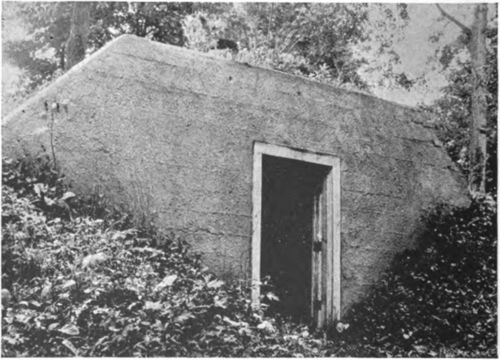
Jager bee cellar in Minnesota.
Packing Outside
Various plans to provide extra protection to the hives on their summer stands have been used. Formerly expensive packing cases were in general use but large scale operators have discarded them because of the cost involved and because it has been found that the bees winter as well with much less costly preparation.
No amount of packing will atone for improper colony condition. The bees in well packed hives consume less stores than unpacked hives but a strong colony of bees seldom dies from cold where other conditions are right. Langstroth in early editions of his book called attention to a winter entrance near the top of the hive. This was lost sight of for many years but since its revival the winter problem seems greatly simplified. Whether or not bees are packed such an upper entrance is very useful. With an auger hole near the top there is far less condensation of moisture within the hive in cold weather. Condensation of moisture around the cluster which forms ice in severe weather often destroys the bees.
One of the most important things is wind protection. Bees at any season should be protected from driving winds and a location which is well sheltered is highly desirable. In a windswept situation much bee energy is wasted in a fruitless effort to maintain uniform temperatures. When an apiary is established this matter of windbreak should always be kept in mind and less important factors be sacrificed if necessary to secure it.
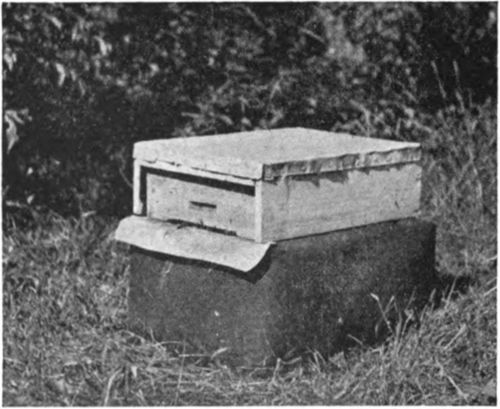
Hive with lower story packed with tar paper, upper entrance and super of honey in Littlefield apiary, Exira, Iowa.
Much space could be occupied with a discussion of details of packing cases. This is hardly necessary since anything which keeps out the cold will serve so long as the bees are permitted to fly at will through an entrance kept open at all times.
Wooden packing cases have largely been replaced with temporary cases made of tar paper. Some use the tar paper without any supplementary material while others use straw, shavings or dry leaves to fill a space of three to six inches surrounding the hives.
It is important that conditions be such as to permit the bees to take advantage of any warm days suitable for flight. The author has lost strong colonies packed in heavy cases with several inches of packing material when lightly packed colonies came through. The winter was severe with few flight days. Because of the heavy packing the bees in such cases failed to fly and the long confinement was too much for them.
No amount of packing will enable the bees to maintain warm temperatures in the space surrounding the cluster. Since the packing delays the cooling process so it also delays it in warming again. Thus too heavy packing is as undesirable as too little protection.
Continue to:


My Books

