


Golden-Crowned Parrakeet Of New Zealand. Psittacus auriceps. Cyanoramphus auriceps, Bp.; Cyanoramphus Malherbi, Snc;
Description
This section is from the book "Parrots In Captivity", by William Thomas Greene. Also available from Amazon: Parrots in Captivity.
Golden-Crowned Parrakeet Of New Zealand. Psittacus auriceps. Cyanoramphus auriceps, Bp.; Cyanoramphus Malherbi, Snc;
Psittacus auriceps, Russ. Synonyms: Cyanoramphus auriceps, Bp.; Cyanoramphus Malherbi, Snc;
Psittacus pacificus, var. d., Gml.; Euphema auriceps, Lchtst.;
Platycercus auriceps et Malherbi, Gr.
German: Der Springsittich.
THIS charming bird, one of the most delightful of all the Parrot family, according to Dr. Russ, is, as its English name denotes, a native of New Zealand, as well as the Species described in the preceding chapter, and is about the same size as the Turquoisine, but of heavier and less elegant build than the latter bird: the plumage on the upper parts of the body is a dark grass green, with here and there a Shade of blue; on the breast and abdomen the feathers are of a lighter, or rather a yellower, shade of green than on the back and wings, the front edges of the latter are blue: the tail is dark green above, and grey underneath.
The legs are long and of a greyish slate colour, the claws black, and of unusual length: the upper mandible is blue with a black tip, and the lower horn colour. Surrounding the beak is a narrow line of an intensely red colour, which seems to be continued into the eye, the iris of which is a brilliant red: the top of the head is pale golden yellow.
The long shanks of this bird enable it to run and hop with great freedom, and have obtained for their possessor the German name of Springsittich: it has a curious habit, which seems to be peculiar, and common to the Parrots of New Zealand, of scratching with its feet in the sand and dust after the manner of the Gallinaceoe, and it also makes use of them to hold its food, after the well-known fashion of the Grey and other large Parrots.
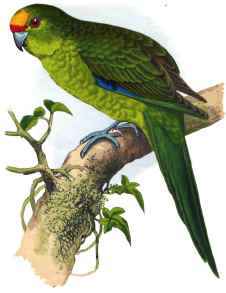
GOLDEN - CROWNED PARRAKEET.
Although the beak of this Parrakeet is very long and sharp, and its claws of unusual size and strength, it is a remarkably gentle and timid creature, never bites, even when taken in the hand, or makes itself in any way a nuisance to its owners or to its companions in the aviary, where it permits itself to be bullied by birds not a third or quarter of its size, without evincing the least resentment.
The voice of the Golden-crowned Parrakeet is soft and musical, and we have never heard it scream. It becomes exceedingly tame in captivity, to the extent even of accompanying its owner out of doors; it is easily frightened, however, and as its wings are strong, and its flight powerful, it is apt to stray away when terrified, but invariably returns when the alarm is over.
The female bears a Strong resemblance to her mate, and can only be distinguished from him by comparison, when she will be found to be a trifle smaller, and to have a rather paler frontlet than he.
Although so tame and gentle, there is no record of these birds having, so far, bred in captivity; yet they are hardy enough to pass the winter in an unheated bird-room without inconvenience to themselves, and it is probable that in a well-sheltered aviary they might be even safely wintered out of doors.
Occasionally they are imported in large numbers, and may then be bought cheaply; as a rule, however, the dealers charge two or three pounds a pair for them.
The Golden-crowned Parrakeet requires to be fed and treated as recommended for its red-fronted congener, described in the preceding chapter, and seems to be particularly fond of bread-crumb soaked in cold water, which, probably, reminds it of the soft seeds upon which it was accustomed to feed in its native land; it drinks freely, and should never be without water, both for bathing and drinking purposes.
It is a very cautious bird, and though extremely fond of a dip, displays a considerable amount of sagacity in the indulgence of its propensities, and will by no means rush inconsiderately into danger: we lately witnessed one of these birds anxious to take a bath, but fearful of the depth of water, make a circuit round the pan, as if considering what steps to take, and then, holding on tightly by one foot to the edge of the vessel, back cautiously into the water to about a third of its own length, when, thinking, doubtless, it had gone far enough, it flapped its wings vigorously, wetting itself completely in a few seconds, and then, drawing itself up carefully out of the pan, flew off to a perch to dry and arrange its feathers.
This bird is excessively fond of washing itself, and also drinks freely, notwithstanding which facts we have seen the poor creatures condemned to an agony of chronic thirst in a dry and choky atmosphere, where, we were not surprised to hear, they seldom survived for any length of time: we remonstrated with the person in charge, bat without avail, Parrots never drank, he said, and we found that it was useless to attempt to convince him of his error, in which his superiors of course participate.
Superstitions die hard, as a rule, but are tollable nevertheless, and it will be no fault of ours if this "vulgar error" is not decently buried out of sight ere long.
In refutation of the notion that the Golden-crowned Parrot of New Zealand does not long survive in captivity, we may mention that we have one that has lived over two years in confinement, and appears to be quite healthy and contented, and we are not without hopes that he and his mate may be induced to breed in their aviary next season.
Although an undeniably charming bird, we consider that fifty shillings, the price quoted in a dealer's list now lying before us, is quite too long a figure to pay for a comparatively common bird, which we have by no means found difficult to preserve, whether in cage in doors, or garden aviary: during the moulting season, however, it is wise to take it into the house, as the evenings are chilly in autumn, and we found that the process of renewing its feathers was, under such circumstances, protracted; and that it was better to take the poor bird into the house.
If kept in a cage this Parrakeet becomes tolerably familiar, and we have no doubt would learn to speak, at least a few words, but we have not tried to teach ours, which, we must say, are not particularly tame; but then, as we have said, we have not in the least attended to their education. Occasionally these birds can be picked up cheaply, and amateurs should be on the look out for such opportunities, and make their purchases as soon as possible after the birds have reached the dealers' hands; they may lose one or two, it is true; but, on the whole, we think they will be thus more likely to secure healthy subjects, than if they waited for several weeks, by which time the high temperature at which foreign birds are chiefly kept in the shops of the dealers cannot fail to have had an injurious effect upon their constitutions.
This Parrakeet is very slim of figure and can squeeze himself through a very small opening without the slightest difficulty, so that in placing him in a cage, care must be taken that the bars are sufficiently close together to prevent him taking French leave. The first bird of this species we possessed was, upon its arrival, transferred to an ordinary Parrot cage in which it seemed to make itself very much at home; but scarcely was our back turned when we heard a terrible commotion, and, to our consternation, beheld our new acquisition in the mouth of our big black tom-cat. Naturally we thought the poor stranger's doom was sealed; and to seize the cat, choke him till he dropped the Parrakeet, and prepare to bind up the wounds of the latter, if indeed he were yet alive, was the work of but a few seconds, when to our surprise the liberated Auriceps flew off as if nothing had been the matter, and darted round and round the room in evident enjoyment of. his recovered liberty: nor was it without some difficulty that he was eventually recaptured.
When at length we had secured our truant, we found the poor fellow to be so seriously wounded on the back, between the wings, that we gave him up for lost; we put him in a small cage, however, he had walked out between the bars of the large one, as one might do through an ordinary door-way, and in a few days Richard was himself again, whereupon we turned him into a large aviary out of doors in company with a mixed collection of foreign birds, where he soon made himself at home.
We have kept a number of different kinds of Parrots and Parrakeets in our time, and the subject of the present notice stands almost as high as any of them in our estimation.
Since writing the above, we have been obliged to remove our favourite in-doors: about the beginning of October he began to moult, and appeared to feel the sharp weather that soon afterwards set in so keenly, that we thought it would be decidedly cruel to subject him to it any longer, but another change of temperature taking place, we decided to leave him where he was, for at least a few days longer. One morning, however, when we entered the aviary to feed the birds, Auriceps was nowhere to be seen !
High and low, in every box and husk we looked for him, in vain: he was gone, and the mysterious part of the matter was that we could see no possible way by which he could have made his escape. He had not been carried off by a marauding rat, or dragged through the wires by a prowling cat, for, in either case, some of his feathers would certainly have been lying about. What could have become of him?
In one corner of the aviary, on the ground, stood an old cage, we lifted it up and crouching under it, in a burrow which he had evidently excavated for himself in the soft earth, lay Auriceps, perdu! But the cold ground had chilled him, he was cramped and unable to fly: we thought he had taken his death, as the saying is, and removed him at once indoors; but in a few days he was himself again; so after keeping him for a while in an old canary-breeding cage, we turned.
Continue to:


My Books

