


Blue Bonnet Parrakeet. Psittacus hcematogaster. Psephotus hoematogaster, Gld
Description
This section is from the book "Parrots In Captivity", by William Thomas Greene. Also available from Amazon: Parrots in Captivity.
Blue Bonnet Parrakeet. Psittacus hcematogaster. Psephotus hoematogaster, Gld
Psittacus hcematogaster, Russ. Synonyms: Psephotus hoematogaster, Gld.;
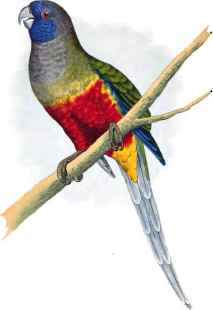
BLUE BONNET PARRAKEET.
Platycereus hoematogaster, Pnsch.; Euphema hoematogaster.
German: Der Blutbauchsittich.
THIS handsome bird is a native of New South Wales, but is not very frequently seen there, and is of comparatively rare occurrence in England, and rarer still on the continent. "Einer der aller-seltensten", says Dr. Suss, who quotes its price at ninety marks, "und daruber fur die Prch": that is, £4 10s. and upwards for the pair.
The greyish white beak is surrounded by a blue mask, of a deeper shade on the forehead than on the throat; the back, wing coverts and breast are yellowish grey, the sides of the wings and the tail blue; the sides and under tail coverts, yellow, and the abdomen bright red.
The female is coloured like the male, but the shades of her dress are duller than his.
Some diversity of opinion exists as to the merits and qualifications of this bird as a cage pet: Mr. Wiener writing of it says: "I do not know a more pleasing Parrakeet than the Blue Bonnet, whom I used to consider the clown of a collection of Parrakeets I had at one time. A pair of these birds used to play together like kittens, rolling over and over in the sand, or sitting on the perches and cawing to each other in the most amusing manner. Whenever their cage was fresh sanded, they picked out all the small stones, and cleverly arranged them in a row on a ledge in their cage. This rare Parrakeet is probably one of the most intelligent of all the Australian Parrots, although I have not heard that any have learned to talk, nor do any appear to have been bred."
Mr. A. Johnson, of St. Olave's Grammar School, writing in The Bazaar of 21st. March, says, "These birds (Blue Bonnets), which Dr. Buss describes as among the rarest imported, have of late been seen rather more frequently. They are certainly the hardiest of the Parrot tribe in captivity, not excepting the Budgerigar. Introduced into an exposed out-door aviary last spring, immediately after importation, without any attempt at acclimatisation, they have undergone hardships, both as to exposure and food, under which even the Cardinal has succumbed, and yet they never had an hour's sickness. They are seen to the best advantage when seated on a lofty perch, with their primrose underside, so curiously aproned with blood-red, exposed to view; their elaborate bowings and antics are calculated to produce shouts of merriment. They seem the mildest of the inmates of the aviary, but they are really its most insiduous assassins. I have found young birds with their pinions cruelly mutilated, although they were apparently safe in small cages; young Budgerigars, valuable Bourke's Parrakeets, Turquoisines, and others, dead or dying, with their wing joints mutilated, or their heads smashed; and I never was able to trace the assassins, until one day I saw my innocent looking pets, sidle up to a delicate graceful Dove, seize him by the wing, and begin to gnaw him savagely. They will live for months with smaller birds on the most friendly terms, but in the end they will clear an aviary of all weaker than themselves, although like true assassins, they never attack one of their own size. It is only fair to say that these are only imported birds, and that some I have bred myself have not developed this murderous tendency. For hardiness, intelligence, grace, and most amusing ways, commend me above all to the Blue Bonnet, but be sure to keep him with birds who are his match in strength, or, better still, in a small compartment by himself, when he will be a model of good behaviour."
Having no one to fight with, or to murder, he will be perfectly inoffensive, no doubt; but as we have already remarked more than once, birds vary in their dispositions, as Mr. Johnson himself admits, and one pair of Blue Bonnets will be found to be as peaceable and orderly, as another is cantankerous and objectionable.
In size these birds are somewhat less than the Cockatiel, but of more slender build. As Mr. Johnson remarks, they are very hardy, and thrive exceedingly on a diet of oats, to which they are especially partial, canary seed, millet, hemp, and boiled maize: they are very fond of green food of all kinds, and especially of the bough of some tree, such as elm or poplar, which they soon peck to pieces with every manifestation of delight.
Much of the mischief wrought in aviaries by one sort of bird, or another, is due to overcrowding: better keep four birds comfortably, than a dozen where they have not room to turn round without treading on each other's heels.
Continue to:


My Books

