


II. Cat Care And Management
Description
This section is from the book "Cats And All About Them", by Frances Simpson. Also available from Amazon: Cats And All About Them.
II. Cat Care And Management
Those who have had a long experience with cats or kittens know how impossible it is to lay down a hard-and-fast rule regarding their feeding and management. As with human beings so it is with cats. They have their likes and dislikes, their dispositions vary, and their constitutions are totally different. If we wish our pets to thrive we must study them individually, not collectively. There is a saying that "what is one man's meat is another man's poison," and I have known some kittens to grow fat and look well on food on which others have dwindled away.
It is a mistake for a novice to start with a large number of cats, for failure is sure to follow. Two good females is enough to begin with, and these would probably be indoor pets.
Kittens are no trouble to "settle down," but with grown cats it is very different, and it is well to find out from pussy's late owner whether she has been a house pet or cattery cat, as well as her favourite diet, and whether she had been used to sawdust or earth in her sanitary-pan. Her happiness on entering a new home depends greatly on her own disposition. Some cats do not seem to mind a change of abode and ownership in the least, and are most affectionate and demonstrative on being liberated from the basket. They will eat anything that is placed before them. Unhappily there are others that, as soon as they find themselves in a strange place, are frightened and miserable, and will rush into the farthest and darkest corner of the room under a chair or sofa. It is kindest in these cases to leave puss alone for some time; then try by gentle persuasion to coax her out of her hiding-place with a saucer of milk or some " tit-bit." She may refuse all food for two or three days, but before long she will get accustomed to her new surroundings, and at the end of a week or ten days will probably be perfectly happy and contented.
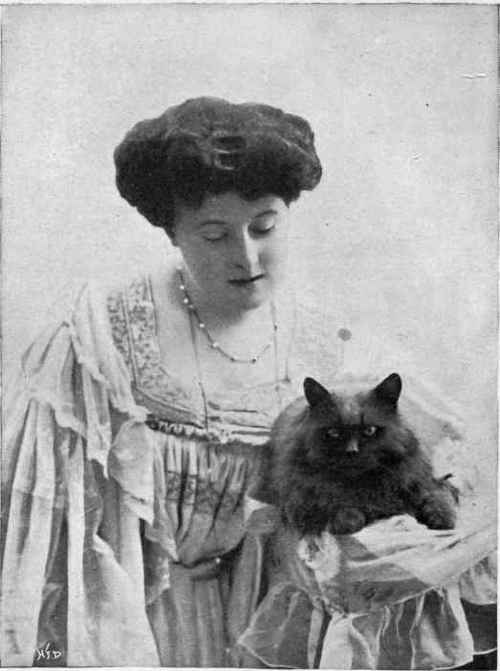
Mrs. Collingwood's Royal Bobs Charles, photo, London
Of course, for the first few days it will be necessary to keep windows and doors shut, and to show her constantly the pan she is to use - or to take her into the garden, so as to teach clean habits. If, when she is in the garden, you find she has made a sudden dart, do not attempt to chase her; it is the worst thing you can do. Wait until she is inclined to stop and look about; then call her gently. You will probably find she does not want to run away. But be careful how you take her up. Some cats will not be handled, and will struggle and fight and scratch and bite, but a cat cannot escape if you catch her by the skin at the back of the neck. I do not mean that you should keep her in a hanging position, but your right hand would be holding her neck as you nurse her in your left arm. Cats are naturally timid, and it is curious to note what antipathy they have as a rule to men, though they will grow as devoted to a master as to a mistress. But a strange man's step fills them with alarm.
The golden rules to observe in the feeding of cats are Regularity and Moderation. An authority on cats recently told me that the primary cause of the majority of the ills that the cat is subject to is over-feeding, and the consequent over-taxation of the digestive organs. Two solid meals a day besides milk twice, are quite sufficient for any ordinary cat (nursing mothers and young kittens excepted - of which I will speak later). For breakfast a solid meal of some "food" such as The Phoenix Food, Melox, and those prepared by "Salvo," Freeman, and Mellin; any of these given hot make a delightful breakfast. Porridge and fish or fish and rice are very much appreciated - and if you wish to flavour equally any of the "food," it is a good plan to get the fish and put it on a dish and pour some boiling milk or water on it; then mash up the fish with a fork and pour the fish and milk (or fish and water, as the case may be) over the "food," biscuit, rice or oatmeal porridge; then mix well together to give the whole food a fishy flavour. For supper give a meat meal - raw meat, horseflesh, liver, tripe, rabbit, or lights - but do not give lights constantly if any lung trouble is suspected among your pets.
Where several cats are kept it is advisable to get a mincing-machine, as not only does it save considerable time, but the food finely minced is much more digestible than cut up meat, however small. Green vegetables should be given in moderation, as they act as a blood purifier. Every care should be taken not to give food that is the least tainted. For growing cats or kittens that may be at all weak in their limbs, lime-water is indispensable, as it gives strength and forms bone. A dessert-spoonful of lime-water in milk should be given to cats, and a little less to kittens. In the spring of the year a pinch of sulphur powder (the black for preference) should be mixed with the first meal of the day twice a week, as a preventive of skin troubles.
On no account should you allow your queen to mate more than twice in the year, nor should these litters follow too closely - as it is a strain on the mother, besides making her dreadfully thin; and it must be remembered that this will affect the kittens, making them weakly and delicate. Gestation lasts nine weeks (sixty-three days), but cats often go three days and even longer beyond that time. As the day for the " accouchement" approaches, it is as well to give a small dose of oil or to feed on sardines as the bowels should be kept well opened. The bed should be made a week or more beforehand and be shown to "Madame" for her approval. It is best to have a box - fairly high so as to keep out all draughts, yet not high enough to prove an inconvenience to puss each time she jumps in and out. Hay is nicest to put in the box - and a little insect powder should be sprinkled underneath. After the kittens have arrived a piece of blanket on the hay is much appreciated by the mother, but neither she nor her kittens should be handled for at least twenty-four hours.
Continue to:


My Books

